Refined Zinc Export Window Nears Opening, Will June Exports Surge? [SMM Analysis]

Published: Jun 23, 2026 14:28
[Refined zinc export window nearing opening; will exports surge in June?] According to the latest customs data, refined zinc imports in May 2026 stood at 5,000 mt, down 1,000 mt or 17.15% MoM and 81.28% YoY. From January to May, cumulative refined zinc imports reached 54,000 mt, down 65.28% YoY. Refined zinc exports in May were 3,900 mt, down 0.49% MoM but up 177.81% YoY.

SMM June 23 news:

According to the latest customs data, refined zinc imports in May 2026 were 5,000 mt, down 1,000 mt or 17.15% MoM and down 81.28% YoY. Cumulative refined zinc imports in January-May reached 54,000 mt, down 65.28% YoY. Refined zinc exports in May stood at 3,900 mt, down 0.49% MoM but up 177.81% YoY. Cumulative exports in January-May totaled 18,500 mt, up 75.56% YoY. This resulted in net refined zinc imports of 1,000 mt in May, bringing cumulative net imports in January-May to 35,600 mt.
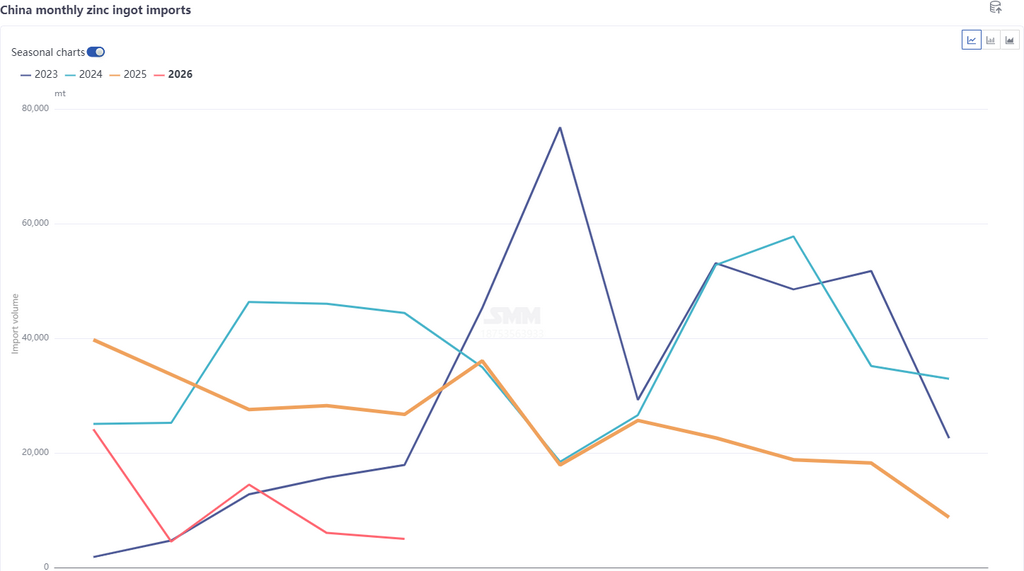
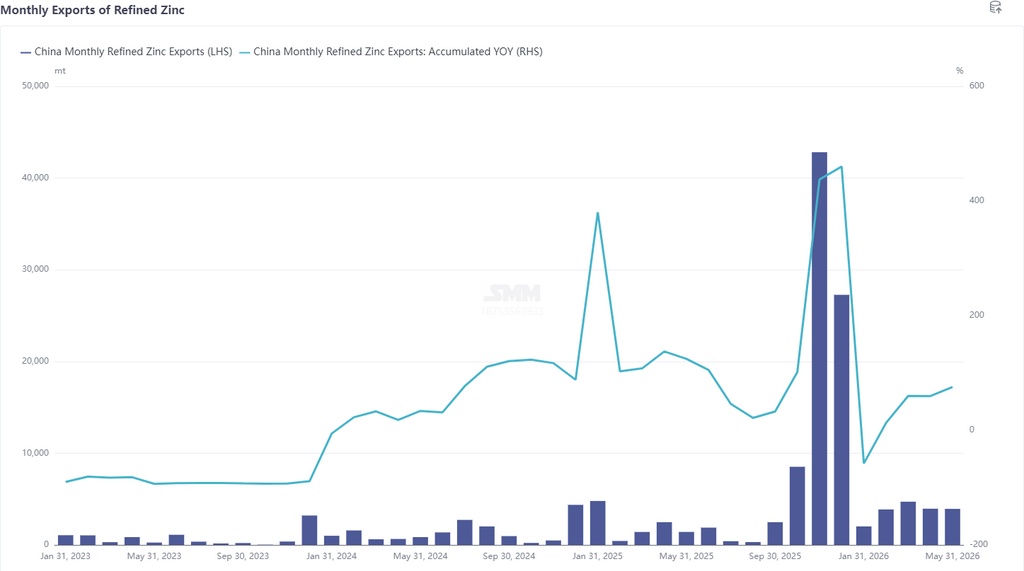
By country, the top three sources for refined zinc imports in May were Kazakhstan (2,900 mt, 58.9%), Australia (1,000 mt, 19.56%), and India (800 mt, 15.9%); the top three export destinations were Vietnam (1,900 mt, 47.12%), Thailand (1,200 mt, 31.49%), and Indonesia (700 mt, 17.85%). The decline in refined zinc imports in May was mainly due to the continued closure of the import window; in addition, by trade mode, Kazakhstan’s imports were predominantly Entry and Exit Goods in Bonded Control Areas, accounting for 58.9%. Although the export window nearly opened in May, it remained largely closed, with some traders exporting small amounts of spot refined zinc to Southeast Asia, mainly as Entry and Exit Goods in Bonded Control Areas, representing over 94%. The actual export volume still requires further opening of the export window.
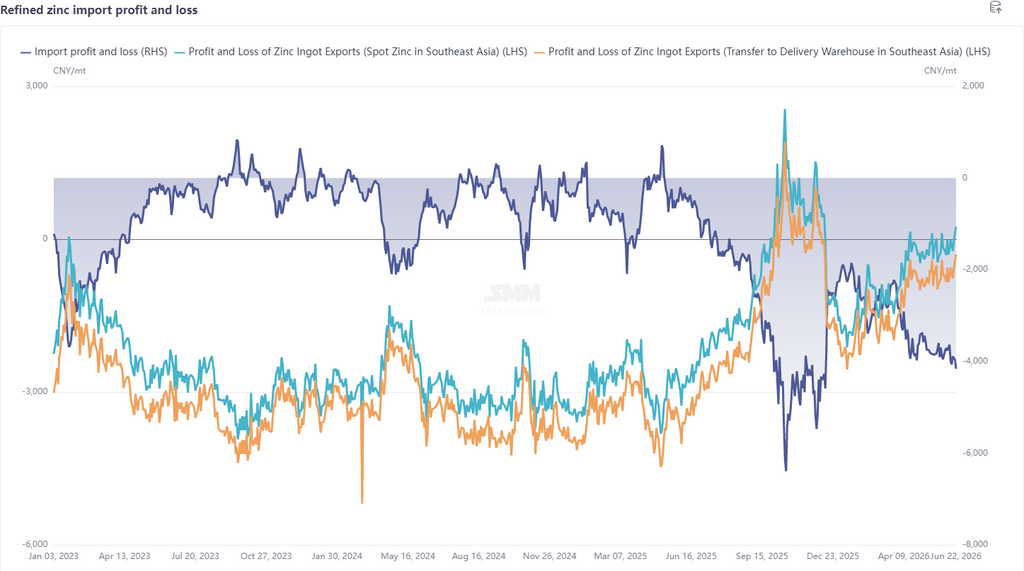
In June, on the macro front, geopolitical tensions have eased somewhat, but amid the US Fed's hawkish stance, rate hike expectations have risen, and liquidity concerns persist. On the fundamentals side, supply-side issues outside China remain unresolved. Shipments through the Strait of Hormuz have gradually resumed, but this still cannot fundamentally resolve the ore shortage. Imported ore TCs have continued to decline. In smelting, South Korea's YP is under maintenance, and LME inventory stands at a relatively low level of around 120,000 mt. Domestic ore TCs in China have all turned negative, and imported TCs have fallen to $71.76/dmt. Supported by earnings from sulphuric acid and minor metals, domestic smelters have largely maintained normal operations, and so far there have been no production cuts or shutdowns due to raw material issues. The supply side remains high. However, the period from June to August is traditionally the off-season. Amid insufficient end-use consumption, social inventory has continuously accumulated to a historical high of over 270,000 mt. Overall, the trend of LME outperforming SHFE continues. The import window for refined zinc remains closed. While the export window for Southeast Asian spot cargo is open, the delivery window is closed. Imports in June are expected to stay low. Exports are expected to see a slight increase due to poor export economics. However, a significant rise in actual exports will still require the delivery window to open.


Data Source Statement: All data other than public information are processed by SMM based on public information, market communication, and SMM's internal database model. They are for reference only and do not constitute decision-making advice.



Data Source Statement: Except for publicly available information, all other data are processed by SMM based on publicly available information, market communication, and relying on SMM's internal database model. They are for reference only and do not constitute decision-making recommendations.

For any inquiries or for more information, please contact: lemonzhao@smm.cn
For more information on how to access our research reports, please contact:service.en@smm.cn
Related News
Storm High-Grade Copper PFS Slated for Q3, Regional Targets Return High-Grade Zinc up to 30.8%
34 mins ago
Storm High-Grade Copper PFS Slated for Q3, Regional Targets Return High-Grade Zinc up to 30.8%
Read More
Storm High-Grade Copper PFS Slated for Q3, Regional Targets Return High-Grade Zinc up to 30.8%
American West Metals reported that the Pre-Feasibility Study (PFS) for its high-grade Storm project in Nunavut, Canada, is slated for completion in Q3 2026, which will detail the parameters of a direct shipping ore (DSO) operation. Since the completion of the PEA last March, JORC-compliant resources have expanded by over 20% to 28.22 million tonnes, containing 608.7 million lbs of copper and 2.97 million oz of silver. While finalizing the PFS and advancing mine permitting, American West is expanding its exploration scope across the 110-kilometer-long belt of high-grade sediment-hosted copper and zinc mineralization. Notably, the Tempest target, located 40 kilometers south of the main Storm area, is defined by a 4-kilometer zone of surface gossans where grab samples have returned extraordinary grades of up to 30.8% zinc and 38.2% copper, highlighting the district's significant polymetallic potential.
34 mins ago
Spartan Metals Confirms Two Tungsten Skarn Zones at Eagle Project with Zinc Grades up to 3.3%
45 mins ago
Spartan Metals Confirms Two Tungsten Skarn Zones at Eagle Project with Zinc Grades up to 3.3%
Read More
Spartan Metals Confirms Two Tungsten Skarn Zones at Eagle Project with Zinc Grades up to 3.3%
Spartan Metals announced the confirmation of two tungsten skarn zones at the Tungstonia claims within its wholly owned Eagle Project in Nevada, US. As part of its ongoing exploration programme launched in May 2026, rock sampling from the historic Yellow Jacket Mine within the project returned tungsten trioxide grades ranging from 0.89% to 1.87%. Crucially, assays from the mine entrance and dumps detected notable concentrations of zinc (up to 3.3%) and 1,320 ppm beryllium, the latter being a newly discovered critical metal at the property. Backpack core drilling at the mine also intercepted a 0.3-meter interval grading 0.21% tungsten trioxide and 0.33% zinc. The confirmed mineralization, spanning an estimated 2-kilometer area, hosts a complex system of tungsten, molybdenum, beryllium, rubidium, and silver. Spartan Metals intends to launch approximately 3,000 meters of diamond core drilling at selected targets from early to mid-August to further untangle this expanding mineralized system.
45 mins ago
Vizsla Copper Commences 10,000m Drilling at Alaska Palmer VMS Project, Targeting High-Grade Copper-Zinc Mineralization
1 hour ago
Vizsla Copper Commences 10,000m Drilling at Alaska Palmer VMS Project, Targeting High-Grade Copper-Zinc Mineralization
Read More
Vizsla Copper Commences 10,000m Drilling at Alaska Palmer VMS Project, Targeting High-Grade Copper-Zinc Mineralization
Vizsla Copper announced the commencement of diamond drilling at its Palmer volcanogenic massive sulphide (VMS) project in southeast Alaska, launching the first phase of a multi-year exploration programme. The fully funded 2026 campaign will utilize two drill rigs to complete approximately 10,000 meters of drilling during the field season, with initial work focused on defining and expanding the high-grade copper-rich core at the South Wall Zone. According to the company's 2025 NI 43-101 technical report, Palmer hosts a substantial critical metals endowment, including an indicated mineral resource of 4.77 mt grading 1.69% copper and 5.17% zinc, alongside an inferred resource of 12 mt grading 0.57% copper and 3.92% zinc. The company plans to expand drilling to the HG and Waterfall prospects later in the season while advancing environmental and technical evaluations across more than 15 kilometers of prospective stratigraphy.
1 hour ago
Register to Continue Reading
Gain access to the latest insights in metals and new energy
Already have an account?Sign in here