China’s May Copper Scrap Imports Plunge Amid Tight Overseas Supply & Squeezed Margins

Published: Jun 22, 2026 16:34
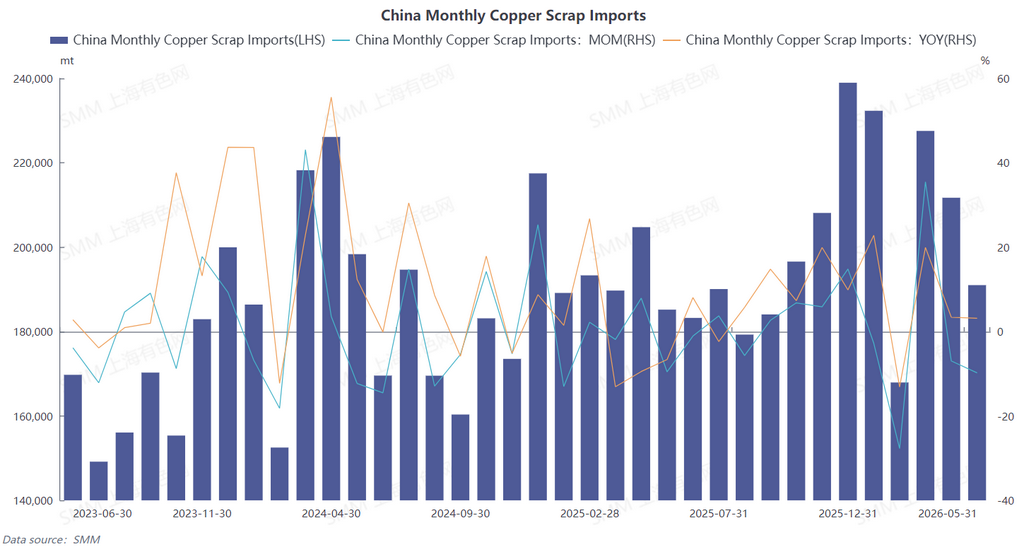
In May 2026, China imported 191,000 mt in physical content of copper scrap and shredded copper scrap, down 9.78% MoM but up 3.14% YoY.

In May 2026, China imported 191,000 mt in physical content of copper scrap and shredded copper scrap, down 9.78% MoM but up 3.14% YoY. Cumulative imports from January to May reached 1.0306 million mt in physical content, up 7.11% YoY. (HS code: 74040000)

1. Shipments from top suppliers pulled back across the board; tightening overseas spot supply was the core driver of the decline
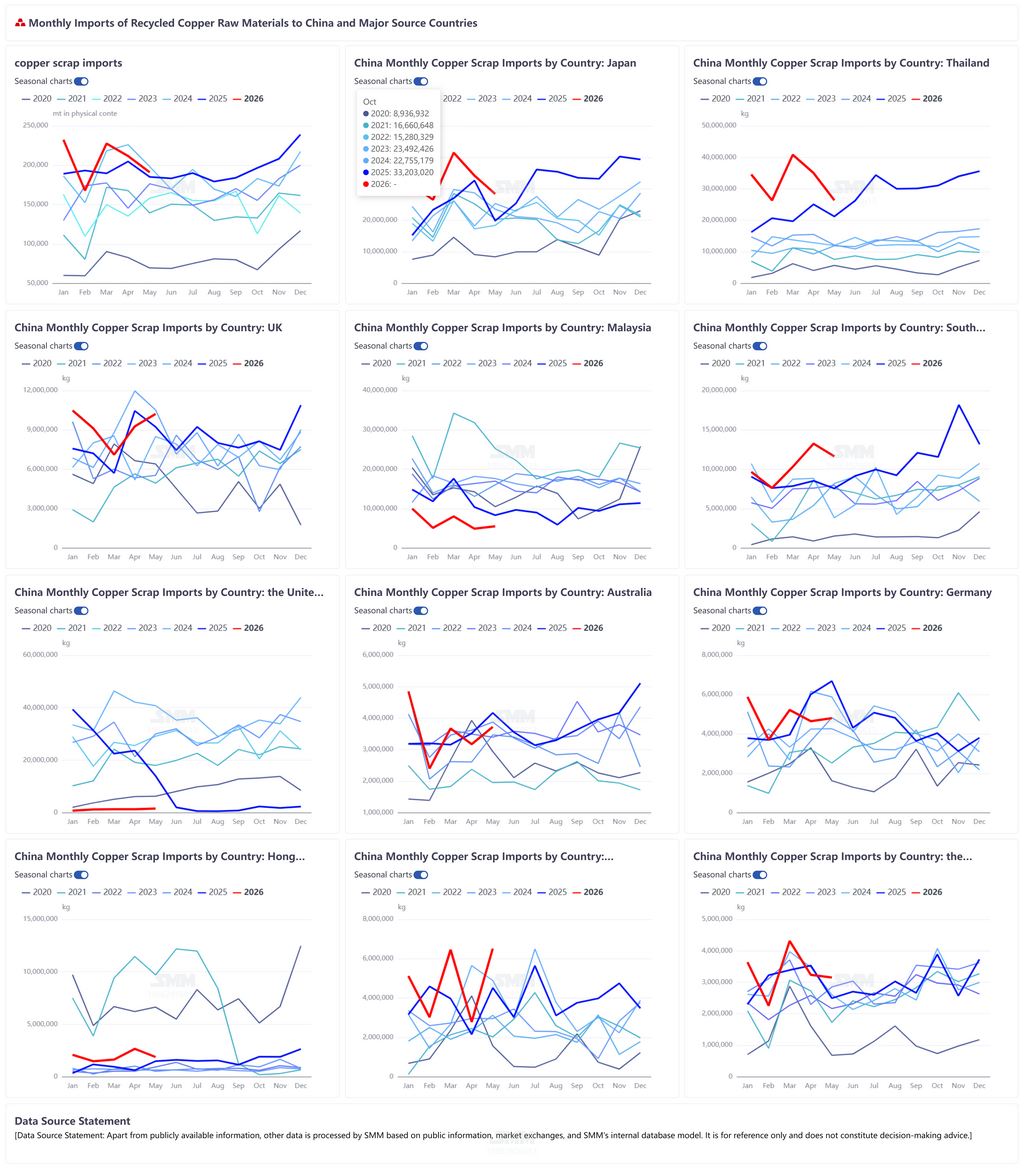
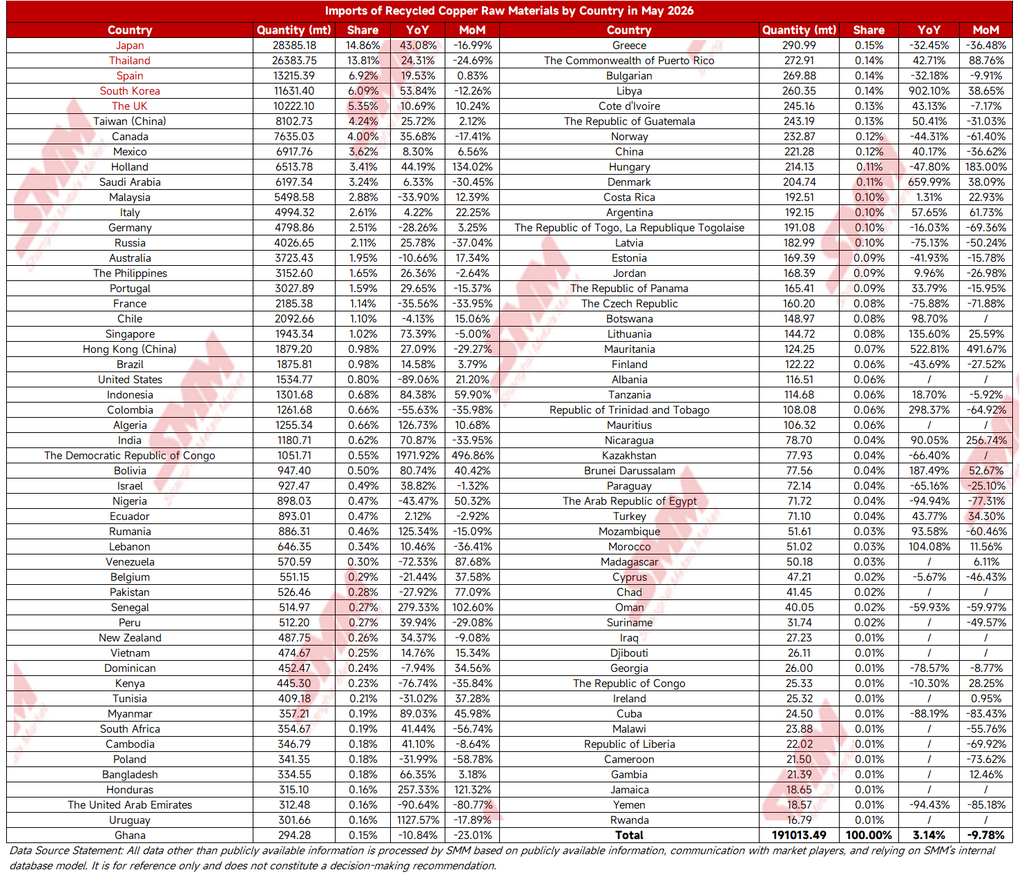
The tier structure of import source countries remained unchanged in May. Japan and Thailand stayed China’s largest and second-largest import sources, but shipments from both core suppliers to China dropped sharply MoM. Reduced exportable overseas supply was the fundamental reason behind the overall import decline:

Japan: Supplied 28,400 mt in physical content to China in May, accounting for 14.86%, up 43.08% YoY, down 16.99% MoM. Domestic copper scrap collection entered the off-season in Japan, output from dismantling enterprises fell, and smelters there diverted exportable supply for their own use. The volume of spot cargo available for shipment to China shrank notably, leading to a significant MoM pullback in shipments to China.

Thailand: Exported 26,400 mt to China in May, accounting for 13.81%, up 24.31% YoY, down 24.69% MoM. Demand for copper scrap in Southeast Asia diverted supply, seasonal declines in collection-side output compounded the situation, and traders slowed their procurement pace. Shipments to China weakened MoM for the second consecutive month.

Spain: The third-largest supplier delivered 13,200 mt, accounting for 6.92%, up 19.53% YoY, up only 0.83% MoM.

Traditional major sources such as South Korea, Canada, Saudi Arabia, and Russia all saw MoM declines in arrivals, with supply tightening simultaneously across multiple countries. While niche suppliers such as Libya, Denmark, and Mauritania posted substantial YoY and MoM volume increases, their individual volumes were measured in only the hundreds of metric tons, accounting for less than 0.2% of the total. These incremental volumes were far too small to offset the decline caused by supply tightening from mainstream countries.

2. Import profit margins narrowed marginally, traders proactively slowed procurement pace
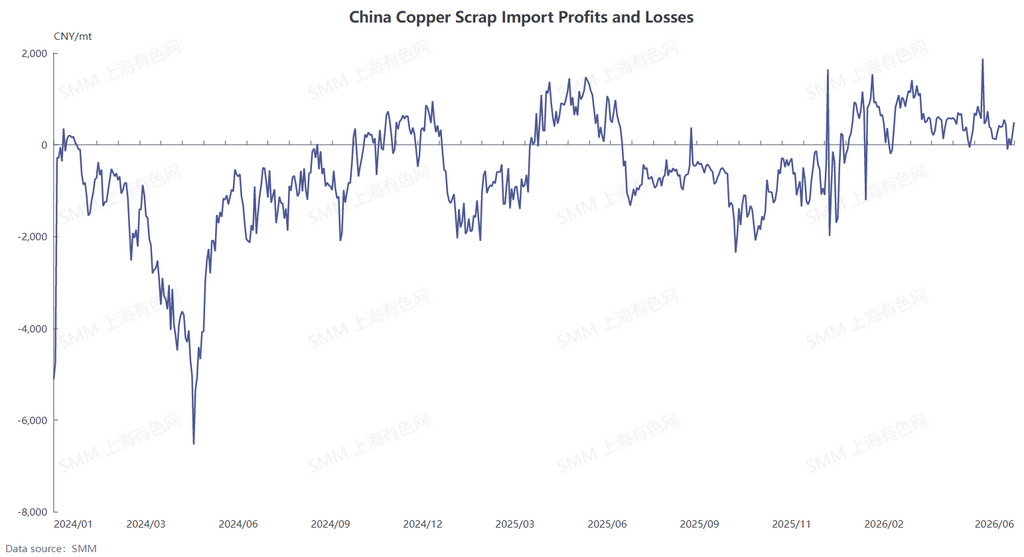
The SMM China copper scrap import profit margin curve shows that, although the import window remained profitable overall during April-May, profit margins compressed, weakening traders’ willingness to lock in cargoes proactively:

LME copper prices continued to fluctuate at highs, overseas suppliers were strongly inclined to hold prices firm, bare bright copper quotation coefficients stayed high, and overseas procurement costs rose. Compared with import profits seen in February-March, April-May offered only limited profitability. Traders proactively reduced forward overseas booking and cargo-locking volumes, slowed the pace of arrivals, and further amplified the MoM decline in imports for the month.

3. Structural shortage in China’s tax-inclusive copper scrap provided a floor, keeping import growth positive YoY
Imports in May still edged up 3.14% YoY. The core support came from China’s persistent shortage of compliant copper scrap: difficulties with documentation for circulating domestic copper scrap have yet to see material improvement, and the circulation volume of domestically traded copper scrap with proper documentation remained persistently tight, keeping tax-inclusive domestic trade prices high. Downstream copper processing enterprises, requiring both production stability and tax compliance, maintained solid rigid demand for overseas copper scrap with complete import customs documentation. Even as import profit margins thinned, enterprises still needed to maintain baseline import stockpiling, which is why imports did not turn negative on a YoY basis.

Two factors weighing on imports in the short term are likely to persist: first, supply-side collection activity in mainstream overseas supply countries is in the off-season, and exportable supply is unlikely to see significant incremental growth in the near term; second, import profit margins are expected to remain in thin-profit territory, and traders’ willingness to procure at scale proactively remains weak. Copper scrap imports are expected to remain in the doldrums in June. However, China’s shortage of tax-inclusive copper scrap supply is unlikely to ease in the short term, and emerging niche sources such as Libya and Tanzania continue to release incremental volumes. As a result, the probability of a sharp plunge in total imports is low, with the overall picture hovering at lows. (See below for a breakdown of May copper scrap imports by country)

Data Source Statement: Except for publicly available information, all other data are processed by SMM based on publicly available information, market communication, and relying on SMM's internal database model. They are for reference only and do not constitute decision-making recommendations.

For any inquiries or for more information, please contact: lemonzhao@smm.cn
For more information on how to access our research reports, please contact:service.en@smm.cn
Related News
AI Computing Power Demand Boom Fuels Continuous Climb in Copper Foil Operations; Copper Cable High-Speed Connectors Strengthen, Taichenguang Leads Gains [SMM Express]
5 hours ago
AI Computing Power Demand Boom Fuels Continuous Climb in Copper Foil Operations; Copper Cable High-Speed Connectors Strengthen, Taichenguang Leads Gains [SMM Express]
Read More
AI Computing Power Demand Boom Fuels Continuous Climb in Copper Foil Operations; Copper Cable High-Speed Connectors Strengthen, Taichenguang Leads Gains [SMM Express]
5 hours ago
Tertiary Minerals Completes Phase 4 Drilling at Zambia’s Mushima North Copper Project
5 hours ago
Tertiary Minerals Completes Phase 4 Drilling at Zambia’s Mushima North Copper Project
Read More
Tertiary Minerals Completes Phase 4 Drilling at Zambia’s Mushima North Copper Project
Tertiary Minerals Plc has completed its Phase 4 drilling programme at Target A1 within the Mushima North Project in Zambia, with early portable X-Ray Fluorescence (pXRF) results identifying further copper mineralisation and supporting previously identified higher-grade zones.​ The Phase 4 programme comprised 3,639 m of drilling across 39 holes. Early results included an intersection of 15 m grading 0.53% copper from 100 m depth, including 7 m at 0.77% copper. Additional intersections included 4 m at 0.68% copper and 8 m at 0.62% copper, while broader infill intersections returned 65 m at 0.23% copperand 83 m at 0.16% copper.​ Mushima North is a polymetallic silver-copper-zinc prospect located within Zambia’s prospective Iron-Oxide-Copper-Gold region, approximately 28 km east of the historic Kalengwa copper-silver mine. The latest drilling supports the previously identified near-surface Exploration Target of 15–30 million tonnes grading 40–60 g/t silver equivalent, while also providing further indications of higher-grade copper and silver mineralisation within the target area.​ Samples from the drilling programme have been submitted for independent laboratory testing, with certified results expected to be released as they become available. Remaining pXRF results from the final nine holes are also expected, covering additional infill drilling at Target A1 and exploration of mineralisation west of Target A1 and at Target A2.​ With Phase 4 drilling now complete, the project is moving into its next stage of technical evaluation. Initial metallurgical testwork is expected to commence shortly, followed by data compilation and resource modelling. Tertiary Minerals is targeting the delivery of a JORC-compliant Mineral Resource Estimate for Mushima North before the end of 2026, which would provide a clearer assessment of the scale and grade distribution of the mineralised system following the latest drilling campaign.
5 hours ago
Copper Mineralisation Extends Beyond Current Resource at Zambia’s Mumbezhi Project
6 hours ago
Copper Mineralisation Extends Beyond Current Resource at Zambia’s Mumbezhi Project
Read More
Copper Mineralisation Extends Beyond Current Resource at Zambia’s Mumbezhi Project
According to foreign media reports, step-out drilling at the Nyungu Central deposit within Zambia’s Mumbezhi Copper Project has returned further copper intersections, extending a newly identified mineralised zone southeast beyond the boundaries of the current Mineral Resource Estimate (MRE).​ Recent drilling returned 65.8 m grading 0.42% copper from 226 m, including higher-grade intervals of 17.0 m at 0.58% copper and 13.2 m at 0.82% copper. A separate intersection returned 29.6 m grading 0.34% copper from 237 m, including 5.2 m at 0.80% copper. The results extend the known copper system outside the current resource estimate and provide additional targets for continued exploration.​ A total of 16 Phase 3 diamond drill holes covering 4,723 m have so far been completed at the southern end of Nyungu Central, while priority assay results remain pending for seven holes. In addition, a 6,200 m infill diamond drilling programme commenced at Nyungu Central in late July, supported by an additional drill rig now on site.​ Exploration is also continuing across the wider Mumbezhi Project, with four diamond drill rigs currently operating. Three are focused on Nyungu Central, while another is drilling at the regional Sharamba prospect, where exploration is targeting shallow copper mineralisation associated with a strong airborne electromagnetic anomaly. Visual copper mineralisation has been observed in five holes drilled along approximately 700 m of strike on the western side of the anomaly.​ The latest intersections further extend the known copper mineralisation beyond the existing Nyungu Central resource boundaries, while several priority assay results remain outstanding. Continued step-out and infill drilling will provide further indications of the scale and continuity of the mineralised system and its potential to support future resource expansion at Mumbezhi.
6 hours ago