SMM, June 17, 2026:
I. India's Supply-Demand Imbalance: Structural Anatomy of the Shortage
In the summer of 2026, India encountered extreme heatwaves, causing soft drink and beer consumption to surge sharply and driving a rapid expansion in the aluminum beverage can market. However, the rapid demand growth was not met with an effective response from domestic supply—India's domestic aluminum can stock capacity has long been insufficient, with can stock supply heavily reliant on imports, primarily from West Asian countries like the UAE and Saudi Arabia. Since March 2026, transportation disruptions in West Asia, combined with escalating BIS import certification delays, have plunged the supply chain into systemic strain.
From an industrial structure perspective, although India is one of the world's major aluminum producers, the deep processing segment of can stock manufacturing has consistently been a weak link. Currently, only Hindalco's planned expansion of approximately 50 kt at its Aditya plant in Odisha and Ball Corporation's $60 million expansion project in Sri City, Andhra Pradesh are in progress, yet these capacity releases are expected to take 2-3 years. The inherent insufficiency on the supply side dictates that India will maintain structural dependence on external can stock sources for a considerable period to come.
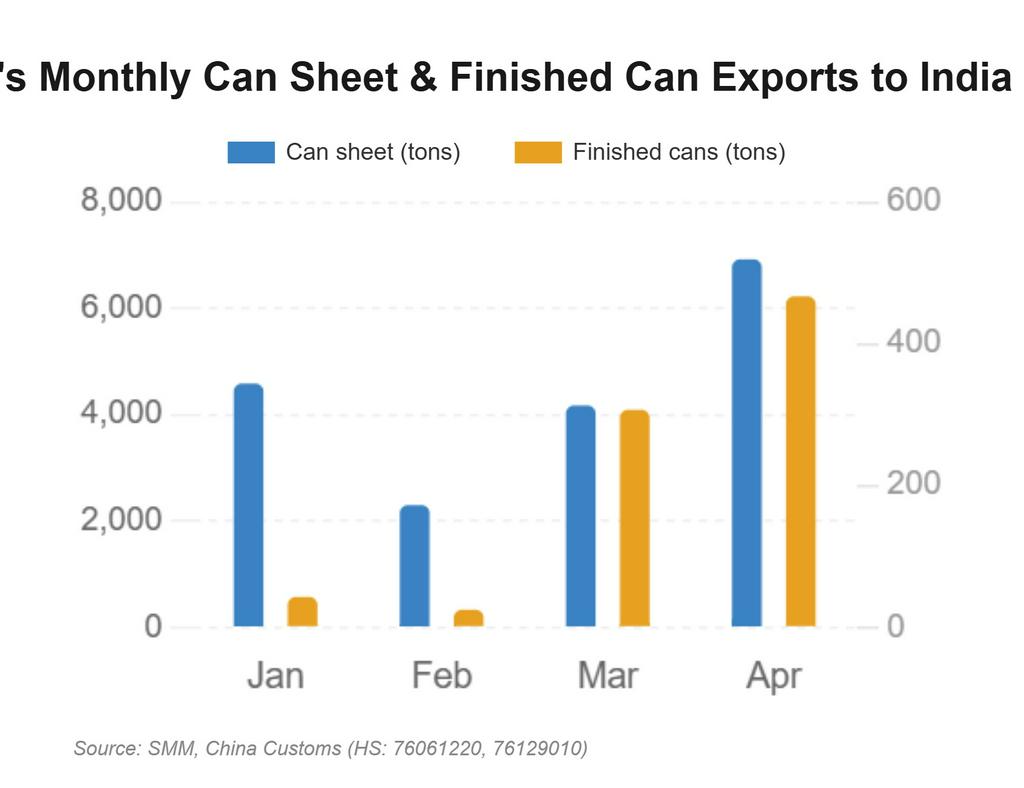
According to China Customs data, from January to April 2026, India's imports of can stock (highly correlated with HS 76061220) from China rose from 4,587 mt to 6,923 mt, while imports of finished cans (HS 76129010) also increased from 43 mt to 467 mt (equivalent to approximately 38.9 million cans) over the same period. Starting in May, China's can stock exports to India are expected to further expand, forming a phased export peak.
II. China's Export Window: Policy Exemptions and Demand Resonance
In terms of trade policy, China's aluminum can stock exports to India have a relatively clear compliance pathway. India's anti-dumping duties on Chinese aluminum flat-rolled products (HS 7606/7607) are valid until December 5, 2026, but its exemption list explicitly excludes "aluminum can body blanks (including can end stock)" from the scope of duties. In December 2025, India's Ministry of Commerce and Industry further included wide-width Lithograde aluminum coil in the exemption, effectively broadening the range of exportable Chinese products.
Worth noting is that in March 2026, India's Ministry of Commerce and Industry initiated the first sunset review of anti-dumping duties on Chinese aluminum flat-rolled products, with the dumping investigation period spanning from April 2024 to September 2025. If the review results in maintaining the existing duties, China's aluminum flat-rolled product exports to India (approximately 330,000 mt in full-year 2025) will face substantive blockage. While the current exemption policy remains effective, as the review progresses, policy uncertainty will notably rise, becoming a core risk for export enterprises in H2 2026.
III. Sustainability Concerns: Limited Window, Guard Against Overoptimism
In summary, against the backdrop of India's unresolved supply gap, ongoing Middle East transportation uncertainties, and domestic expansion projects being a distant cure for immediate thirst, China's can stock export window to India is likely to remain open throughout 2026. Nevertheless, it must be recognized soberly that this round of export expansion is driven largely by supply-side disruptions and policy exemptions, rather than an active shift in India's procurement demand toward China, thus lacking a foundation for long-term cooperation. Coupled with policy risks from the sunset review, the uneconomical nature of finished can transportation, and India's gradually recovering domestic supply capacity, the incremental space for and sustainability of future Chinese can stock exports to India still face considerable uncertainty.

![Active selling in the market; transactions far from ideal [SMM South China Spot Aluminum Daily Review]](https://imgqn.smm.cn/usercenter/uoPaX20251217171651.jpg)