SMM, June 17:
In the metals market:
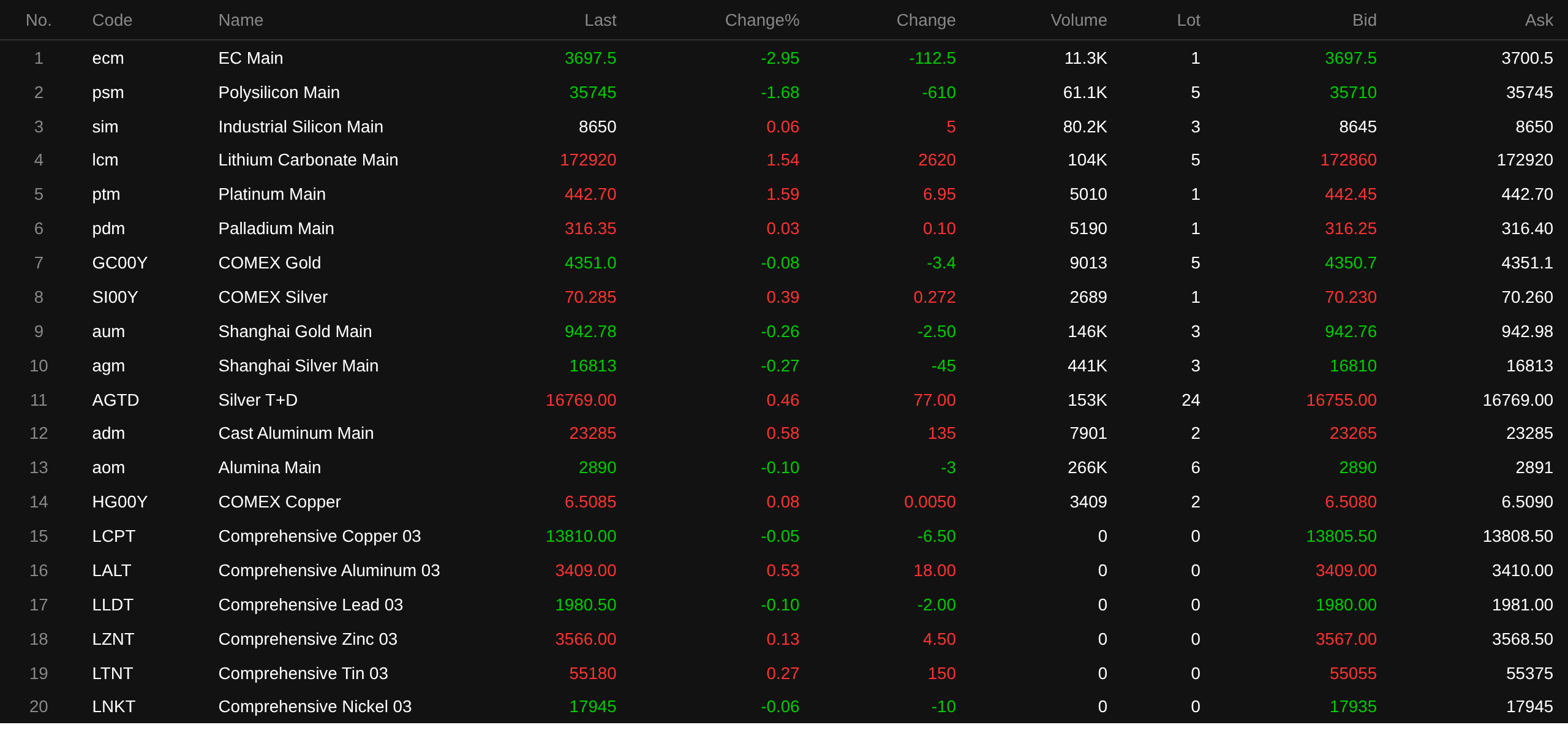
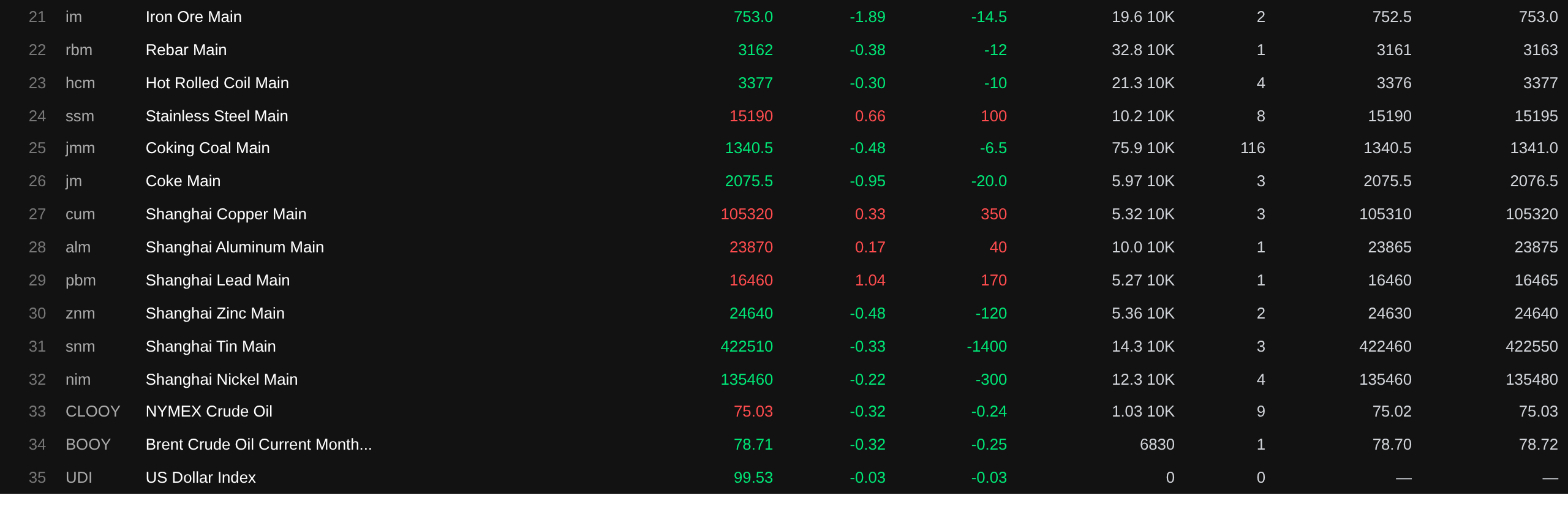
As of the midday close, base metals on the domestic market showed mixed performance. SHFE copper edged up 0.33%, SHFE aluminum edged up 0.17%, SHFE lead increased 1.04%, SHFE zinc fell 0.48%, SHFE tin fell 0.33%, and SHFE nickel fell 0.22%.
In addition, the most-traded foundry aluminum futures contract rose 0.58%, the most-traded alumina contract fell 0.1%, the most-traded lithium carbonate contract rose 1.54%, the most-traded silicon metal contract edged up, and the most-traded polysilicon futures contract fell 1.68%.
Ferrous metals mostly fell, with iron ore down 1.89%, rebar down 0.38%, HRC down 0.3%, and stainless steel up 0.66%. In coking coal and coke: the most-traded coking coal contract fell 0.48%, and the most-traded coke contract fell 0.95%.
For base metals on the overseas market, as of 11:39, LME metals showed mixed performance. LME copper and LME nickel edged up, LME aluminum rose 0.53%, LME lead fell 0.1%, LME zinc rose 0.13%, and LME tin rose 0.27%.
In precious metals, as of 11:39, COMEX gold fell 0.08%, and COMEX silver rose 0.39%. On the domestic precious metals market: the most-traded SHFE gold contract fell 0.26%, and the most-traded SHFE silver contract fell 0.27%.
In addition, as of the midday close, the most-traded platinum futures contract rose 1.59%, and the most-traded palladium futures contract edged up.
As of the midday close, the most-traded container shipping index futures contract fell 2.95% to 3,697.5 points.
Selected futures midday quotes as of 11:39 on June 17:
Spot and Fundamentals
Copper: Today, spot #1 copper cathode in Guangdong against the front-month contract: high-quality copper was quoted at 210 yuan/mt, unchanged from the previous trading day; standard-quality copper was quoted at a premium of 150 yuan/mt, unchanged from the previous trading day; SX-EW copper was quoted at a premium of 90 yuan/mt, unchanged from the previous trading day. The average price of Guangdong #1 copper cathode was 105,500 yuan/mt, up 565 yuan/mt from the previous trading day, and the average price for SX-EW copper was 105,410 yuan/mt, up 565 yuan/mt from the previous trading day. Spot market: Guangdong inventory declined again today after two consecutive days of increases, mainly due to fewer arrivals and more shipments...
Macro Front
China:
[NFRA: Promote the flow of financial resources toward emerging and future industries] Ding Xiangqun, head of the National Financial Regulatory Administration (NFRA), stated that serving the real economy is the foundation of finance. It is necessary to optimize the supply structure of funds, deliver on the five priority areas of finance, and focus on promoting the development of new quality productive forces. The country should continuously improve full-cycle tech-finance service systems, strengthen financing support and insurance guarantees, and promote the flow of financial resources toward emerging and future industries. Efficiently support the strategy of expanding domestic demand. Financial regulatory authorities should guide financial institutions to deeply engage in fiscal-financial coordination to boost domestic demand, help implement the special campaign to invigorate consumption and the action to expand capacity and improve quality in the service sector, and strengthen financial services for major projects under the 15th Five-Year Plan. Enhance financial support for vulnerable areas. Promote a substantial improvement in quality and reasonable growth in volume for loans to small and micro enterprises. Develop tailored inclusive financial products for new employment groups, namely the "two drivers and two delivery workers"—truck drivers, ride-hailing drivers, couriers, and food delivery workers. Continuously improve the level of financial services for disaster prevention, mitigation, and relief, and fortify the line of defense for public safety. (CCTV News)
[PBoC: Improve the short-end interest rate adjustment mechanism] Pan Gongsheng, Governor of the People's Bank of China, stated that the short-end interest rate adjustment mechanism will be improved. Building on the temporary overnight standing repo and reverse repo facilities established in July 2024, the mechanism for using these tools will be refined, and the operating rates will be adjusted to the 7-day reverse repo operating rate plus and minus 25 basis points, narrowing the corridor from 70 basis points to 50 basis points. The toolbox for open market operations will be further enriched, and overnight reverse repo operation instruments will be added when appropriate to better match the short-term liquidity needs of the banking system. (CCTV News)
[Full text of the Action Plan for Shanghai International Financial Center to Develop Offshore Finance is released] The People's Bank of China, the National Development and Reform Commission (NDRC), the National Financial Regulatory Administration, the China Securities Regulatory Commission, the State Administration of Foreign Exchange, and the Shanghai Municipal People's Government jointly issued the Action Plan for Shanghai International Financial Center to Develop Offshore Finance. It mentions that by the end of 2027, a preliminary institutional framework encompassing business rules, risk management and resolution, and the business environment adapted to offshore financial businesses is expected to be established, with explorations of offshore financial business at the forefront of digitalization to better serve enterprises going global. By the end of 2030, a relatively mature offshore financial institutional and legal framework is expected to gradually take shape, providing secure and reliable financial services for the sustained international investment and trade of Chinese enterprises, conducting tests for the reform of the onshore financial system, and strongly supporting the development of global allocation and risk management functions for RMB assets. By the end of 2035, it is expected to become a strategic hub for high-level coordinated and integrated development of offshore and onshore finance, leading the nation's high-standard financial opening and high-quality development. (From Wallstreetcn APP)
[People's Bank of China launches the Foreign Institutional Investor and Central Banks RMB Repo Facility] To support the high-standard opening of China's financial market and facilitate RMB liquidity management for foreign central bank institutions, the People's Bank of China will use the Foreign Institutional Investor and Central Banks RMB Repo (FIMA RMB Repo) facility to provide RMB liquidity to eligible foreign central bank institutions. Overseas central bank-type institutions refer to foreign central banks or monetary authorities, international financial organizations, and sovereign wealth funds. The operational methods of the repo tool include pledge-style and outright repo. The types of bonds for repo include Chinese government bonds, central bank bills, policy financial bonds, and other high-grade RMB bonds recognized by the PBOC. The repo tenors include 7-day, 1-month, and 3-month. The repo rate is determined by adding a spread over the 7-day reverse repo operation rate in the open market. (People's Bank of China)
[PBOC Optimizes Temporary Overnight Repo and Reverse Repo Operations in the Open Market]To flexibly and efficiently utilize the temporary overnight repo and reverse repo tools in the open market, the PBOC decided, effective immediately, to optimize the operational parameters. The operation time was adjusted to 15:00–15:30 on working days, and the operation rates were adjusted to the 7-day reverse repo operation rate in the open market minus 25bp and plus 25bp, respectively. To further clarify the usage rules of the tools, when the overnight money market rate (DR001) remains persistently below or above the corresponding tool operation rate, the PBOC will initiate the relevant operations in conjunction with the demand of primary dealers. (People's Bank of China)
[Wu Qing: Since the New “National Nine Measures”, Social Security, Insurance, and Others Have Net Purchased RMB 1.3 Trillion of A-Shares]At the opening ceremony of the 2026 Lujiazui Forum, Wu Qing, Chairman of the China Securities Regulatory Commission, delivered a keynote speech titled “Further Improving the Capital Market Function of Coordinating Investment and Financing to Better Serve New Quality Productive Forces and High-Quality Economic Development.” He stated that since the release of the New “National Nine Measures” over two years ago, the market value of A-shares held by social security, insurance, and other institutions had grown by 85%, with net purchases of A-shares totaling RMB 1.3 trillion. Wu Qing said that efforts should be made to actively expand funding sources, support complementary advantages between state-owned funds and private capital, guide pension funds, insurance funds, and others to increase equity investment, and facilitate the smooth circulation of “fundraising, investment, management, and exit.” (From the Wall Street Insight APP)
[Zhu Hexin: Grant Higher Convenience to Entities with Sound Operations and Good Credit]Zhu Hexin, Deputy Governor of the People's Bank of China and Administrator of the State Administration of Foreign Exchange, stated at the 2026 Lujiazui Forum that the next step would be to further shift from convenience for individual business items to convenience for business entities, granting higher convenience to those with sound operations and good credit. (From the Wall Street Insight APP)
[PBOC Reverse Repos Saw Net Injection of RMB 261.3 Billion Today]The PBOC conducted RMB 420.3 billion of 7-day reverse repo operations today. With RMB 159 billion of 7-day reverse repos maturing today, a net injection of RMB 261.3 billion was realized. (Jin10 Data APP)
On the US dollar side:
As of 11:39, the US dollar index fell 0.03% to 99.53. Option traders are increasingly divided on the US Fed’s near-term interest rate path, placing bets that range from rate cuts in coming months to rate hikes of varying magnitudes. Swaps market pricing shows that the Fed is almost certain to hold interest rates steady at its Wednesday meeting, with all eyes turning to Chairman Warsh’s first press conference for clues on future policy. Although the US and Iran are set to formally sign a temporary peace deal, with oil prices already falling to three-month lows and offering some relief from inflationary pressures, the policy outlook remains uncertain. (Jin10 Data APP)
The Federal Reserve will conclude its policy meeting in the early hours of Thursday Beijing time, and the market is now focused on a key variable: the dot plot may lack a key dot. The Federal Open Market Committee (FOMC) will release its quarterly Summary of Economic Projections (SEP) after the meeting, which includes individual officials’ assessments of the interest rate path for 2026 to 2028 and beyond—the closely watched dot plot. Investors will parse the distribution of dots to gauge the overall bias of officials on the economic outlook and monetary policy. However, most Wall Street Fed watchers expect that new Chairman Warsh Kevin (Warsh Kevin) will not submit his own rate projection dot. He only assumed his post on May 22 and feels he has not yet prepared a full forecast; additionally, he has consistently been critical of the dot plot and the broader forward guidance communication framework. Should Warsh decline to submit a dot, it would break from a practice that has persisted for 14 years since the financial crisis, and could also ruffle feathers among FOMC members who rely on the dot plot to convey policy signals. Yet, this move would also serve as his first step in pushing for fundamental reforms at the Fed. (Jin10 Data APP)
According to CNBC, the Federal Reserve will release its latest dot plot on Wednesday, showing officials’ expectations for the interest rate trajectory. However, most Wall Street Fed watchers expect new Fed Chairman Warsh Kevin not to participate, possibly because he feels unprepared or simply because he dislikes the dot plot. Warsh has previously spoken out against dot plots and other forward guidance methods, arguing that they constrain the Fed’s decision-making ability. Should Warsh refuse to provide a dot plot projection, it would run counter to the practice the Fed has followed for roughly 14 years since the financial crisis and could distance him from other Fed officials who support this communication tool. Yet, for Chairman Warsh, who has pledged to fundamentally reform the way the institution operates, this could serve as an effective first step. “In my opinion, he likely does not want to submit a rate forecast.”Bill English, former head of monetary policy at the US Fed and now a professor at Yale University, said, “There may be others on the committee who don’t particularly like the dot plot, and they might be willing to do the same.”
According to CME FedWatch, the probability that the Fed would keep interest rates unchanged in June was 99.5%, and the probability of a cumulative 25bp rate cut was 0.5%. The probability that the Fed would keep rates unchanged through July was 92%, with a 7.9% probability of a cumulative 25bp rate hike and a 0% probability of a cumulative 25bp rate cut.
In other currencies:
Goldman Sachs economist Akira Otani said that the Bank of Japan is very likely to raise interest rates again in January 2027, but there is high uncertainty over the timing of future rate hikes. “With underlying inflation near 2%, even a small change, such as a further modest depreciation of the yen, could significantly increase the risk of inflation exceeding 2%,” the economist noted, “Thus, the probability distribution of the timing of the next rate hike is seen as skewed towards an earlier move.” Otani added that the actual timing of the rate hike would be “significantly influenced by the progress of communication with the government.” (Jin10 Data APP)
A senior official at the Reserve Bank of Australia said on Wednesday that as a tense geopolitical environment reshapes financial and economic linkages, Australian institutions need to prepare for a financial system that is more susceptible to shocks. RBA Deputy Governor Brad Jones said, “We have to accept the world as it is, not as we would like it to be, and it is against this backdrop that policymakers are intensifying efforts to ensure the financial system can cope with a more challenging risk environment.” Jones noted that the high level of foreign ownership in Australia’s fixed-income market means the country’s financial system will not be immune to external shocks. Referring to pension funds, he said, “About half of the assets in our superannuation fund industry are invested offshore.” (Jin10 Data APP)
Data:
Due for release today are the US May retail sales month-over-month rate, US April business inventories month-over-month rate, US May pending home sales index month-over-month rate, UK May CPI month-over-month rate, UK May retail price index month-over-month rate, eurozone May final CPI year-over-year rate, eurozone May final CPI month-over-month rate, and other data. Also in focus: ECB President Lagarde is participating in a summit on the impact of artificial intelligence (AI); the 2026 Lujiazui Forum in China takes place from June 17 to 18.
Oil:
As of 11:39, both oil benchmarks extended their losses from the previous four trading sessions, with WTI down 0.32% and Brent down 0.32%. Trump stated that the Strait of Hormuz will reopen this Friday, with the US and Iran expected to sign a provisional memorandum of understanding in Switzerland at that time, though the full text has not yet been released. The provisional agreement between the US and Iran on reopening the Strait of Hormuz sparked wild swings in global oil markets.
According to the Wall Street Journal, people familiar with the matter said the deal will allow Iran to immediately resume oil and fuel export sales, providing Tehran with an upfront economic incentive to help de-escalate the conflict. The provision on sanctions waivers for oil sales will take effect immediately after the signing this week. At the same time, necessary services supporting oil sales, such as banking, transportation and insurance, will also be exempted to ensure smooth transactions. United Against Nuclear Iran (UANI) said a supertanker carrying Iranian crude oil left Chabahar port, broke through the US blockade and sailed out of the Gulf of Oman on Tuesday with its vessel tracking system turned on. This is the first such incident since the US imposed a maritime blockade in April this year. A senior US official said Tuesday that while Iran will receive upfront sanctions waivers for oil sales, long-term and sustained sanctions relief will depend on Iran’s compliance with US demands, including opening the Strait and issues related to its nuclear program. The official added that Iran will still not immediately obtain the tens of billions of dollars frozen outside China. (Jin10 Data)
Spot market roundup:
►
►
►
►
►
►
►
►
►
►
►
►
![US Fed is about to hold its June FOMC meeting, the most-traded SHFE tin contract consolidates at highs above 420,000 [SMM Tin Midday Review]](https://imgqn.smm.cn/usercenter/pwiFP20251217171752.jpg)
![Pre-holiday restocking willingness not strong, spot trades moderate [SMM South China Spot Copper]](https://imgqn.smm.cn/usercenter/KtfdC20251217171713.jpeg)
![Long-term contract delivery is dominant, spot market activity is sluggish [SMM North China Spot Copper]](https://imgqn.smm.cn/usercenter/XTMPt20251217171713.jpeg)