[SMM Analysis] High-end High-Induction Grain-Oriented Steel Expected to Maintain Stable and Improving Trend

Published: Jun 17, 2026 11:21
Semi-Annual Review and Outlook: Rigid Demand Steadily Released, High-end High-Induction Grain-Oriented Steel Expected to Maintain Stable and Improving Trend

H1 Price Review:

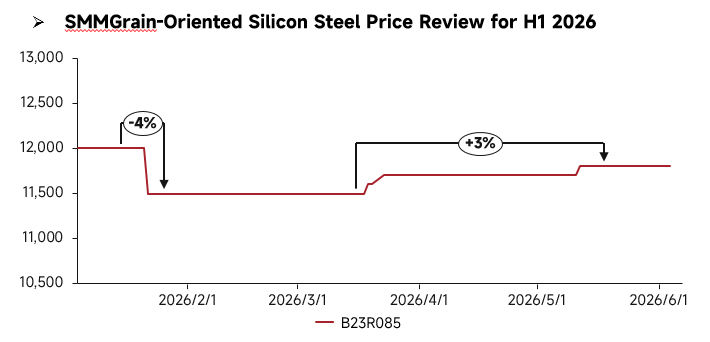
In H1 2026, China’s grain-oriented silicon steel market fluctuated overall, with prices first suppressed and then rebounding. At the start of the year, market prices edged down, but as downstream demand gradually recovered, prices saw a rebound. Performance diverged notably by product type: competition intensified for regular grades amid mediocre demand, keeping prices generally weak; high-end high-permeability grades, supported by rigid demand from power infrastructure, remained firm throughout. On the supply side, regular grades were in ample supply and competition intensified, while high-end products, limited by technological barriers, saw constrained capacity deployment and persistently tight supply. The demand side showed pronounced structural divergence, with ongoing UHV construction and power grid upgrades sustaining solid rigid demand for high-end products, whereas demand for regular grades remained weak.

H1 Fundamentals Review:

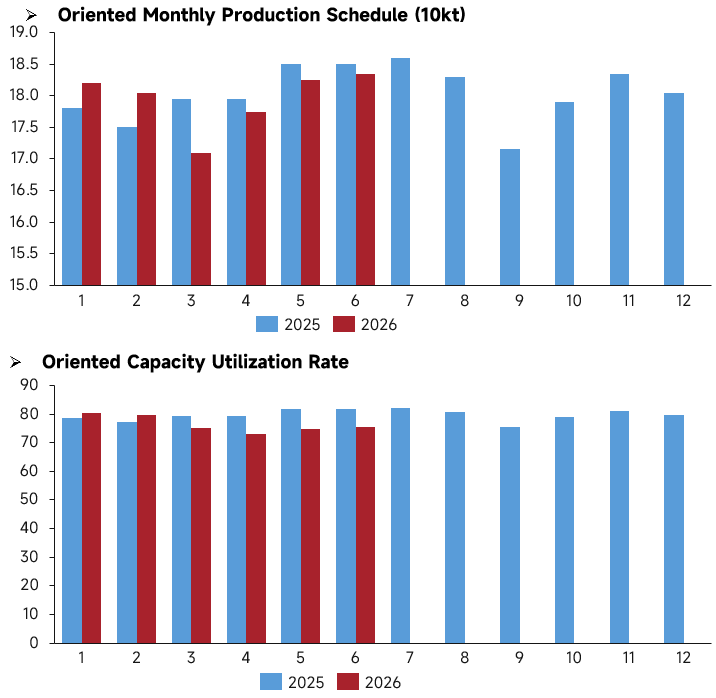
From a production perspective, the production schedule of grain-oriented silicon steel in China in H1 2026 followed a trend of rising, then falling, and then rising again. Only the January-February production schedule volume exceeded the level in the same period of 2025, while the schedule from March to June all fell short of the year-earlier level. In March, it dropped to the H1 low of about 171,000 mt, and in May-June, it recovered to around 183,000 mt as production arrangements were stepped up. However, the overall production schedule center was lower than in H1 2025, and Q2 saw a marked contraction in production activity. Over the same period, the capacity utilization rate trend was highly synchronized with the production schedule. In January-February, the utilization rate was slightly higher than last year, then declined continuously from March to April, hitting the H1 low of 74% in April, and rebounded to 76% in May-June as the schedule recovered. For each month of H1, the utilization rate was significantly lower than the same period in 2025, with the full-year range kept at 74%-81%. This diverging pattern—"slight strength at the start of the year and simultaneous weakening of production schedule and utilization rate in Q2"—indicates that downstream demand support in H1 was weaker than in 2025. Enterprises proactively lowered their Q2 production plans, and the pace of capacity commissioning slowed down. Even with moderate supplementary production in May and June, overall actual operating loads remained weaker than in the same period last year.

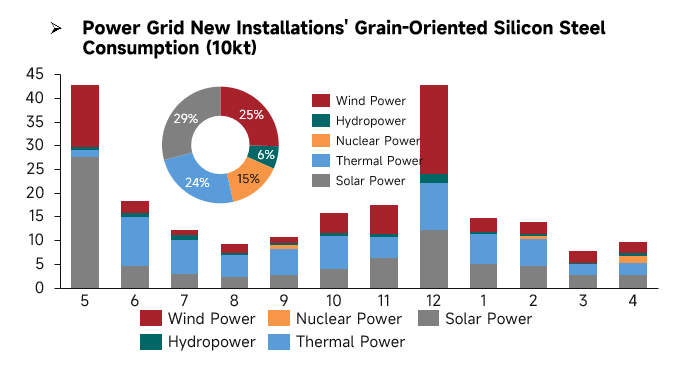
From the perspective of grain-oriented silicon steel consumption driven by power grid installations, overall demand in H1 2026 (January-April) showed a gradual weakening trend, with monthly consumption declining step by step. January marked the H1 demand peak, with total consumption of approximately 150,000 mt, supported simultaneously by PV, thermal power, and wind power. In February, total demand pulled back slightly, with consumption contracting across all sub-sectors. March fell to the H1 trough, as total monthly consumption was under 80,000 mt, and PV and thermal power installation releases slowed markedly. April saw a slight recovery in demand, but the overall volume remained low.

In terms of demand structure, solar, wind, and thermal power remained the core consumption sources in H1, together accounting for nearly 80% of consumption, with nuclear power providing a small supplement and hydropower contribution consistently low. In January, thermal power and PV provided strong boosts, while wind power, which saw concentrated year-end commissioning, had limited release in H1. PV, the largest demand segment, saw continuously declining consumption from January to April, becoming the primary factor dragging down H1 demand.

Compared with the full year, overall installation demand in H1 (January-April) was far below the two peak season highs of last May and December. The release pace of new installations was weak, with insufficient commissioning increments across all power sources. Overall, the end-use demand for grain-oriented silicon steel exhibited market characteristics of underperforming in the peak season and coming under monthly pressure.

H2 Outlook:

In H1 2026, only the Phase II 80,000 mt HIB grade grain-oriented silicon steel capacity of Angang Longdu Electromagnetic New Materials in central China came on stream in Q2, with limited new capacity additions in H1. H2 will mark a concentrated period for GO silicon steel capacity commissioning, with enterprises across multiple regions gradually starting up capacity: in east China, Baoshan Iron & Steel Co., Ltd.'s 220,000 mt HIB grade GO silicon steel capacity will simultaneously commence production in H2, Zhejiang Jinlei Soft Magnetic Materials will start up 100,000 mt CGO grade GO silicon steel capacity in Q3, and Jiangsu Zhongsheng Electromagnetic Technology (180,000 mt HIB) and Jiangxi Chongxin New Materials (80,000 mt HIB) both plan to start production in Q4; in central China, Wuhan Iron & Steel Co., Ltd. plans to launch its 200,000 mt HIB grade GO silicon steel capacity in Q3.

Looking ahead to H2, market divergence will persist. The industry’s capacity structure continues to optimize, with new capacity focusing on high-end categories. Supported by energy efficiency upgrade policies and power infrastructure projects, rigid industry demand is expected to be steadily released. Overall, ordinary grades still face downward price pressure, while high-end, high magnetic induction grain-oriented silicon steel will maintain a stable to positive trend backed by favorable demand.

Data Source Statement: Except for publicly available information, all other data are processed by SMM based on publicly available information, market communication, and relying on SMM's internal database model. They are for reference only and do not constitute decision-making recommendations.

For any inquiries or for more information, please contact: lemonzhao@smm.cn
For more information on how to access our research reports, please contact:service.en@smm.cn
Related News
[SMM Lecong HRC Inventory] This week, Lecong inventory ended its increase and turned to a decline.
48 mins ago
[SMM Lecong HRC Inventory] This week, Lecong inventory ended its increase and turned to a decline.
Read More
[SMM Lecong HRC Inventory] This week, Lecong inventory ended its increase and turned to a decline.
[SMM Lecong HRC Inventory] This week, Lecong inventory ended its increase and turned to a decline.
Lecong HRC inventory this week was 941,800 mt, down 39,400 mt WoW, a decrease of 4.02%; Gregorian YoY +36.39%, Lunar YoY +46.11%.
48 mins ago
6.16 SMM Global Steel Daily Report
18 hours ago
6.16 SMM Global Steel Daily Report
Read More
6.16 SMM Global Steel Daily Report
SMM News Flash:  [Rebar] Rebar export FOB offers remained stable today. Market traders reported that inquiries were relatively mediocre and transactions remained weak, with strong wait-and-see sentiment among market participants. [Steel Billet] Billet export offers were in the doldrums today, quoted at 473-476 USD/tonne. Market feedback indicated that current trader offers were on the high side, while overseas billet export offers declined, weakening China's competitiveness and resulting in mediocre inquiries and poor transaction performance.  [HRC] Sheet & plate export prices dropped1-2 USD/tonne day on day today, with HRC transaction prices at 496-50 USD/tonne. Market feedback showed that inspection rates at North China ports had increased recently, causing some unofficial quoted sources to shift to relatively less stringent ports for port departures, and corresponding price spreads narrowed. Regarding the de-escalation of US-Iran tensions, some export participants consulted today reported no notable increase in inquiries yet, and buyers may also be waiting to see subsequent risks.ently, there have been some new inquiries for medium and heavy plate in the Middle East, with a portion of them resulting in transactions. [India] A 0.40 INR/kWh industrial power tariff increase in Chhattisgarh, effective 1 Jul 2026, will raise induction furnace billet costs by ~3.17–3.80 USD/tonne and re-rolling (rebar/wire rod) costs by ~0.51–0.63 USD/tonne. Weak monsoon-season demand limits cost pass-through, with billet margins at risk of erosion by 2.64–3.69 USD/tonne. [SEA] Currently, construction project operating rates in Vietnam, the Philippines, Indonesia, and Thailand are at a seasonal low, severely suppressing rigid demand for long steel products such as rebar and wire rod. End-user buying sentiment is weak, the pace of overall inventory destocking is slow, and local major mills' rebar EXW prices are at 520–535 USD/tonne. Meanwhile, with the release of information on US-Iran negotiations, news of the Strait of Hormuz unblocking has sparked expectations among Southeast Asian buyers of lower freight rates, creating a mindset of buying on dips and waiting on the sidelines. However, according to SMM's latest survey, even if the agreement can be signed smoothly on the 19th, the actual unblocking of the strait will still require a buffer period. Freight rates are expected to be difficult to lower in the short term and will mainly fluctuate at high levels. [Taiwan, China] This week, Feng Hsin, a leading long steel producer in Taiwan, kept its long steel prices stable, halting a three-week downward streak. Specifically, the rebar price stabilized at 583 USD/tonne EXW (approximately 18400 TWD/tonne), while the structural steel price held steady at 792 USD/tonne EXW (approximately 25000 TWD/tonne). This price stability indicates that mills are ready to accept new orders as the market gradually bottoms out.
18 hours ago
MMi Daily Iron Ore Report (June 16)
18 hours ago
MMi Daily Iron Ore Report (June 16)
Read More
MMi Daily Iron Ore Report (June 16)
The most-traded iron ore futures contract on the DCE, I2609, experienced weak fluctuations today and ultimately closed at 762 yuan/ton, down 0.85% from the previous trading session
18 hours ago