Raw Material Crunch Keeps Brass Billet Operating Rates Persistently Low

Published: May 25, 2026 15:52
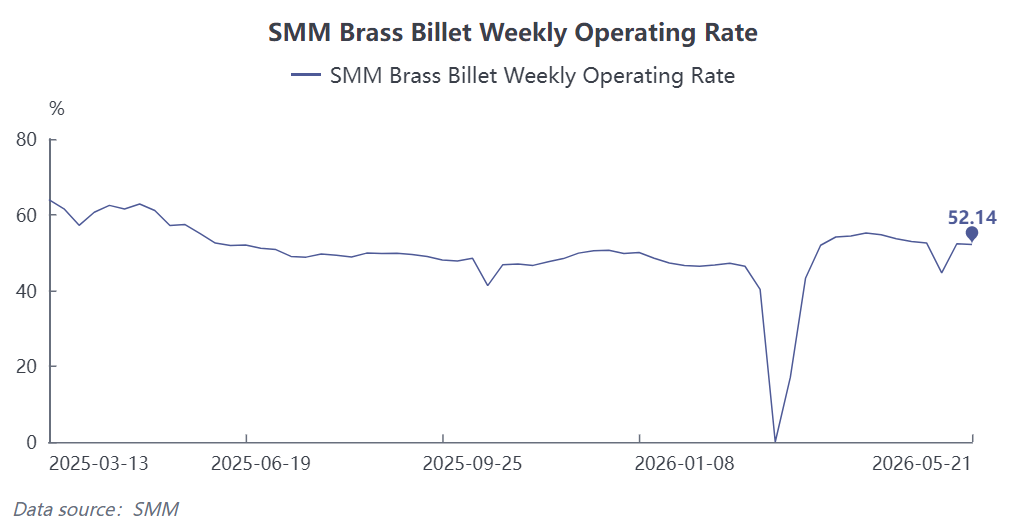
The brass billet industry continued to be in the doldrums under the triple pressures of the traditional off-season, high raw material costs, and weak demand. According to SMM data, the brass billet industry operating rate registered 52.14% this week (5.15-5.21), down 0.2 percentage points WoW, extending the low-level trend since late April.

The brass billet industry continued to be in the doldrums under the triple pressures of the traditional off-season, high raw material costs, and weak demand. According to SMM data, the brass billet industry operating rate registered 52.14% this week (5.15-5.21), down 0.2 percentage points WoW, extending the low-level trend since late April. The "tight supply and high prices" pattern on the raw material side remained unbroken, the off-season effect on the demand side fully fermented, and the industry exhibited weak characteristics of constrained supply, soft demand, and slight inventory accumulation.
Supply side: Recycled raw materials remained tight and expensive, with production constraints intensifying

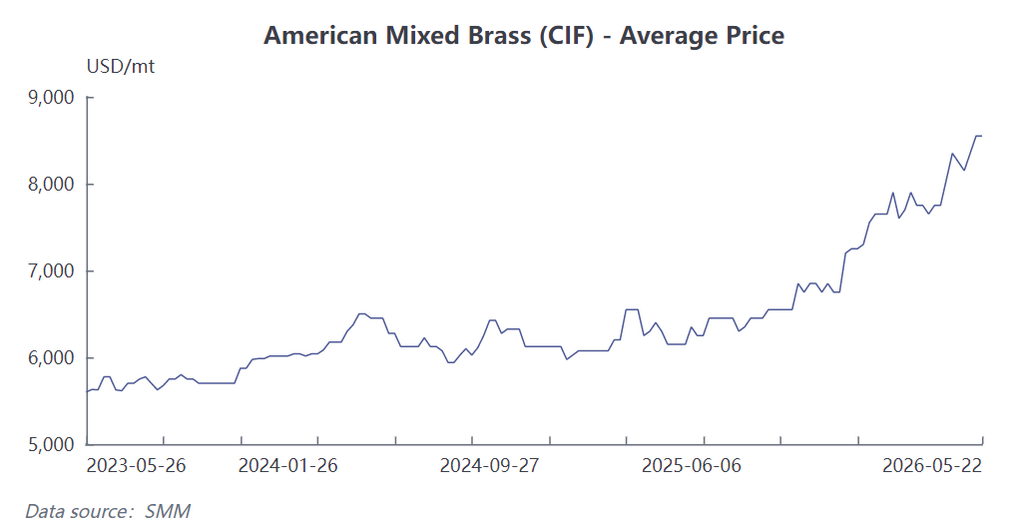
The recycled brass raw materials market continued in an imbalanced state of tight supply and high prices, imposing hard constraints on enterprise production. On one hand, the tight supply of imported secondary brass showed no signs of easing, compounded by limited domestic scrap brass recycling volume, market circulating resources remained tight, and raw material procurement difficulty increased. On the other hand, raw material prices stayed high, continuously squeezing enterprise profit margins. Most enterprises maintained low raw material inventory levels to control costs, while some small and medium-sized enterprises were forced to slow down their production pace due to raw material procurement difficulties, with production cuts becoming more common.
Demand side: Traditional off-season dragged down downstream orders across the board. The industry has entered the traditional consumption off-season, with weak end-use demand showing no improvement whatsoever, becoming the core factor dragging down industry operations. Orders from core downstream sectors such as home appliances, refrigeration, and bathroom hardware followed up weakly. End-users exhibited strong wait-and-see sentiment, with low purchase willingness, mostly making just-in-time procurement, and very few new orders.

By sub-sector, demand in areas such as refrigeration valve components that previously supported industry production schedules also cooled as the off-season arrived. Orders in traditional hardware, plumbing, and other general sectors performed even weaker. After completing prior contracts, enterprises showed extremely low willingness to take orders, with a strong wait-and-see atmosphere in the market. Affected by this, the pace of brass billet enterprises taking orders slowed significantly. Meanwhile, copper billet prices remained high, downstream willingness to pick up goods was insufficient, and product shipments were sluggish, leading to continued accumulation of finished product inventories at relatively high levels, with increasing capital turnover pressure.
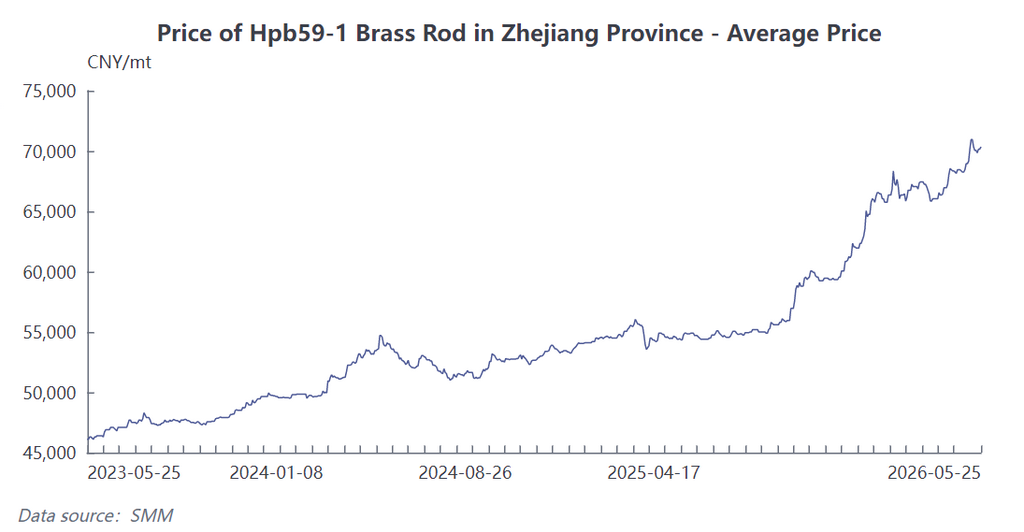
Looking ahead to this week (5.22-5.28), the traditional off-season nature of the brass billet industry is unlikely to reverse, and end-use demand is not expected to recover substantially in the short term. Meanwhile, copper prices are expected to continue fluctuating at highs, cost side disturbances will persist, the tight supply of recycled brass raw materials is unlikely to ease in the short term, and raw material constraints on production will continue to manifest. SMM forecasts that the brass billet industry operating rate will continue to run at low levels this week, edging down 0.06 percentage points WoW to 52.08%. Overall, the industry is expected to remain in the doldrums in the short term amid the interplay of high costs, weak demand, and high inventory, with little relief from enterprise operational pressure. 
Data Source Statement: Except for publicly available information, all other data are processed by SMM based on publicly available information, market communication, and relying on SMM's internal database model. They are for reference only and do not constitute decision-making recommendations.

For any inquiries or for more information, please contact: lemonzhao@smm.cn
For more information on how to access our research reports, please contact:service.en@smm.cn
Related News
Bezant Targets First Concentrate at Namibia’s Hope & Gorob in September
5 hours ago
Bezant Targets First Concentrate at Namibia’s Hope & Gorob in September
Read More
Bezant Targets First Concentrate at Namibia’s Hope & Gorob in September
Bezant Resources said development of the Hope & Gorob copper-gold project in Namibia and the associated Tsoaxaub Metals Processing Plant remains in line with the current project schedule, with first run-of-mine ore expected to be processed during September 2026. Subject to completion of the remaining commissioning activities, processing of the first ROM ore is expected to generate the project’s first concentrate. Ore from the first two mine blasts has already been stockpiled and is ready for transport to the processing plant, while Bezant said the stockpiled tonnage exceeded initial projections due to additional ore recovery recorded in the company’s Mineral Inventory. Development work is progressing at both the mine and processing plant. Mine-site camp construction is approximately 75% complete, around 75% of surface infrastructure has been delivered and is being installed, and the full Unitrans mining and haulage fleets are now on site. At the Tsoaxaub plant, Bezant has received the C1 Civils and Structural Completion Certificate, confirming completion of major structural steelwork and civil works, while the C2 Mechanical Completion Certificate is scheduled for completion during September. Electrical drives and instrumentation are around 90% complete, with the cone crusher, flotation equipment, tailings infrastructure and other processing components undergoing final preparation ahead of commissioning. Bezant has also accelerated its review of a Phase II expansion plan, considering current and projected copper, gold and silver prices as well as the potential inclusion of lower-grade mineralisation that had previously been considered sub-economic. The company is evaluating a higher mass-pull operating strategy for the ore sorter that could increase copper recoveries, although potentially at a lower pre-concentrate grade. Based on the current Mineral Inventory, existing JORC (2012) Mineral Resource, planned flotation-plant capacity and the higher mass-pull scenario under consideration, management believes Hope & Gorob has the potential to support an approximately 35-year mine life. Bezant has not yet published a revised economic model incorporating this longer-life scenario. SMM Analysis: The September processing target places Hope & Gorob close to the transition from mine development into initial concentrate production, with ROM ore already stockpiled and key processing infrastructure approaching mechanical completion. The potential 35-year mine life and Phase II expansion remain under technical and economic review and should not yet be treated as a confirmed revised development plan. In the near term, the key milestone to watch will be completion of plant commissioning and confirmation of first concentrate production during September.
5 hours ago
SMM expects overall copper anode operating rate to edge up MoM in September
5 hours ago
SMM expects overall copper anode operating rate to edge up MoM in September
Read More
SMM expects overall copper anode operating rate to edge up MoM in September
[SMM Copper Anode Flash] SMM expects the overall operating rate of China copper anode enterprises to rebound 1.30 percentage points MoM to 44.11% in September 2026. Among them, primary copper anode enterprises are expected to see their operating rate fall 7.19 percentage points MoM to 57.88% due to maintenance at some enterprises and refining capacity ramp-up; secondary copper anode enterprises are expected to see their operating rate rebound 4.76 percentage points MoM to 38.48%. (Non-captive copper anode only)
5 hours ago
Aug SMM China copper anode operating rate fell to 42.81% MoM
5 hours ago
Aug SMM China copper anode operating rate fell to 42.81% MoM
Read More
Aug SMM China copper anode operating rate fell to 42.81% MoM
[SMM Copper Anode Flash] In August 2026, the operating rate of SMM China copper anode enterprises was 42.81%, down 1.85 percentage points MoM. By raw material, the operating rate of primary copper anode enterprises rose 1.54 percentage points MoM to 65.07%; the operating rate of secondary copper anode enterprises fell 3.23 percentage points MoM to 33.72% due to tight supply of tax-inclusive copper scrap. (Non-captive copper anode only)
5 hours ago
Raw Material Crunch Keeps Brass Billet Operating Rates Persistently Low - Shanghai Metals Market (SMM)