China April Phosphate Ore Imports Hit 207K mt, Up 13.5% MoM; Jordan Resumes, Peru Becomes No.2 Source

Published: May 20, 2026 13:19
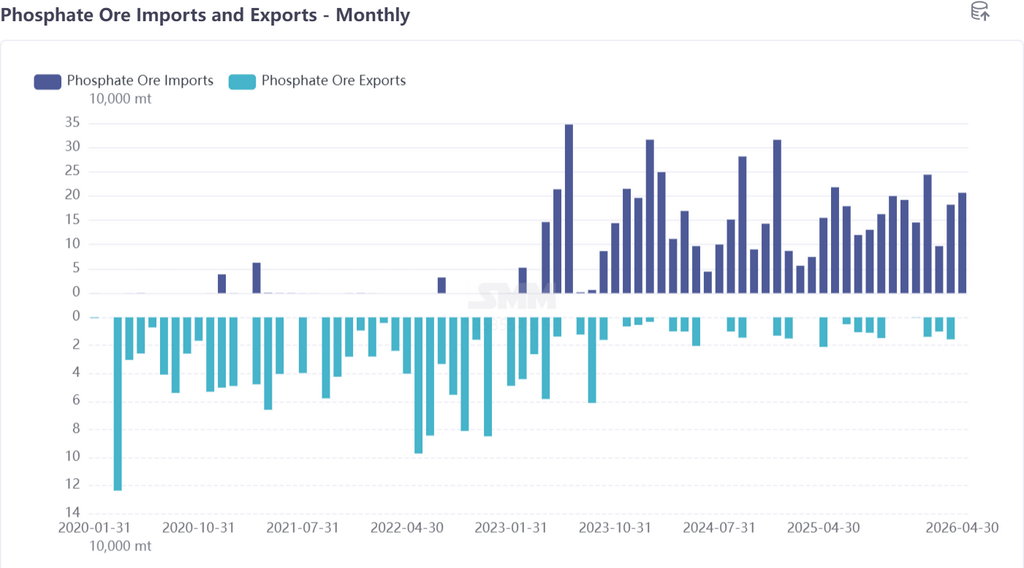
According to customs data released on May 20, 2026, China’s phosphate ore imports stood at 207,000 mt in April 2026, rising 13.5% month-on-month from 182,000 mt in March. April total import value hit US$19.741 million, a MoM increase of 35.7% versus US$14.552 million in March. The average import unit price was US$95.5 per mt, up 19.6% from US$79.9 per mt in March.
SMM May 20,

According to customs data released on May 20, 2026, China’s phosphate ore imports stood at 207,000 mt in April 2026, rising 13.5% month-on-month from 182,000 mt in March. April total import value hit US$19.741 million, a MoM increase of 35.7% versus US$14.552 million in March. The average import unit price was US$95.5 per mt, up 19.6% from US$79.9 per mt in March.

Phosphate ore imports: Jordan resumed exports to China, Hubei's imports surged, and Peru became the second-largest source country.
Note: China's traditional major phosphate ore import sources are Egypt, Peru, and Jordan. The main importing provinces are Guangxi and Zhejiang, and the main importing enterprises are coastal phosphorus chemical companies such as Chuanjinnuo.
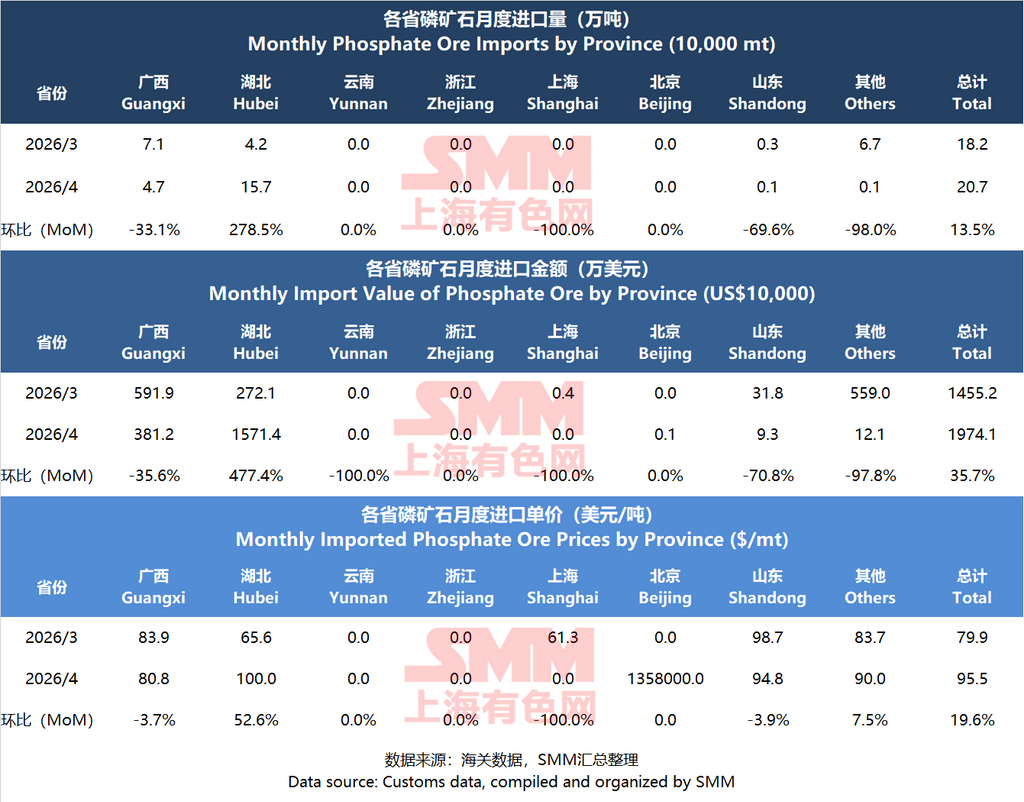
 

In April, China's phosphate ore import landscape underwent significant changes. Jordan, whose exports were disrupted by logistics issues in the Strait of Hormuz, resumed supply with 48,000 mt. Egypt remained the largest source country, yet its April imports of 97,000 mt pulled back sharply month-on-month from 170,000 mt in March. Notably, Peru ranked as the second-largest supplier with 60,000 mt arrivals, versus zero shipments recorded in March. Besides, imports from Pakistan dropped to merely 1,000 mt.

Looking at importing provinces, Hubei took the top spot with 157,000 mt, a surge of 278.5% month-on-month, replacing Guangxi’s traditional leading position. Guangxi’s imports stood at 47,000 mt, down 33.1% month-on-month. Imports by Shandong and other provinces were minimal.
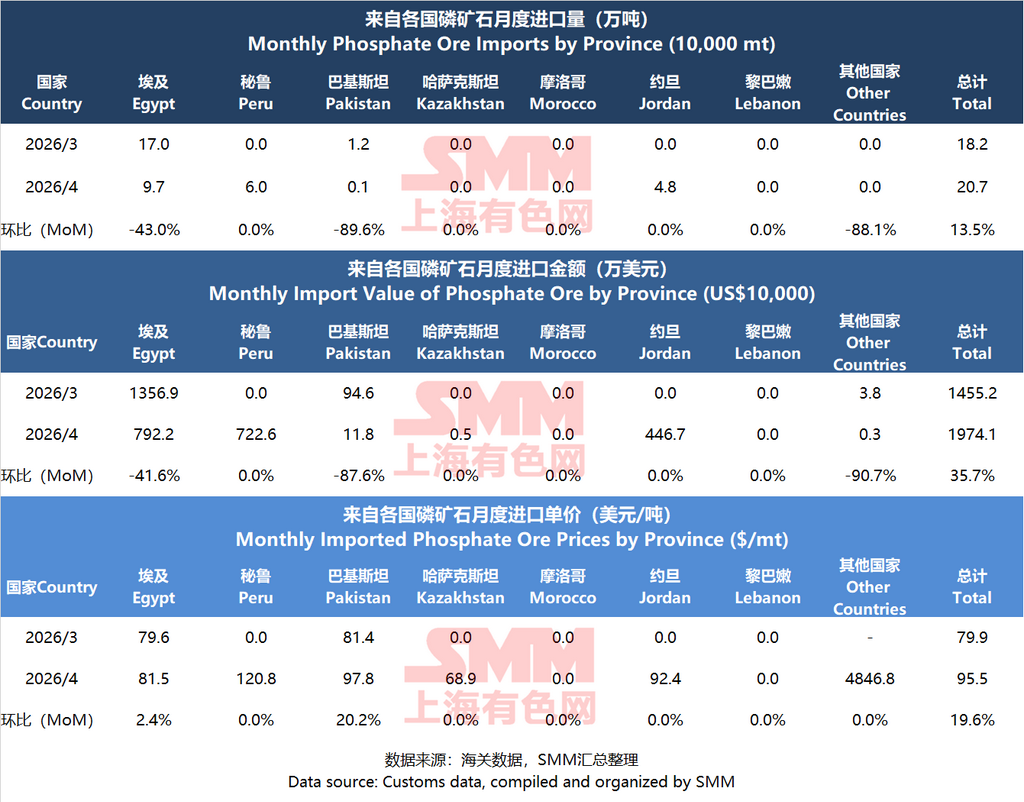
In terms of prices, the average import price rebounded to US$95.5/mt in April. Among major source countries, prices from Peru (US$120.8/mt) and Pakistan (US$97.8/mt) were higher, while Egypt (US$81.5/mt) and Jordan (US$92.4/mt) were relatively lower. The increase in higher-priced sources, together with the return of high-priced Jordanian ore, pushed up the overall import cost in April.
Import comment: In May, Egypt’s phosphate ore exports showed a trend of “tighter policy and weaker demand”. On May 13, Egypt’s Ministry of Petroleum and Mineral Resources announced that it would not sign any new phosphate ore export contracts. Earlier, at a meeting on May 10, Egyptian Prime Minister Mostafa Madbouly made clear that the government is promoting a shift from exporting raw materials to producing high-value-added products such as phosphate fertilizers. Existing long-term contracts are not affected. This is expected to push up import prices in the future and may also affect import volumes.

2.Phosphate Ore Exports: Export volume fell month-on-month, Fujian became the main exporting province.
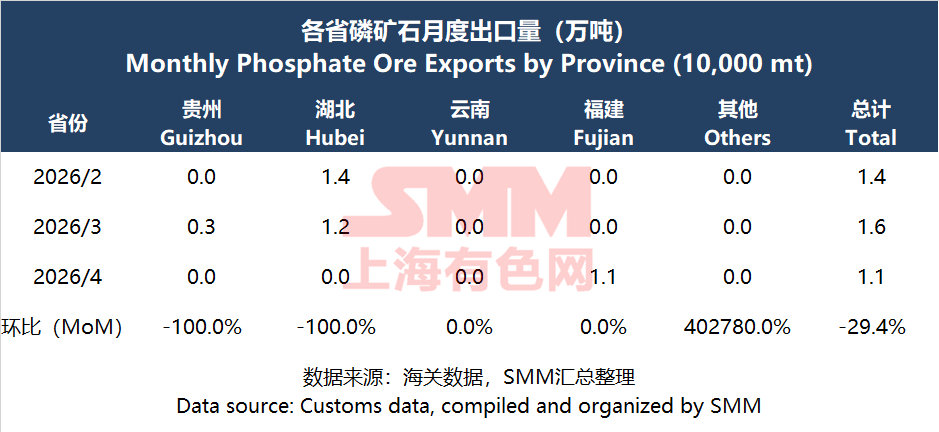
 

In April 2026, China’s phosphate ore exports were 11,000 mt, down 29.4% from 16,000 mt in March. Looking at exporting provinces, all shipments in April came from Fujian (11,000 mt), while Guizhou, Hubei and other provinces that had recorded exports earlier had no volumes in April.

Note: If you have any further details to add regarding the points mentioned in this article, or if you have any questions on the phosphorus chemical industry (phosphate rock, phosphoric acid, iron phosphate, lithium iron phosphate, etc.) and solid-state batteries, please feel free to contact:

Tel: 021-20707860 (or add WeChat: 13585549799) – Yang Chaoxing. Thank you!

Data Source Statement: Except for publicly available information, all other data are processed by SMM based on publicly available information, market communication, and relying on SMM's internal database model. They are for reference only and do not constitute decision-making recommendations.

For any inquiries or for more information, please contact: lemonzhao@smm.cn
For more information on how to access our research reports, please contact:service.en@smm.cn
Related News
International Graphite Signs Graphite Supply and Offtake Agreement with Wogen
11 hours ago
International Graphite Signs Graphite Supply and Offtake Agreement with Wogen
Read More
International Graphite Signs Graphite Supply and Offtake Agreement with Wogen
Australian graphite developer International Graphite has signed a non-binding supply and offtake agreement with UK trading firm Wogen. Under the agreement, Wogen will supply up to 10,000 tpy of graphite flake concentrate to International Graphite's Collie micronised graphite plant in Western Australia, while International Graphite will supply at least 3,000 tpy of micronised spherical graphite to Wogen's Pacific unit for distribution across Asia-Pacific, primarily Japan and South Korea. The companies intend to finalize a binding agreement before the Collie facility begins commercial production in mid-2027.
11 hours ago
Hongyuan Pharmaceutical Commissions 6,000-tpa LiPF₆ Production Line
12 hours ago
Hongyuan Pharmaceutical Commissions 6,000-tpa LiPF₆ Production Line
Read More
Hongyuan Pharmaceutical Commissions 6,000-tpa LiPF₆ Production Line
Hongyuan Pharmaceutical announced that its new 6,000-tpa lithium hexafluorophosphate (LiPF₆) production line commenced operations in June and will gradually ramp up output in the second half of the year. Together with its existing capacity, the company's total LiPF₆ production capacity is expected to reach 18,000–20,000 tpa by the end of 2026.
12 hours ago
South Korea Finalizes Revised EV Charging Fee Plan
13 hours ago
South Korea Finalizes Revised EV Charging Fee Plan
Read More
South Korea Finalizes Revised EV Charging Fee Plan
The Ministry of Climate, Energy and Environment announced on July 1 that it has finalized a revised public EV charging fee system, which will raise rates for ultra-fast chargers and lower rates for slow chargers. The new system will take effect on August 1. Under the revised plan, chargers with output below 30 kW will be charged at KRW 295.0/kWh, while chargers of 30 kW to below 50 kW will be charged at KRW 307.2/kWh. Chargers of 50 kW to below 100 kW will be charged at KRW 325.6/kWh, those of 100 kW to below 200 kW at KRW 348.4/kWh, and those of 200 kW or above at KRW 393.1/kWh.
13 hours ago
China April Phosphate Ore Imports Hit 207K mt, Up 13.5% MoM; Jordan Resumes, Peru Becomes No.2 Source - Shanghai Metals Market (SMM)