SMM News, April 28:
Metals market:
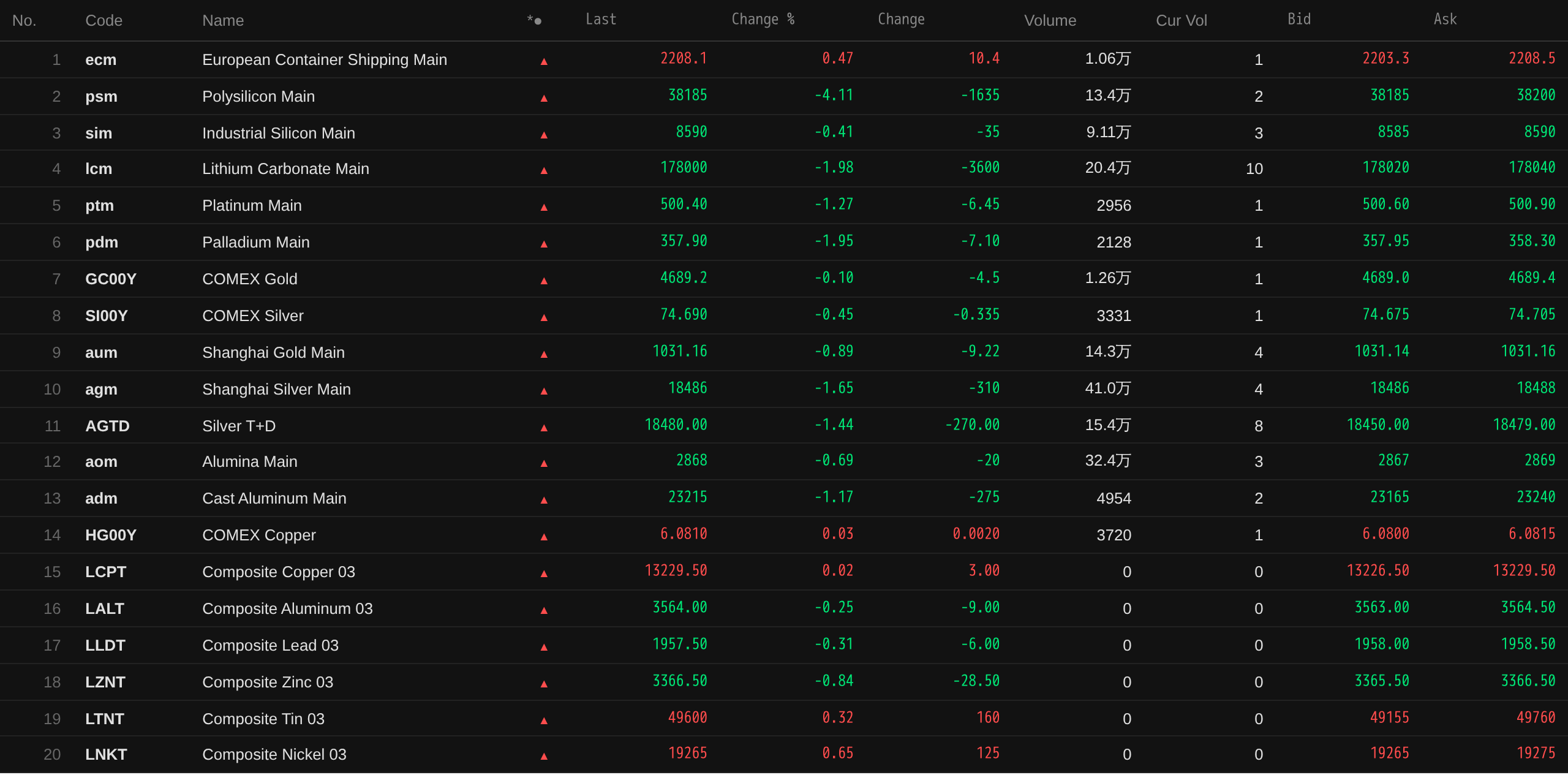
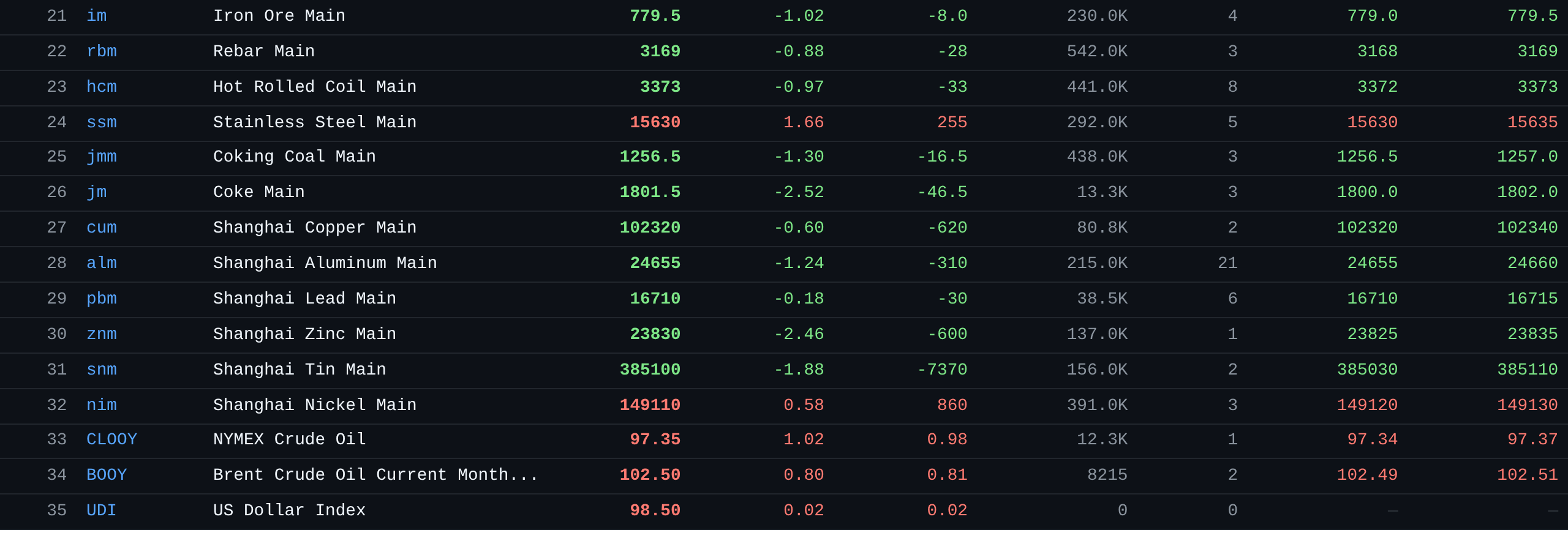
As of the midday close, domestic market base metals fell nearly across the board. SHFE copper fell 0.6%, SHFE aluminum fell 1.24%, SHFE lead fell 0.18%, SHFE zinc fell 2.46%, SHFE tin fell 1.88%, and SHFE nickel rose 0.58%.
In addition, the most-traded casting aluminum futures fell 1.17%, and the most-traded alumina futures fell 0.69%. The most-traded lithium carbonate futures fell 1.98%. The most-traded silicon metal futures fell 0.41%. The most-traded polysilicon futures continued the downtrend from the previous three trading days, falling 4.11%.
Ferrous metals mostly fell. Iron ore fell 1.62%, rebar fell 0.88%, hot-rolled coil fell 0.97%, and stainless steel rose 1.66%. Coking coal and coke: the most-traded coking coal contract fell 1.3%, and the most-traded coke contract fell 2.52%.
Overseas market base metals, as of 11:39, LME metals showed mixed performance. LME copper edged up 0.02%. LME aluminum fell 0.25%, LME lead fell 0.31%, and LME zinc fell 0.84%. LME tin rose 0.32%. LME nickel rose 0.65%.
Precious metals, as of 11:39, COMEX gold fell 0.1% and COMEX silver fell 0.45%. Domestic market precious metals: the most-traded SHFE gold contract fell 0.89%, and the most-traded SHFE silver contract fell 1.65%.
In addition, as of the midday close, the most-traded platinum futures fell 1.27%, and the most-traded palladium futures fell 1.95%.
As of the midday close, the most-traded Europe containerized freight index contract rose 0.47% to 2,208.1 points.
As of 11:39 on April 28, midday futures quotes for selected contracts:
Spot and fundamentals
Copper:Today, Guangdong #1 copper cathode spot prices against the front-month contract: high-quality copper was quoted at a premium of 320 yuan/mt, up 40 yuan/mt from the previous trading day; standard-quality copper was quoted at a premium of 230 yuan/mt, up 30 yuan/mt from the previous trading day; SX-EW copper was quoted at a premium of 170 yuan/mt, up 30 yuan/mt from the previous trading day. The average price of Guangdong #1 copper cathode was 102,320 yuan/mt, down 765 yuan/mt from the previous trading day; the average price of SX-EW copper was 102,215 yuan/mt, down 770 yuan/mt from the previous trading day. Spot market: Today, Guangdong inventory increased again, mainly due to increased arrivals and decreased warehouse withdrawals...
Macro front
China:
[SASAC: Continue to push efforts in key areas such as NEVs and artificial intelligence, driving emerging industries to develop with greater momentum]A signed article by the Party Committee of the State-owned Assets Supervision and Administration Commission of the State Council published in Study and Research stated that during the 15th Five-Year Plan period, efforts must focus on opening up a "second curve" of growth, adopting tailored and coordinated policies for different enterprises, promoting smooth and strong succession of old and new growth drivers, accelerating the development of a batch of emerging pillar industries that lead future competition, and better supporting the construction of a modern industrial system with advanced manufacturing as its backbone. The article proposed coordinating the transformation of traditional industries with the development of emerging industries. On one hand, adhering to the direction of intelligentization, green development, and integration, deepening and expanding the "AI+" initiative, stepping up efforts in technological upgrading and equipment renewal, vigorously promoting energy conservation and carbon reduction in key industries, and further accelerating the transformation of traditional industries. On the other hand, following the approach of "leading a batch, catching up with a batch, and cultivating a batch," based on enterprise resource endowments and industrial foundations, adhering to differentiated layouts, further consolidating advantages in new energy, aerospace and other industries, continuing to push forward in key areas such as NEVs, artificial intelligence, and new materials, and proactively cultivating frontier tracks such as quantum information, nuclear fusion, and low-altitude economy, driving emerging industries to build stronger momentum. (Jin10 Data)
[Guangdong: Increasing Support for Trade-in of Bulk Durable Consumer Goods Such as Automobiles and Home Appliances]The Outline of the 15th Five-Year Plan for National Economic and Social Development of Guangdong Province was officially released. It mentioned the bulk consumption upgrade initiative. Promoting the "fiscal subsidies + enterprise discounts + financial empowerment" model, increasing support for trade-in of bulk durable consumer goods such as automobiles and home appliances, and continuing to implement consumption-boosting policies such as "Guangdong Premium Shopping." Implementing automobile replacement and retirement and renewal policies, encouraging eligible cities to issue subsidies for new car purchases. Expanding after-market consumption such as automobile modification and leasing. Accelerating the construction of recycling systems for automobiles, electronic products, home appliances and furniture. Actively, prudently, and orderly advancing urban village renovation under new models, expanding the supply of affordable housing, and better meeting housing consumption demand.
The PBOC conducted 43.5 billion yuan in 7-day reverse repo operations in the open market, with an operation rate of 1.40%. 5 billion yuan in reverse repo operations matured today.
US dollar:
As of 11:39, the US dollar index rose 0.02% to 98.5. The Congressional Budget Office (CBO) stated that recent US tariff policy adjustments could increase the federal budget deficit by $1.1 trillion over ten years, though the exact figure remained uncertain. CBO Director Swagel stated that the Supreme Court's ruling invalidating Trump's use of emergency economic powers to impose tariffs on his own would increase the fiscal deficit by $2 trillion over ten years, while other trade measures Trump had taken to offset this loss totaled $800 billion to $900 billion (in revenue). Swagel stated: "Because the Supreme Court eliminated some tariffs and the government reimposed some, the fiscal deficit over ten years would be approximately $1.1 trillion higher."The government has significant power to impose new tariffs and adjust them, so it is difficult to determine the exact deficit amount before the entire process is concluded."
Bridgewater Associates founder Ray Dalio said on April 27 local time that with persistent inflationary pressures coupled with an economic slowdown, policymakers must remain cautious. Dalio said on Monday, "We are undoubtedly in a period of stagflation," warning that the US economy had fallen into a stagflationary environment. He noted that if Kevin Warsh, who is about to take over as Fed Chairman, chose to cut interest rates, it would be a policy mistake. According to CME "FedWatch": the probability of the US Fed keeping rates unchanged in April was 100%. The probability of a cumulative 25-basis-point interest rate cut by June was 4.5%, while the probability of keeping rates unchanged was 95.5%. (Jin10 Data)
On the data front:
Data to be released today include the US weekly ADP employment change for the week ending April 11, the US February FHFA House Price Index MoM, the US February S&P/CS 20-City non-seasonally adjusted Home Price Index YoY, the US April Conference Board Consumer Confidence Index, the US April Richmond Fed Manufacturing Index, and the Bank of Japan target rate as of April 28. Also worth watching: Bank of Japan Governor Ueda Kazuo will hold a monetary policy press conference; the Bank of Japan will release its interest rate decision and economic outlook report.
On other currencies:
[BOJ Kept Rates Unchanged as Expected, Three Members Advocated for a Rate Hike]The Bank of Japan kept interest rates unchanged on Tuesday, but three of the nine-member policy board proposed a rate hike, signaling concerns over inflationary pressures triggered by Middle East conflicts. The 6-to-3 vote also marked the largest split since Ueda Kazuo became governor. At the conclusion of its two-day meeting, the BOJ decided to keep the short-term policy rate unchanged at 0.75%, in line with broad market expectations. Board members Takada Hajime, Tamura Naoki, and Nakagawa Junko dissented, advocating for raising the rate to 1.0%. Nakagawa Junko argued that despite ongoing uncertainty over the Middle East situation, price risks were tilted to the upside under accommodative financial conditions given economic developments. Tamura Naoki argued that given price risks were significantly tilted to the upside, the BOJ should set the policy rate as close to the neutral rate as possible. Takada Hajime argued that Japan's price stability target had essentially been achieved, and price risks had clearly tilted to the upside due to second-round effects of price increases triggered by developments outside China. BOJ Governor Ueda Kazuo is expected to brief the media on the decision later. (Jin10 Data APP) Hirofumi Suzuki, chief FX strategist at Sumitomo Mitsui Banking Corporation, said that three votes in favor of a rate hike was somewhat surprising, and that policy board member Nakagawa Junko also switched to supporting a rate hike. In Japan, the impact of the Middle East shock has begun to show in consumer confidence, which is concerning in itself, and this impact is expected to further transmit to the price side. Meanwhile, the yen remains under depreciation pressure in financial markets. Overall, the Bank of Japan will have no choice but to maintain its rate-hike inclination. If easing of Middle East tensions can be confirmed, the bank is expected to raise rates further around June-July. (Jin10 Data)
Crude oil:
As of 11:39, oil prices in both markets rose, with WTI up 1.02% and Brent up 0.8%. The US-Iran deadlock remained unresolved, and market sentiment was generally cautious.
According to the Wall Street Journal, as the US Navy enforced a blockade and negotiations remained deadlocked, Iran was scrambling to find new oil storage methods to avoid devastating production shutdowns. As oil piled up domestically, Iran was reactivating abandoned sites known as "junk storage," using makeshift containers, and attempting to continue exports by rail. These unconventional measures aimed to delay an infrastructure crisis and undermine US leverage in the Strait of Hormuz standoff.
Huatai Securities noted in a research report that, considering hindered transportation through the Strait of Hormuz and limited alternative routes, combined with potentially months-long production resumptions at shut-in Middle East oil fields and a round of strategic restocking of crude oil, refined products, and other energy and chemical products globally after the strait reopens, the medium-term oil price center is expected to stay high, maintaining the 2026 Brent crude oil average price forecast at $90/barrel. (Jin10 Data)
Spot market overview:
►
►
►
►
►
►
►
►
►
►
![[SMM Flash News] ESDM Warns 106 Mining Companies as 90% of 2026 RKAB Quotas Are Approved](https://imgqn.smm.cn/usercenter/tSwaX20251217171735.jpg)
![Near-Port Warehouse B/L Premiums Dropped Sharply, Forward-Month Trade Also Sluggish [SMM Yangshan Spot Copper]](https://imgqn.smm.cn/usercenter/KTLHT20251217171714.jpeg)
![Stronger US Dollar Dragged Down Copper Prices, BC Copper Closed Down 0.72% Intraday [SMM BC Copper Commentary]](https://imgqn.smm.cn/usercenter/HhNHP20251217171708.jpg)