SMM 20 de abril:
Mercado de Metais:
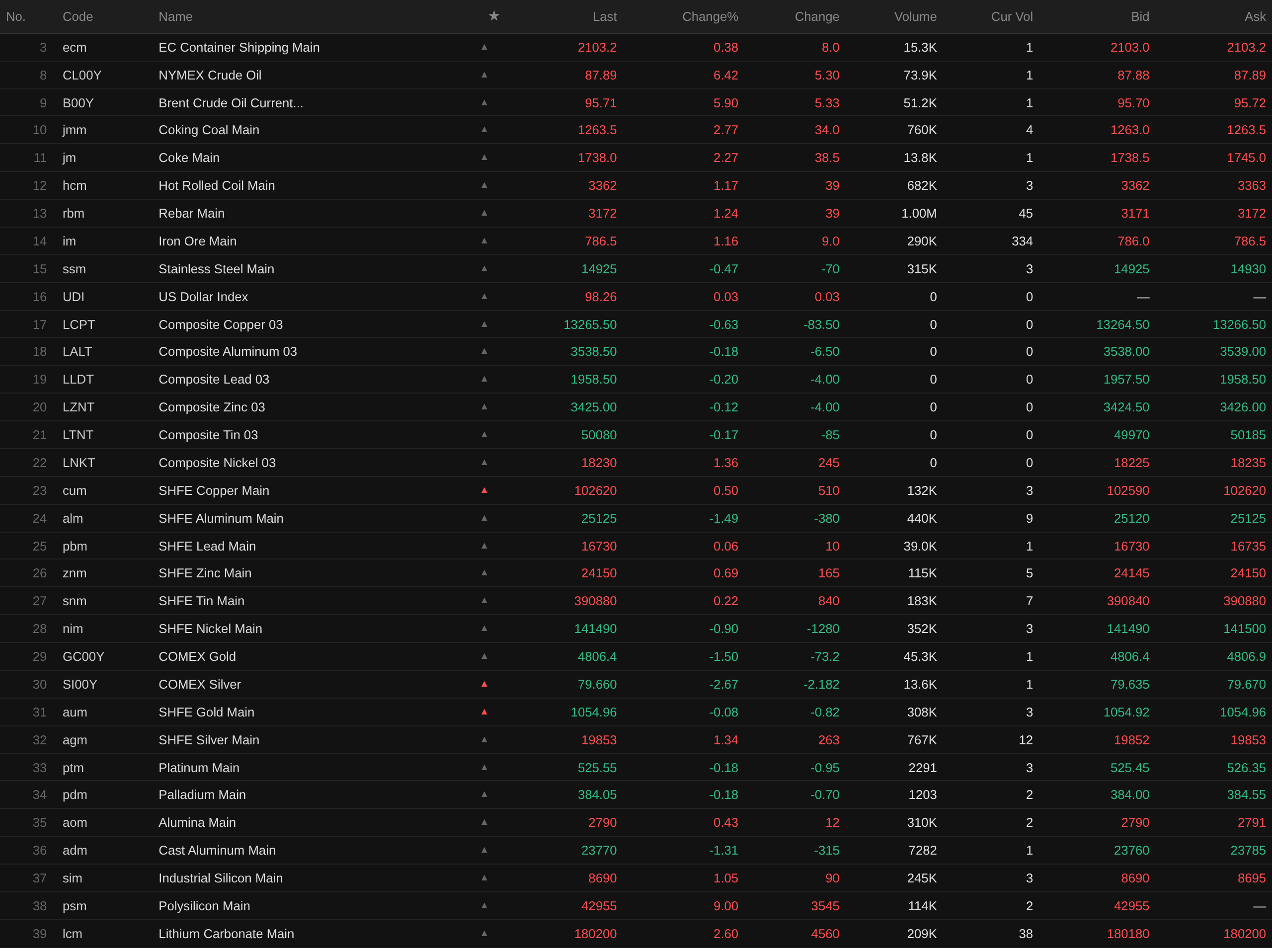
Até o fechamento diurno, os metais base no mercado doméstico subiram em sua maioria, com apenas o alumínio SHFE e o níquel SHFE em queda. O alumínio SHFE caiu 1,49% e o níquel SHFE caiu 0,9%. Os demais metais subiram, com o zinco SHFE em alta de 0,69% e os outros com ganhos inferiores a 0,6%. O contrato do mês anterior de alumina subiu 0,43%, enquanto o contrato do mês anterior de alumínio para fundição caiu 1,31%.
Além disso, o contrato do mês anterior de carbonato de lítio subiu 2,6%, o contrato do mês anterior de silício metálico subiu 1,05%, e o contrato do mês anterior de polissilício atingiu novamente o limite diário durante o pregão, fechando a 42.955 yuan/t com ganho de 9%. O contrato do mês anterior de frete containerizado para a Europa subiu 0,38% para 2.103,2.
Os metais ferrosos subiram em sua totalidade, exceto o aço inoxidável, que caiu 0,47%. Bobina laminada a quente, vergalhão e minério de ferro tiveram ganhos superiores a 1% (bobina laminada a quente 1,17%, vergalhão 1,24%, minério de ferro 1,16%). Carvão de coque e coque: o carvão de coque subiu 2,77% e o coque subiu 2,27%.
No mercado externo, até as 15:07, todos os metais caíram exceto o níquel LME, que liderou os ganhos com alta de 1,36%. Os demais recuaram, com o cobre LME liderando as perdas em 0,63%.
Metais preciosos, até as 15:07, o ouro COMEX caiu 1,5% e a prata COMEX caiu 2,67%. Na China, o ouro SHFE caiu 0,08% e a prata SHFE subiu 1,34%.
Além disso, o contrato do mês anterior de platina caiu 0,18% e o contrato do mês anterior de paládio caiu 0,18%.
Dados de Mercado até as 15:07 de Hoje
Cenário Macroeconômico
China:
[NEA: Consumo Total de Eletricidade Atingiu 2,5141 trilhões de kWh, Alta de 5,2% A/A, Janeiro-Março]A Administração Nacional de Energia divulgou os dados de consumo de eletricidade de março. De janeiro a março, o consumo total de eletricidade atingiu 2,5141 trilhões de kWh, alta de 5,2% A/A. Por setor, o setor primário consumiu 33,6 bilhões de kWh, alta de 7,1% A/A. O setor secundário consumiu 1,5987 trilhão de kWh, alta de 4,7% A/A; deste total, o consumo industrial de eletricidade foi de 1,5836 trilhão de kWh, alta de 4,9% A/A, e a manufatura de alta tecnologia e equipamentos consumiu 274,6 bilhões de kWh, alta de 8,6% A/A. O setor terciário consumiu 483,3 bilhões de kWh, alta de 8,1% A/A; deste total, os serviços de carregamento e troca de baterias de VE e os serviços de dados de internet consumiram 37,6 bilhões e 22,9 bilhões de kWh respectivamente, com taxas de crescimento de 53,8% e 44,0%. O consumo residencial urbano e rural de eletricidade foi de 398,5 bilhões de kWh, alta de 3,4% A/A.
[LPR de Abril Inalterada: Taxas de 5 Anos e 1 Ano Mantidas Estáveis pelo Décimo Primeiro Mês Consecutivo]A LPR de abril foi anunciada: o PBOC manteve a LPR de 1 ano e 5 anos em 3% e 3,5% respectivamente, inalteradas pelo décimo primeiro mês consecutivo.
[Política de "Troca" de Habitação Comercial de Foshan Chegou! Primeiro Lote Envolve 22 Projetos Residenciais]Recentemente, o Aviso sobre a Organização do Primeiro Lote do Programa de "Troca" de Habitação Comercial pelo Departamento Municipal de Habitação e Desenvolvimento Urbano-Rural de Foshan foi oficialmente divulgado. Não se trata apenas de um documento de incentivo; é uma solução que sistematicamente elimina gargalos na substituição habitacional por meio de inovação de modelo e pacote de políticas. O objetivo é impulsionar a transição do mercado imobiliário de "transações unilaterais" para um "ciclo virtuoso entre estoque habitacional existente e novo", alcançando um resultado vantajoso para residentes, empresas e mercado. A inovação da política de troca de Foshan reside em trazer múltiplas empresas imobiliárias para o programa: Foshan Anju, Chancheng Anju, Nanhai Youju, Shunde Chengtie, Gaoming Airport Construction e Sanshui Anju atuam como entidades de aquisição, enquanto Foshan Chengfa, Foshan Urban Renewal, Foshan Lianzhi, Heyue Yaji, Shunkong Chengtou, Yongdeli Commerce, Sanshui Chanfa e Miaohui Real Estate fornecem fontes de habitação nova. Este modelo determina o valor dos imóveis existentes por negociação, estabelece um "período de proteção para rescisão contratual" para evitar pressão cega por preços mais baixos, completando assim o ciclo fechado de "vender o antigo, comprar o novo" e servindo como estabilizador de mercado. (Foshan Release)
Dólar Americano:
Até as 15:07, o índice do dólar americano subiu 0,03% para 98,26. Segundo relatório de pesquisa da CITIC Securities, o Governador do Fed dos EUA Miran e outros três economistas publicaram recentemente um artigo de trabalho intitulado "Guia do Usuário para Reestruturação do Balanço do Federal Reserve", cuja estrutura apresenta semelhanças com o amplamente discutido "Guia do Usuário para Reestruturação do Sistema de Comércio Global". O artigo desafia a visão convencional de que o Fed não pode reduzir significativamente seu balanço, argumentando que a demanda por reservas é amplamente determinada pelo ambiente regulatório e que a redução do balanço pode ser alcançada sem causar estresse inesperado no mercado, ajustando o quadro regulatório, contendo motivos precaucionários e abordando outras fontes de demanda por reservas. Usando simulações de Monte Carlo, o artigo estima o espaço potencial de redução do balanço entre US$ 1,2 trilhão e US$ 2,1 trilhões. Acreditamos que o "guia de redução do balanço" tem certo grau de viabilidade no mundo real, mas algumas opções são um tanto idealistas. (Jin10 Data APP)
Segundo o "Fed Watch" da CME: a probabilidade de o Fed dos EUA aumentar as taxas de juros em 25 pontos base em abril era de 0,5%, enquanto a probabilidade de manter as taxas inalteradas era de 99,5%. A probabilidade de um corte acumulado de 25 pontos base até junho era de 4,5%, a probabilidade de manter as taxas inalteradas era de 95%, e a probabilidade de um aumento acumulado de 25 pontos base era de 0,5%. (Jin10 Data APP)
No cenário macroeconômico:
O PPI mensal da Alemanha de março, o IPC mensal do Canadá de março e outros dados seriam divulgados hoje. Também digno de nota: o Chanceler alemão Merz e a Presidente do Banco Central Europeu Lagarde fizeram discursos; Trump disse que uma delegação dos EUA chegaria a Islamabad na noite do dia 20 para negociações, enquanto o Irã negou relatos de uma segunda rodada de conversas sendo realizada em Islamabad.
Petróleo Bruto:
Até as 15:07, os preços do petróleo em ambos os mercados dispararam, com o WTI em alta de 6,42% e o Brent em alta de 5,9%. O Irã havia novamente fechado o Estreito de Ormuz, impulsionando fortemente os preços do petróleo.
No dia 19, horário local, um funcionário do ministério do petróleo iraquiano disse que o fechamento do Estreito de Ormuz bloquearia a exportação de quase 4 milhões de barris de petróleo bruto iraquiano nos próximos três dias. A Marinha do Corpo de Guardiões da Revolução Islâmica do Irã emitiu um comunicado no dia 18 dizendo que, devido aos EUA violarem compromissos de cessar-fogo e não suspenderem o bloqueio naval aos portos e navios iranianos, o Estreito de Ormuz seria bloqueado a partir daquela noite. (CCTV News)
Gary Pedersen, chefe da trading Gunvor, alertou que o mercado de petróleo enfrentava mais turbulência à medida que as tensões no Oriente Médio colidiam com a desaceleração sazonal na demanda de petróleo bruto, aumentando a probabilidade de flutuações acentuadas e imprevisíveis nos preços do petróleo bruto. (Jin10 Data)
A Agência Internacional de Energia previu que a demanda global de petróleo bruto cairia 1,5 milhão de barris por dia no 2º trimestre, a maior queda desde a pandemia de COVID-19. A previsão da OPEP foi relativamente moderada, projetando uma queda diária de 500 mil barris. (Jin10 Data)
Um relatório de pesquisa do CICC observou que, à medida que a situação do Irã entrava em sua 7ª semana, houve um novo ponto de inflexão. Embora a primeira rodada de conversas de paz tenha "fracassado", tanto os EUA quanto o Irã "anunciaram" a reabertura da navegação pelo Estreito de Ormuz, o que ainda impulsionou amplamente o sentimento otimista no mercado, apesar de reversões subsequentes. Isso estava amplamente alinhado com nossa premissa de cenário base: embora reversões de curto prazo permaneçam possíveis, uma perda total de controle no médio prazo não é o cenário base, pois Trump ainda tem as eleições de meio de mandato a considerar, e uma escalada abrangente e incontrolável não serve aos interesses de nenhum dos lados. Neste cenário, o centro de preço do petróleo bruto Brent recuaria gradualmente para cerca de US$ 80 no 2º e 3º trimestres, e o Fed ainda poderia cortar as taxas de juros. (Jin10 Data APP)
Revisão Diária SMM
►
►
►
►
►
►
►
►
►
►
►
►
![Estoque social de silício metálico nas principais regiões recuou levemente na comparação semanal [estoque de silício SMM]](https://imgqn.smm.cn/usercenter/OGmeJ20251217171722.jpeg)