Ahead of the US session on Friday, oil prices extended their decline after Iran's Foreign Minister Araghchi announced that the Strait of Hormuz was "fully open."
Iran's Foreign Minister Araghchi noted that, under the Lebanon ceasefire agreement, Iran's Ports and Maritime Organization had announced that passage through the Strait of Hormuz would be fully open to all commercial vessels for the remainder of the ceasefire, with transit routes identical to those previously announced.
Following this announcement, US President Trump quickly posted on social media: "The Strait of Hormuz is fully open, ready for business activity and full passage, but the naval blockade on Iran will remain fully in effect until our deal with Iran is 100% done."
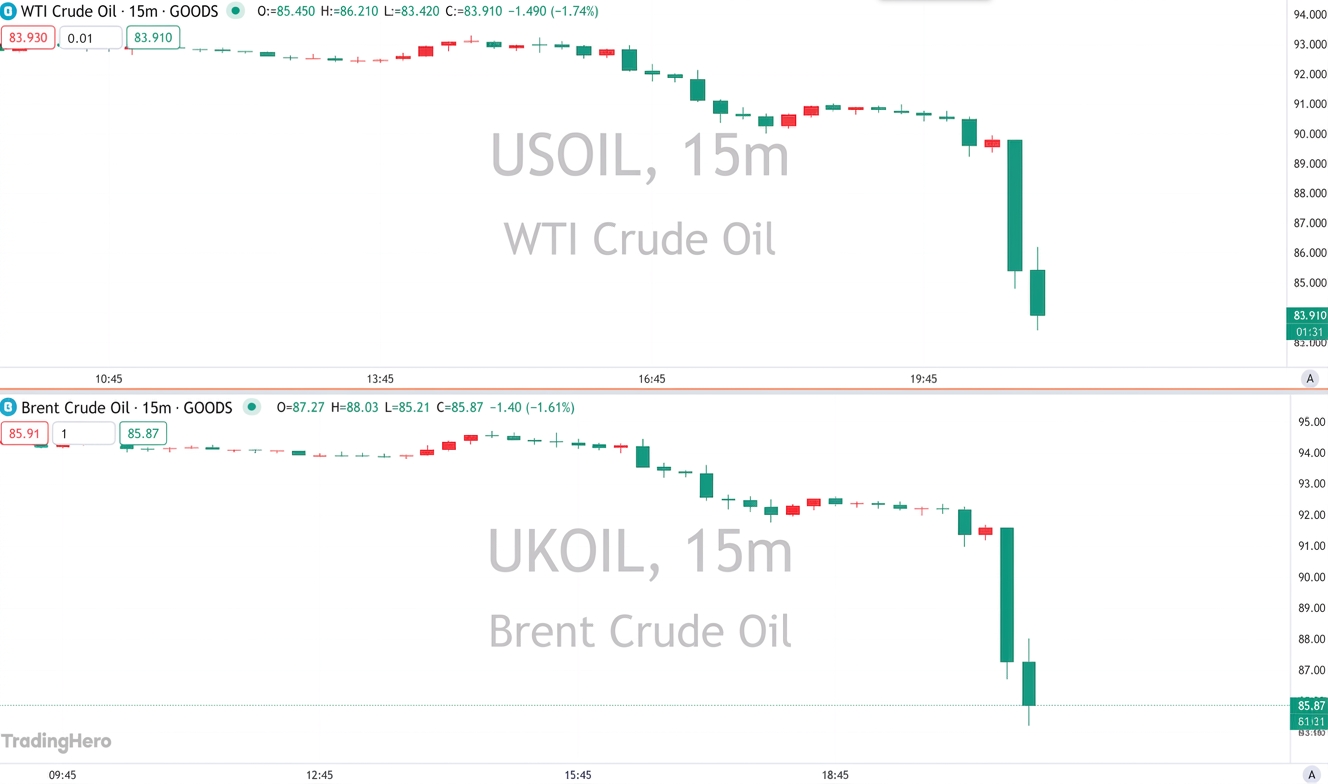
On this news, US crude fell more than 9% on the day to around $84; Brent crude oil broke below the 90 level, dropping more than 8% on the day and erasing all of the week's gains; European benchmark natural gas prices also saw a sharp decline.
Trump had earlier claimed that thereby ending the conflict that had been cutting off energy supplies from the Persian Gulf.
Earlier, US news website Axios reported that and oil prices extended their decline further after it emerged that negotiators from both sides were highly likely to hold a new round of talks this weekend.
The conflict, now approaching its 50th day, had sent crude oil markets through wild swings. The fighting brought an unprecedented supply shock, as Iran cut off the vast majority of shipping through the Strait of Hormuz, directly choking off one-fifth of global oil flows. More recently, the US had also imposed its own naval blockade.
"Trump has been sending clear signals that things are moving in the right direction, and the market is currently quietly pricing in a full reopening of the Strait of Hormuz by the end of April," said Bjarne Schieldrop, chief commodities analyst at SEB AB in Oslo. "The exact date when the strait actually reopens will make a world of difference for oil prices."
According to officials involved, leaders from some Gulf Arab states and Europe indicated that a US-Iran peace deal would take approximately six months to finalise, and the warring parties should extend the ceasefire agreement to cover this period.
Given that infrastructure in the Persian Gulf region was damaged in the fighting, International Energy Agency chief Birol warned that it could take up to two years to restore most of the oil and gas capacity that was forced offline, and that any recovery would be a gradual process.
The conflict began with US and Israeli strikes on Iran at the end of February. During the war, Trump frequently issued contradictory statements and flip-flopped on the timetable for the conflict, threats of further action, and the terms of deals that had been reached, leaving investors bewildered. At times, when markets clearly were not buying it, Trump also showed a tendency to backtrack.
On Thursday, the US president said he did not expect to have to extend the two-week ceasefire in order to reach a deal and predicted the dispute would be resolved "soon," but he also left himself an out, saying he would do so if necessary. He also revealed that if a deal with Iran was successfully hammered out, he might personally head to Pakistan — the country that had previously hosted the first round of talks.
Later, at an event in Nevada, Trump sought to reassure voters concerned about rising living costs driven by soaring energy prices from the conflict. He said the war in Iran was "going very well" and should end soon.
After a bout of exceptionally volatile trading, crude oil price movements have cooled somewhat. Brent crude saw a record $38 swing in mid-March. Currently, the gauge measuring the volatility of the benchmark's next-month contract has fallen to its lowest level since the beginning of last month.
Israel and Lebanon also reached a 10-day ceasefire agreement, a move that could ease tensions in the region. Israel had been locked in fierce fighting with Hezbollah, a key ally of Tehran. Iran had made a ceasefire in Lebanon a precondition for pausing its hostilities with Washington. Trump said he hoped Hezbollah would "behave."
But questions remain over the Strait of Hormuz: Iran plans to levy transit fees on passing vessels even after the war ends. French President Macron and UK Prime Minister Starmer convened a leaders' meeting on Friday specifically to discuss this thorny issue. Priyanka Sachdeva, senior market analyst at Phillip Nova Pte, said:
"The dominant narrative is no longer one of escalation but of stabilization. The crude oil market is sending a clear signal: panic sentiment was the engine driving oil prices higher, and now diplomacy is steering the downward correction. As for the road ahead, lingering uncertainty will continue to trigger market fluctuations."