China’s Brass Bar Imports Fell 9.94% YoY in January-February 2026

Published: Mar 25, 2026 14:14
According to the latest customs data, in January 2026, China’s imports of copper-zinc alloy (brass) bars and rods were 2,050.01 mt in physical content, down 8.37% MoM and up 24.53% YoY. In February, China’s imports of copper-zinc alloy (brass) bars and rods were 1,344.87 mt in physical content, down 34.4% MoM and down 36.67% YoY, showing an overall sharp decline. Cumulative imports in January-February 2026 were 3,394.87, down 9.94% YoY cumulatively. (HS codes 74072111, 74072119, 74072190).
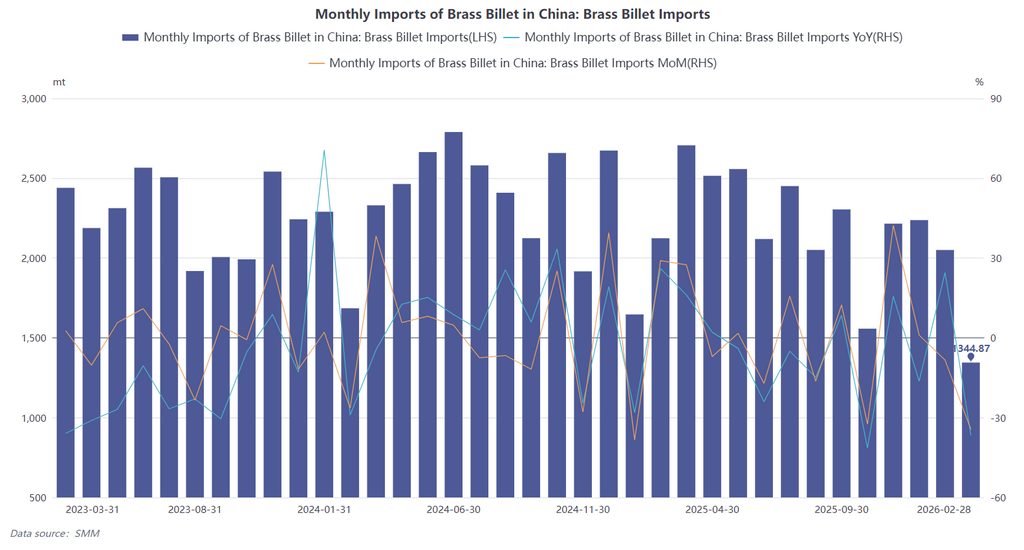
According to the latest customs data, in January 2026, China’s imports of copper-zinc alloy (brass) bars and rods were 2,050.01 mt in physical content, down 8.37% MoM and up 24.53% YoY. In February, China’s imports of copper-zinc alloy (brass) bars and rods were 1,344.87 mt in physical content, down 34.4% MoM and down 36.67% YoY, showing an overall sharp decline. Cumulative imports in January-February 2026 were 3,394.87, down 9.94% YoY cumulatively. (HS codes 74072111, 74072119, 74072190).

The Chinese New Year holiday in 2026 fell in February, significantly shortening effective production time, which was one of the reasons for the sharp drop in imports in February. In addition, persistently high raw material costs clearly suppressed import demand. Judging from operating conditions, the post-holiday resumption pace in the brass billet industry was also noticeably slower than in previous years.

It is worth noting that the continuously escalating geopolitical conflict in the Middle East since 2026 has already caused substantial disruption to the global non-ferrous metals supply chain. The rise in energy prices and increase in transportation costs caused by geopolitical conflict are putting pressure on brass processing enterprises from the cost side.

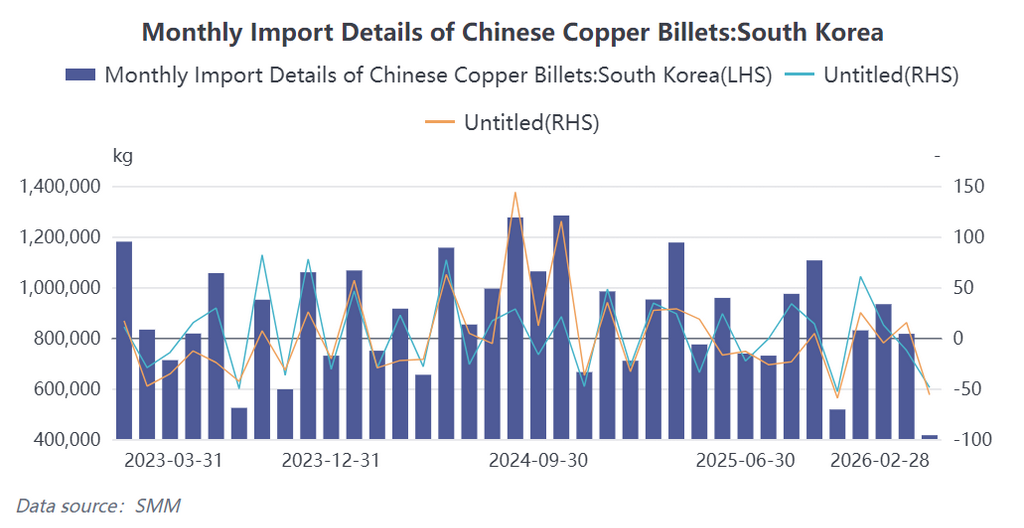
The import source landscape changed, with South Korea still ranking first but posting a significant decline: In terms of import origins, South Korea remained China’s largest source of brass billet imports, leading in the share of cumulative imports in January-February. Imports in January were 815.33 mt, down 12.55% MoM and up 15% YoY. Imports from South Korea in February were 414.98 mt, down 49.1% MoM and down 56.35% YoY, accounting for 30.86%. Japan ranked second, with February imports at 306.87 mt, down 34.23% MoM and down 19.36% YoY, accounting for 22.82%. Notably, Indonesia performed strongly, with February imports reaching 258.54 mt, up both MoM and YoY, with YoY growth of 42.8%, and its share rising to 19.22%, surpassing other traditional sources to become the third-largest source country. This change reflected the diversification of China’s brass billet import sources, with supply capability in Southeast Asia improving.
The decline in import value was smaller than that in imports, reflecting higher unit prices: In terms of import value, January import value was $17.64 million, down 5.43% MoM but up 43.58% YoY. February import value was $12.65 million, down 28.26% MoM and down 19.78% YoY, with the decline significantly smaller than the YoY decline in imports (36.67%), reflecting a YoY increase in the import unit price of brass billet. Cumulative import value in January-February 2026 was $30.29 million, up 7.96% YoY.

Looking ahead, the brass billet market will still face the phased predicament of “high costs, low demand, and weak expectations” in the short term, and the brass billet import market in Q1 2026 is expected to remain at a low level. 

Data Source Statement: Except for publicly available information, all other data are processed by SMM based on publicly available information, market communication, and relying on SMM's internal database model. They are for reference only and do not constitute decision-making recommendations.

For any inquiries or for more information, please contact: lemonzhao@smm.cn
For more information on how to access our research reports, please contact:service.en@smm.cn
Related News
Aurubis Launches €190M CRH Facility in Hamburg for Advanced Metal Recycling
2 hours ago
Aurubis Launches €190M CRH Facility in Hamburg for Advanced Metal Recycling
Read More
Aurubis Launches €190M CRH Facility in Hamburg for Advanced Metal Recycling
Aurubis commissioned the "Complex Recycling Hamburg (CRH)" I at its Hamburg site, a world-first facility with an investment of 190 million euros aimed at strengthening Europe's strategic metal recycling capabilities. The plant can process copper, lead, and sulfur simultaneously in a single production unit.
2 hours ago
KGHM Commits $8.55B to New Strategy, Targets Increased Copper and Silver Production by 2030
2 hours ago
KGHM Commits $8.55B to New Strategy, Targets Increased Copper and Silver Production by 2030
Read More
KGHM Commits $8.55B to New Strategy, Targets Increased Copper and Silver Production by 2030
Poland's copper and silver producer KGHM adopted a new strategy on Friday, committing to invest more than 32 billion zloty ($8.55 billion) by 2030 while setting new production and profit targets.The plan, called "Strategy 2055+", targets payable copper production of 730,000 mt and silver production of 1,290 mt from 2026 to 2030.The company's chief executive officer, Remigiusz Paszkiewicz, said, "After 2035, we hope KGHM becomes a modern, multi-raw-material industrial group."He added that the company plans to build a new mine called "KGHM2.0" in Poland.
2 hours ago
Antofagasta Plans Q4 Environmental Application for Copper Exploration Expansion in Chile
2 hours ago
Antofagasta Plans Q4 Environmental Application for Copper Exploration Expansion in Chile
Read More
Antofagasta Plans Q4 Environmental Application for Copper Exploration Expansion in Chile
An internal company document shows that Chilean copper miner Antofagasta plans to submit an environmental application in Q4 this year to expand exploration activities at its Encierro and Volcanes projects.The move marks an important step forward for two of Antofagasta’s long-term copper growth options. Currently, major global miners are racing to replenish their copper project pipelines, while in Chile, the top copper-producing country, they face challenges including permitting processes, water restrictions, and aging deposits.
2 hours ago
China’s Brass Bar Imports Fell 9.94% YoY in January-February 2026 - Shanghai Metals Market (SMM)