Weak Brass Bar Operating Rates in February Amid Chinese New Year Disruptions; Limited Rebound Expected in March

Published: Mar 5, 2026 15:21
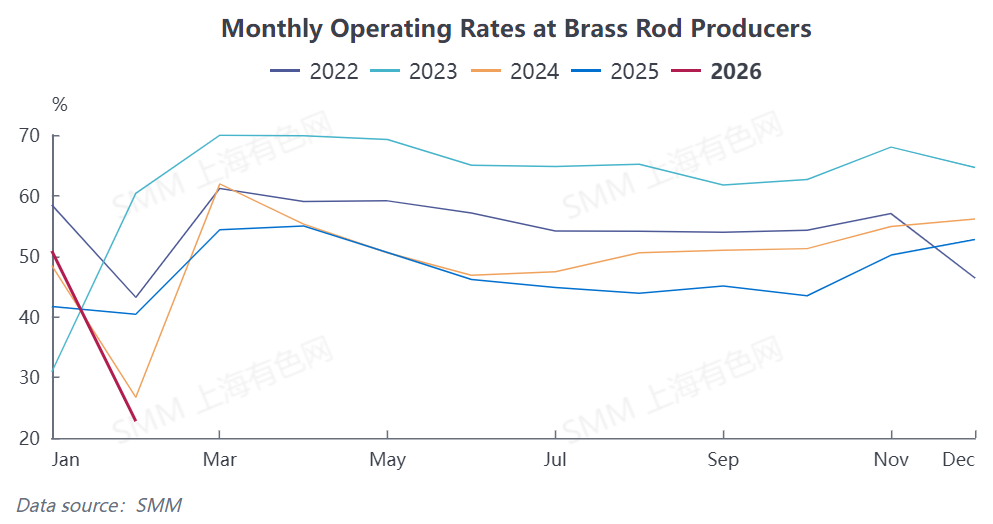
According to SMM data, the composite operating rate of copper bar enterprises in February was 22.78%, down 22.08 percentage points MoM and down 17.64 percentage points YoY.

According to SMM data, the composite operating rate of copper bar enterprises in February was 22.78%, down 22.08 percentage points MoM and down 17.64 percentage points YoY. The operating rate of large enterprises was 24.11%, medium-sized enterprises 23.32%, while small enterprises were only 13.34%. Amid cost pressure and shrinking orders, the room for small enterprises to survive further narrowed.

Demand side, the brass bar market in February showed a clear pattern of “pre-holiday stagnation and a slow recovery after the holiday.” On the one hand, affected by the Chinese New Year holiday, most enterprises entered holiday mode in early February, wrapping up production activities ahead of time. On the other hand, after returning from the holiday, downstream production resumptions in traditional sectors such as valves and sanitary hardware were slow. As of month-end February, many small and medium-sized enterprises were still shut down or running at low utilization, resulting in limited new orders for brass bar enterprises, with deliveries mainly focused on outstanding orders accumulated before the holiday.

Cost and stockpiling, pressure on the raw material side remained pronounced. Enterprises showed low acceptance of high-priced raw materials; coupled with uncertainty over future demand, overall willingness to stockpile was weak, with most maintaining just-in-time procurement. Meanwhile, as end-user cargo pick-up was slower than the production pace, finished product inventories at some enterprises saw a slight buildup. On recycled raw materials, imported secondary brass prices remained elevated, further squeezing profit margins for brass bar enterprises. With weak demand, cost pass-through was not smooth, leaving some small and medium-sized enterprises less willing to resume operations and resulting in a slow rebound in operating rates.

Looking ahead to March, as downstream small and medium-sized enterprises fully resume operations after the Lantern Festival, brass billet operating rates are expected to post a restorative increase. SMM expects the operating rate of copper billet producers in March to rise 22.88 percentage points MoM to 45.66%. However, it should be noted that orders in traditional end-use sectors such as sanitary hardware have not shown a clear improvement, so March operating levels may struggle to surpass those of January. 

Data Source Statement: Except for publicly available information, all other data are processed by SMM based on publicly available information, market communication, and relying on SMM's internal database model. They are for reference only and do not constitute decision-making recommendations.

For any inquiries or for more information, please contact: lemonzhao@smm.cn
For more information on how to access our research reports, please contact:service.en@smm.cn
Related News
Data: SHFE, DCE market movement (Jul 16)
1 hour ago
Data: SHFE, DCE market movement (Jul 16)
Read More
Data: SHFE, DCE market movement (Jul 16)
The following table shows the ferrous and nonferrous metals movement on the SHFE and DCE on 16 Jul , 2026
1 hour ago
Downstream Bearish on Copper Prices, Intraday Purchase Willingness Flat [SMM Secondary Copper Daily Review]
1 hour ago
Downstream Bearish on Copper Prices, Intraday Purchase Willingness Flat [SMM Secondary Copper Daily Review]
Read More
Downstream Bearish on Copper Prices, Intraday Purchase Willingness Flat [SMM Secondary Copper Daily Review]
1 hour ago
[SMM Flash] India Faces Sulfur Export Ban
1 hour ago
[SMM Flash] India Faces Sulfur Export Ban
Read More
[SMM Flash] India Faces Sulfur Export Ban
[SMM Flash] India Faces Sulfur Export Ban
According to feedback from an Indian refinery, the relevant national authorities have issued a directive to prioritise domestic sulfur supply and ban exports, in order to safeguard local availability. Trade data shows that India's sulfur exports are heavily concentrated on the Chinese market. According to WITS data, in 2024 India's exports of crude or unrefined sulphur totalled approximately US$81.02 million, with a volume of about 805.2 million kg (approximately 805,200 tonnes). Among this, exports to China reached US$78.33 million, with a volume of about 797.2 million kg (approximately 797,200 tonnes), accounting for roughly 99% of India's total sulfur exports. Other major destinations included Tanzania, South Africa, Sri Lanka, and Australia, but in very limited quantities. Previously, Indian industry lobbying groups had repeatedly called on the New Delhi government to ban sulfur exports. Of India's annual sulfur demand of about 2 million tonnes, more than half is met by imports, nearly half of which come from the Middle East. The immediate trigger for this export ban is the severe disruption to shipping in the Strait of Hormuz caused by geopolitical conflicts in the Middle East, which has continuously tightened global sulfur supply.
1 hour ago
Register to Continue Reading
Gain access to the latest insights in metals and new energy
Already have an account?Sign in here