The champagne corks in Brussels may have popped too soon.
On January 14, 2026, the European Commission released a soaring press statement celebrating the official entry of the Carbon Border Adjustment Mechanism (CBAM) into its "Definitive Regime." In the official narrative, this was a triumph of digitalization: over 10,000 customs declarations verified in real-time, with the system running as smooth as silk.
However, if we shift the lens from the desks of Brussels to the customs brokers in Hamburg, the steel traders in Rotterdam, and the customs officials currently drowning in paperwork across the continent, a starkly different picture emerges.
What we are witnessing is a carefully whitewashed administrative "cardiac arrest."
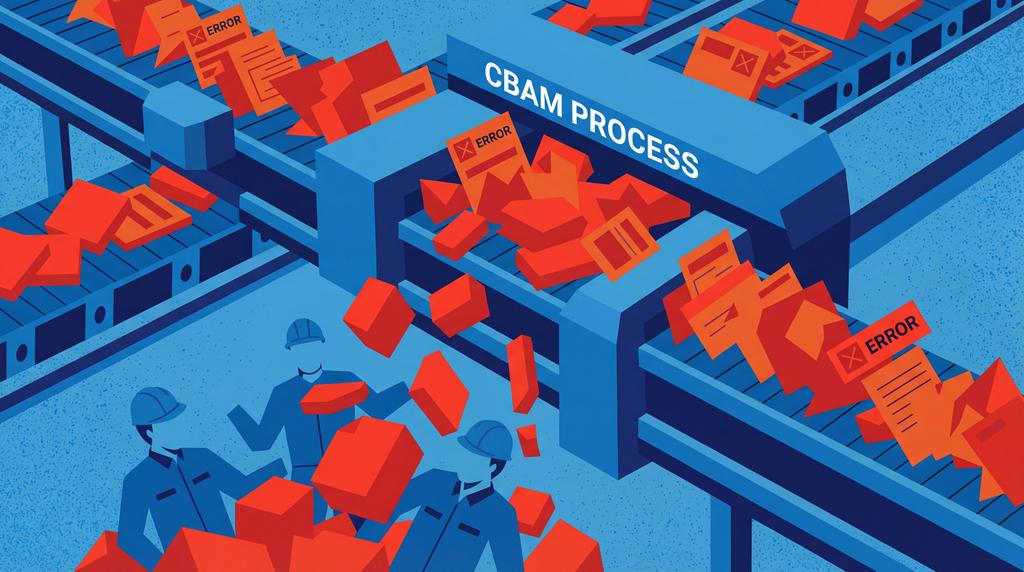
Forensic-level investigation into the first seven weeks of 2026 reveals that the landing of CBAM is far from the glitz claimed by officials. On the contrary, plagued by suspected low-level data errors, catastrophic approval backlogs, and teetering temporary patches, the mechanism is currently mired in a dual crisis of legality and operations.
I. The Absurd "Default Values": When Taiwan’s Stainless Steel "Became" Indonesian Coal
If one were to find a single representative footnote for this chaos, the "Default Value Controversy" would be the undisputed choice.
For importers unable to obtain precise carbon emission data from upstream factories, the EU’s official "default values" are a lifeline. This was supposed to be a baseline derived from rigorous scientific calculation. Yet, in the 2,400-page document released on December 31, 2025, mere hours before the new rules took effect, industry experts witnessed a jaw-dropping scene.
This is not merely a margin of error; it looks more like a metallurgical farce.
Industry bodies have pointed out that when the Directorate-General for Taxation and Customs Union (DG TAXUD) established the carbon emission default values for stainless steel from the Taiwan region, the data tables contained suspected structural errors, bearing traces of a "copy-paste" job from Indonesian data structures.
The consequence? In the physical world, processing a steel slab into a precision tube requires significant electricity, meaning the finished product should logically have higher emissions than the semi-finished one. Yet, in the table published by the EU, industry players have flagged phenomena where "Taiwanese semi-finished stainless steel allegedly emits more than the finished product," vehemently questioning its rationality.
In metallurgy, this is impossible; in a bureaucratic Excel sheet, it became legal reference.
More fatally, Taiwan’s stainless steel industry relies primarily on Electric Arc Furnaces (EAF) and scrap recycling, resulting in a relatively low carbon footprint. In contrast, the Indonesian stainless steel industry is highly dependent on Nickel Pig Iron (NPI) and coal-fired power, yielding extremely high emissions. This suspected "slip of the hand" by the EU is akin to forcefully assigning the calorie count of a rich braised pork belly to a light garden salad. This has directly resulted in European buyers of Taiwanese stainless steel facing artificially inflated financial costs.
II. A 27% Pass Rate: The 15,000-Strong Army Blocked at the Gate
If data controversies are "soft tissue damage," the backlog in administrative approval is a fatal "compound fracture."
The core rule of the CBAM definitive stage is simple: without "authorized declarant" status, you cannot import. This means every company wishing to ship a screw or an aluminum sheet into Europe must first secure an "entry ticket."
The reality is brutal. According to the Commission’s official press release, by January 7, over 12,000 operators across the EU had submitted applications, with just over 4,100 approved (a pass rate of roughly 34%). However, industry estimates suggest that by late February, applications swelled to approximately 15,000, causing the pass rate to slide to around 27%.
Where did the massive remainder go? They are stuck in the overwhelmed approval systems of National Competent Authorities (NCAs). In Germany, due to the deluge of applications, logistics giant DSV issued a public notice stating it could not support clients with CBAM authorization and registration, bluntly forcing thousands of SMEs to crash into the complex reporting system like headless flies. In France, the labyrinthine digital authentication process has turned the application into a maze only a hacker could navigate.
To prevent European ports from paralysis, the EU was forced to administer a "painkiller": Customs Code Y238.
This is a temporary "hall pass" allowing companies that applied before March 31 but have not yet been approved to keep goods moving for now. But make no mistake, this merely lengthens the fuse on the bomb.
III. The Strategy of Silence and the Risk of "Retroactive Reckoning"
Faced with industry skepticism, Brussels seems to have chosen the oldest PR strategy: silence.
Although industry giants like the Gerber Group issued detailed technical warnings as early as January 9, pointing out the absurdity of the Taiwan/Indonesia data, the industry notes that as of late February, no official "Corrigendum" has been issued to legally revise the default values. The updated Excel version released on February 13 merely added a disclaimer: "information only."
This rigid attitude transfers all risk to the enterprises.
For companies currently relying on the Y238 temporary arrangement, the real danger is not "whether goods are released," but "whether they will be retroactively penalized." Competent authorities have publicly warned that if an authorization application is ultimately rejected, member states can, under Article 26 (2)/(2a) of the CBAM Regulation, retroactively penalize goods imported during the waiting period. Such fines can, in certain cases, reach 3 to 5 times the standard penalty. In other words, this is not a procedural flaw; it is a compliance risk that could land directly on cash flows and balance sheets.
Conclusion: Who Pays the Price for Hubris?
CBAM was supposed to be the crown jewel of the EU’s climate ambition, a lighthouse for global green trade. But the opening scene of 2026 makes it look more like an unfinished Tower of Babel.
From the "data ghosts" haunting the industry to the severely backlogged approval channels, this "hard landing" exposes a chasm between regulatory ambition and administrative capability.
For European importers, every day now is an exercise in navigating through fog. They are forced to calculate not just carbon emissions, but the cost of policy uncertainty. And for the European Commission, if it cannot step out of this arrogant "silence" and clarify these glaring operational controversies, what CBAM loses will be more than just data accuracy; it will be the trust of its global trading partners.
![[SMM Nickel Flash News] Indonesia Update — October 9, 2026](https://imgqn.smm.cn/usercenter/KFwsY20251217171734.jpg)

![[NPI Daily Review] China spot NPI trades stall; market divergence on future trends widens](https://imgqn.smm.cn/usercenter/vcoVV20251217171732.jpeg)