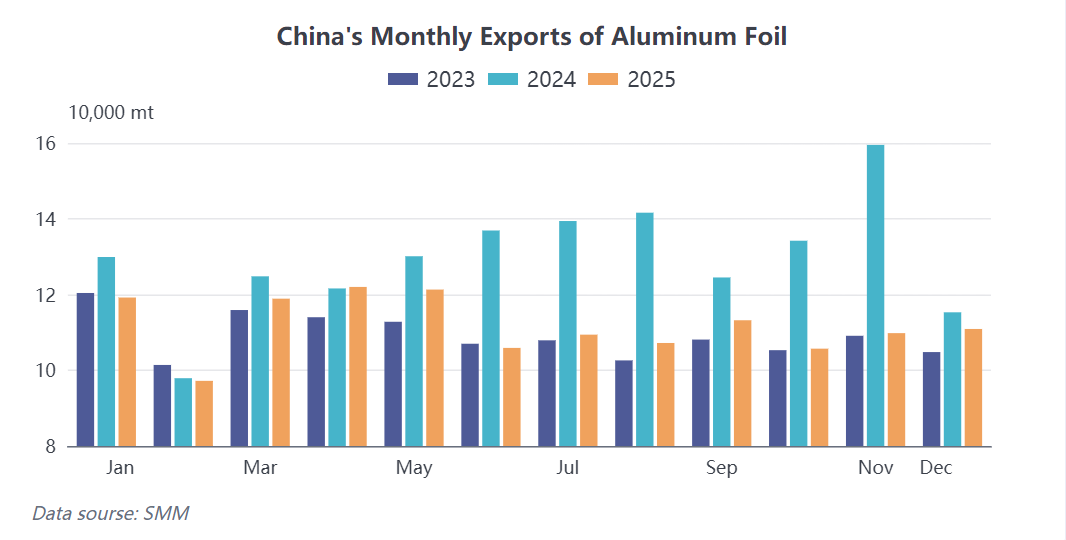
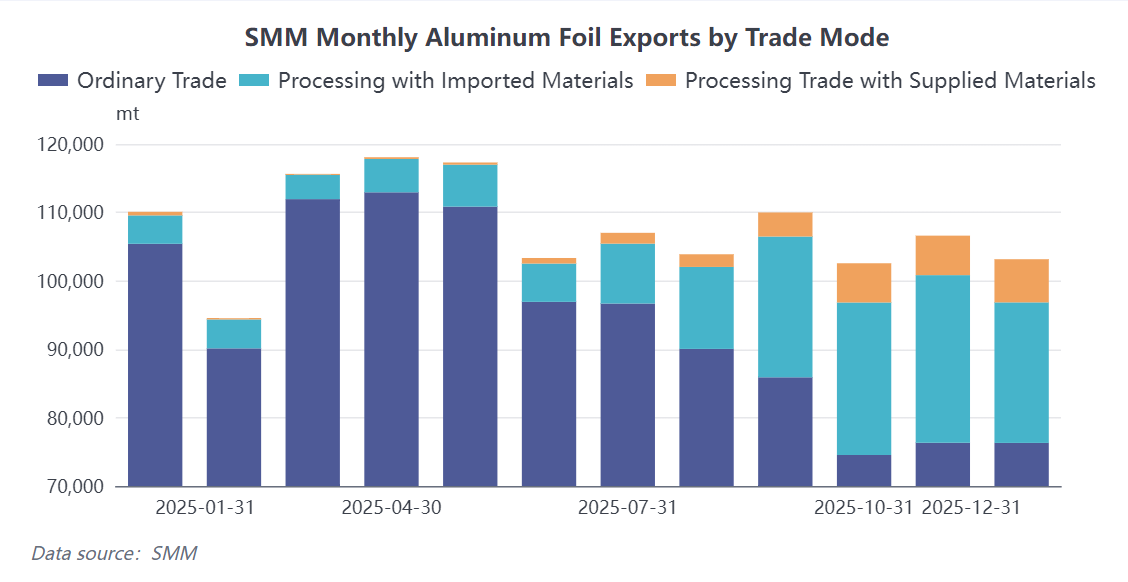
According to customs data, China's aluminum foil exports (customs tariff codes 76071110, 76071120, 76071190, 76071900, 76072000) totaled 110,900 mt in December 2025, up 1% MoM from November but down 4% YoY. Cumulative aluminum foil exports for full-year 2025 reached approximately 1.3407 million mt, down 13.8% YoY.
By trade mode, aluminum foil exports via Processing Trade with Imported Materials amounted to about 20,500 mt in December 2025, accounting for 18.5% of the total, while exports via Processing Trade with Supplied Materials reached 6,300 mt, representing 5.6%. For full-year 2025, aluminum plate/sheet and strip exports via Processing Trade with Supplied Materials and Processing Trade with Imported Materials were 20,500 mt and 137,200 mt, respectively, together accounting for 12.25% of total exports.
International anti-dumping measures against China remain a long-term core constraint on aluminum foil exports. High anti-dumping duties imposed by several major markets have forced export orders to shift to overseas production sites or to markets without restrictions. This "forcing effect" continues to evolve. Meanwhile, the formal implementation of the EU's Carbon Border Adjustment Mechanism (CBAM) has introduced a new "green barrier" for aluminum foil exports. Although aluminum foil production is a downstream segment of aluminum processing, the carbon emission intensity of the entire production process will face strict scrutiny. CBAM not only increases compliance costs and administrative burdens but also fundamentally requires export enterprises to upgrade their carbon management systems comprehensively; otherwise, they will face competitive disadvantages in terms of cost.
On the other hand, global green transition and electrification trends present structural opportunities for aluminum foil: demand for power battery foil used in NEVs and foil for energy storage systems continues to grow; expansion of overseas food preservation and prepared meal industries supports packaging foil demand; industrialization and consumption upgrading in emerging markets such as Southeast Asia and the Middle East create additional space. The market is shifting from broad-based growth to structural differentiation.
In summary, the growth momentum of the aluminum foil industry is gradually shifting to new sectors such as new energy and high-end packaging. Anti-dumping measures and CBAM are reshaping competitive thresholds from the perspectives of trade rules and green standards, respectively. The aluminum foil export market is now in a critical period characterized by overlapping "resilience tests" and "development variables."