Is the U.S. Tariff Delay a Turning Point for Copper Market Structure?

Published: Jan 16, 2026 19:08
In early 2026, U.S. trade policy has once again become a key variable impacting the global copper market. On Wednesday, U.S. President Donald Trump publicly stated that he currently does not intend to impose tariffs on rare earths, lithium, and other critical minerals — including copper, which has been listed as a critical mineral since 2023. This statement quickly triggered a reassessment of U.S. copper import dynamics, leading to a narrowing of the LME-COMEX arbitrage spread.

In early 2026, U.S. trade policy has once again become a key variable impacting the global copper market. On Wednesday, U.S. President Donald Trump publicly stated that he currently does not intend to impose tariffs on rare earths, lithium, and other critical minerals — including copper, which has been listed as a critical mineral since 2023. This statement quickly triggered a reassessment of U.S. copper import dynamics, leading to a narrowing of the LME-COMEX arbitrage spread.

The postponement of copper tariffs, combined with elevated domestic inventory levels in the U.S., is now placing pressure on copper prices. According to market estimates, the U.S. consumes around 1.6 million metric tons (Mt) of refined copper annually, while domestic production stands at roughly 900 kt. Exports remain around 150 kt per year, creating a structural deficit of approximately 850 kt. In 2025, total U.S. copper imports were close to 1.6 Mt — of which 850 kt covered the supply gap, while the remaining 750 kt served as replenishment or speculative inventory. Notably, an estimated 488.4kt is sitting in COMEX-registered warehouses (about 542,900 short tons), with an additional 280 kt believed to be held as unreported stock — a total inventory level approaching 800 kt.
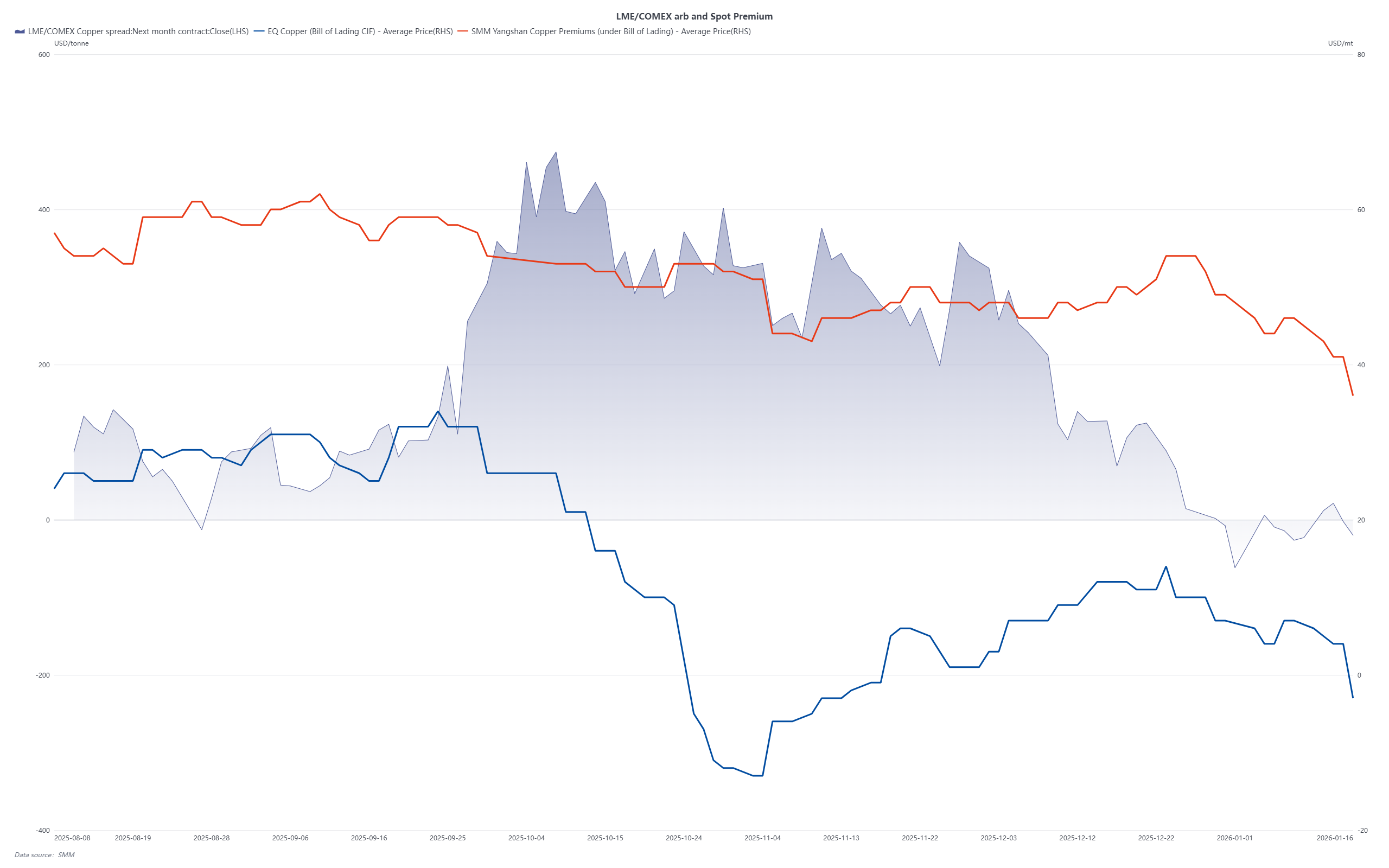
More importantly, a number of long-term contracts signed in 2024–2025 for 2026 delivery — mostly COMEX-registered brands — were priced significantly higher than current spot valuations. With the arbitrage window narrowing, some of these cargoes are now being redirected to Asia. SMM has learned that in recent weeks, COMEX-branded warrants and shipping documents have been sold off at discounted prices in Chinese and Southeast Asian spot markets. Some traders have also expressed interest in re-negotiating semi-annual or quarterly long-term contracts for 2026, signaling a possible shift in trade flows.

As a result, net refined copper imports into China and Southeast Asia may not be as tight in Q1 2026 as previously expected. While competition for African and Indonesian-origin material remains strategically important, the potential return of U.S.-linked copper supply may partially offset the perceived supply risks. The regional copper market could therefore enter a more balanced — or even slightly oversupplied — phase in the early part of the year, marking a subtle shift from the tightness that dominated late 2025.

Data Source Statement: Except for publicly available information, all other data are processed by SMM based on publicly available information, market communication, and relying on SMM‘s internal database model. They are for reference only and do not constitute decision-making recommendations.

For any inquiries or to learn more information, please contact: lemonzhao@smm.cn
For more information on how to access our research reports, please contact:service.en@smm.cn
Related News
"Premier Li Qiang Leads State Council Meeting on Enhancing Effective Investment, Boosting Economic Growth"
19 hours ago
"Premier Li Qiang Leads State Council Meeting on Enhancing Effective Investment, Boosting Economic Growth"
Read More
"Premier Li Qiang Leads State Council Meeting on Enhancing Effective Investment, Boosting Economic Growth"
Premier Li Qiang presided over an executive meeting of the State Council to study policy measures for promoting effective investment. The meeting noted that promoting effective investment plays an important role in stabilizing economic growth and strengthening momentum for development. It is necessary to innovate and improve policy measures, and intensify efforts to enhance the efficiency of utilizing funds such as central budget investments, ultra-long-term special treasury bonds, local government special bonds, and new-type policy-based financial instruments. In conjunction with formulating and implementing the 15th Five-Year Plan
19 hours ago
"Guided by Xi Jinping Thought, Implement 20th CPC Congress Spirit, Apply New Development Philosophy...
19 hours ago
"Guided by Xi Jinping Thought, Implement 20th CPC Congress Spirit, Apply New Development Philosophy...
Read More
"Guided by Xi Jinping Thought, Implement 20th CPC Congress Spirit, Apply New Development Philosophy...
Guided by Xi Jinping Thought on Socialism with Chinese Characteristics for a New Era, we will thoroughly implement the spirit of the 20th National Congress of the Communist Party of China and the plenary sessions of the Party’s 20th Central Committee, fully and faithfully apply the new development philosophy, strengthen top-level design, build computing power interconnection nodes oriented toward national hub periods, major strategic regions, and key industries, establish a system of computing power interconnection nodes, improve the efficiency and service level of public computing power resources, and promote high-quality development of computing power.
19 hours ago
Indirect Iran-US Nuclear Talks in Muscat Show Progress, Omani FM Mediates Tense but Efficient Discussions
19 hours ago
Indirect Iran-US Nuclear Talks in Muscat Show Progress, Omani FM Mediates Tense but Efficient Discussions
Read More
Indirect Iran-US Nuclear Talks in Muscat Show Progress, Omani FM Mediates Tense but Efficient Discussions
After intensive indirect consultations, the new round of nuclear talks between Iran and the US in Muscat, the capital of Oman, has achieved phased progress. It is reported that during this round of talks, the Iranian and US delegations did not meet directly. Instead, Omani Foreign Minister Badr acted as an intermediary, conveying a series of core proposals, strategic concerns, and policy positions to the other side. The atmosphere at the talks was tense yet efficient. According to preliminary on-site assessments, although both sides continue to negotiate over specific terms, they have reached a consensus on the key objective of "continuing dialogue."
19 hours ago