Is the U.S. Tariff Delay a Turning Point for Copper Market Structure?

Published: Jan 16, 2026 19:08
In early 2026, U.S. trade policy has once again become a key variable impacting the global copper market. On Wednesday, U.S. President Donald Trump publicly stated that he currently does not intend to impose tariffs on rare earths, lithium, and other critical minerals — including copper, which has been listed as a critical mineral since 2023. This statement quickly triggered a reassessment of U.S. copper import dynamics, leading to a narrowing of the LME-COMEX arbitrage spread.

In early 2026, U.S. trade policy has once again become a key variable impacting the global copper market. On Wednesday, U.S. President Donald Trump publicly stated that he currently does not intend to impose tariffs on rare earths, lithium, and other critical minerals — including copper, which has been listed as a critical mineral since 2023. This statement quickly triggered a reassessment of U.S. copper import dynamics, leading to a narrowing of the LME-COMEX arbitrage spread.

The postponement of copper tariffs, combined with elevated domestic inventory levels in the U.S., is now placing pressure on copper prices. According to market estimates, the U.S. consumes around 1.6 million metric tons (Mt) of refined copper annually, while domestic production stands at roughly 900 kt. Exports remain around 150 kt per year, creating a structural deficit of approximately 850 kt. In 2025, total U.S. copper imports were close to 1.6 Mt — of which 850 kt covered the supply gap, while the remaining 750 kt served as replenishment or speculative inventory. Notably, an estimated 488.4kt is sitting in COMEX-registered warehouses (about 542,900 short tons), with an additional 280 kt believed to be held as unreported stock — a total inventory level approaching 800 kt.
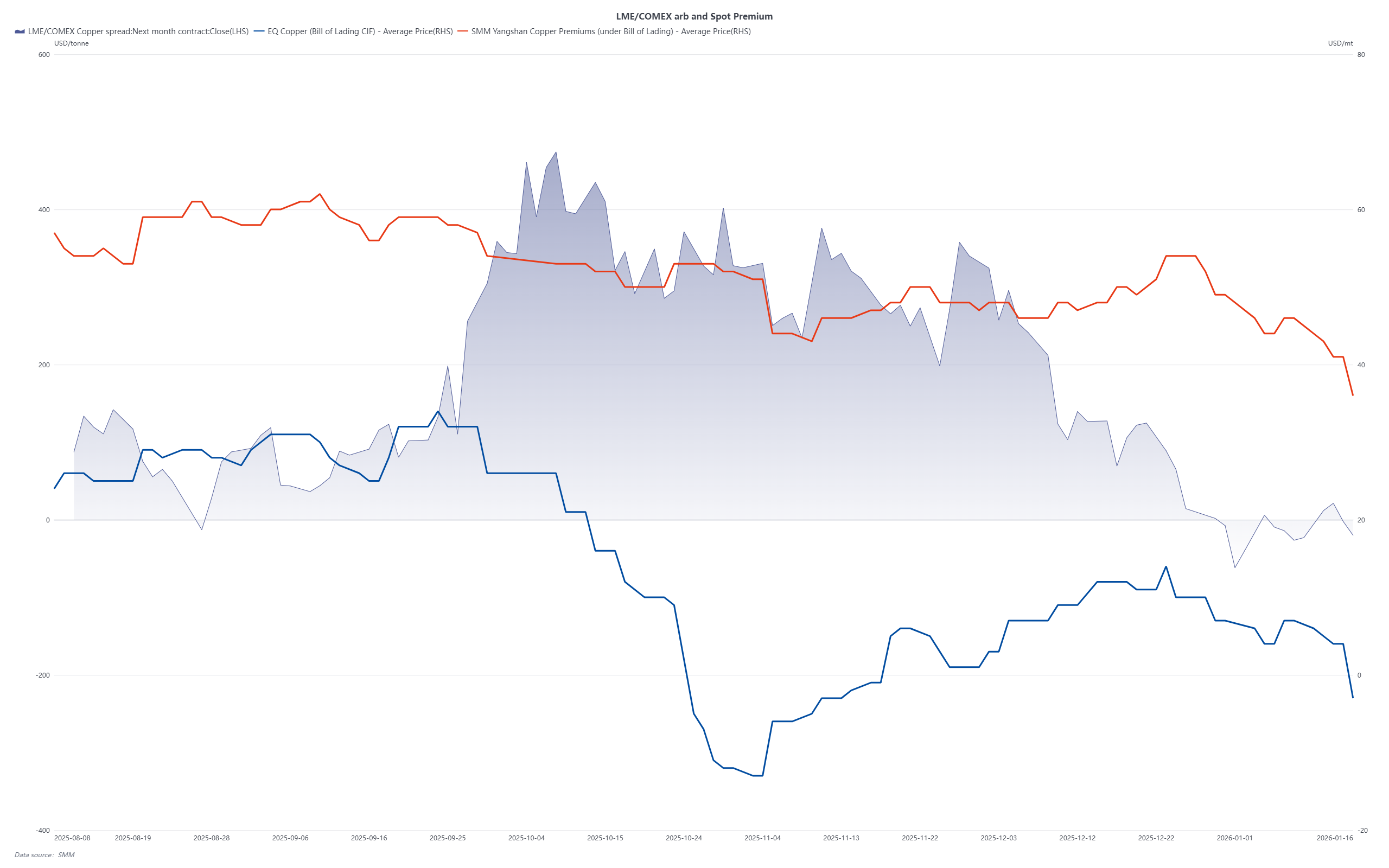
More importantly, a number of long-term contracts signed in 2024–2025 for 2026 delivery — mostly COMEX-registered brands — were priced significantly higher than current spot valuations. With the arbitrage window narrowing, some of these cargoes are now being redirected to Asia. SMM has learned that in recent weeks, COMEX-branded warrants and shipping documents have been sold off at discounted prices in Chinese and Southeast Asian spot markets. Some traders have also expressed interest in re-negotiating semi-annual or quarterly long-term contracts for 2026, signaling a possible shift in trade flows.

As a result, net refined copper imports into China and Southeast Asia may not be as tight in Q1 2026 as previously expected. While competition for African and Indonesian-origin material remains strategically important, the potential return of U.S.-linked copper supply may partially offset the perceived supply risks. The regional copper market could therefore enter a more balanced — or even slightly oversupplied — phase in the early part of the year, marking a subtle shift from the tightness that dominated late 2025.

Data Source Statement: Except for publicly available information, all other data are processed by SMM based on publicly available information, market communication, and relying on SMM‘s internal database model. They are for reference only and do not constitute decision-making recommendations.

For any inquiries or to learn more information, please contact: lemonzhao@smm.cn
For more information on how to access our research reports, please contact:service.en@smm.cn
Related News
Venezuela Passes Mining Bill to Attract Foreign and Private Investment, Easing US Restrictions
Apr 10, 2026 21:56
Venezuela Passes Mining Bill to Attract Foreign and Private Investment, Easing US Restrictions
Read More
Venezuela Passes Mining Bill to Attract Foreign and Private Investment, Easing US Restrictions
Venezuela's ruling party-controlled National Assembly on Thursday approved a mining bill expected to open the sector to private and overseas investment, after the US eased restrictions on the country to stimulate external capital investment in its struggling economy.The bill repealed the 1999 and 2015 mining regulations, allowing domestic, overseas, and state-owned and private companies or consortia to mine gold and "strategic minerals." The maximum term for concessions is 30 years, but can be extended by up to two 10-year periods.Under the bill, mineral resources remain state property, disputes can be resolved through arbitration, and a royalty tax of 13% of the total value of minerals is levie.
Apr 10, 2026 21:56
Copper Transforms from Weak to Top-Performing Metal, Driven by Supply Concerns and Economic Outlook
Apr 10, 2026 21:55
Copper Transforms from Weak to Top-Performing Metal, Driven by Supply Concerns and Economic Outlook
Read More
Copper Transforms from Weak to Top-Performing Metal, Driven by Supply Concerns and Economic Outlook
Nguyen Thu Lan at Commerzbank noted that copper, once among the weakest-performing metals under pressure from rising London Metal Exchange (LME) inventories and mixed supply side news, has now transformed into one of the best-performing metals.Potential inventory sell-offs and the restart of the Panama mine could suppress price gains in the short term, but the sharp decline in Chilean production suggests that once concerns about economic growth ease, supply worries could dominate, supporting copper prices higher over the longer term.Nguyen said: "Copper is one of the best-performing metals. On the one hand, this can be attributed to copper being viewed as a highly cyclical metal.
Apr 10, 2026 21:55
Argentina Passes Mining Bill in Glacier Regions, Sparking Environmental Concerns and Water Security Fears
Apr 10, 2026 21:54
Argentina Passes Mining Bill in Glacier Regions, Sparking Environmental Concerns and Water Security Fears
Read More
Argentina Passes Mining Bill in Glacier Regions, Sparking Environmental Concerns and Water Security Fears
Argentine lawmakers passed a government-backed reform bill aimed at promoting mining investment in glacier regions. Environmentalists and scientists said the move would weaken related protections and threaten water security.The lower house passed the reform bill with 137 votes in favor, 111 against, and 3 abstentions. The bill took effect immediately upon publication in the official gazette.The reform, driven by the libertarian government of Javier Milei, sparked controversy for allowing provinces to set their own protection standards for glaciers and periglacial areas. Critics said the shift could weaken protections for high-altitude glacial landscapes that serve as vital freshwater reserves.
Apr 10, 2026 21:54
Is the U.S. Tariff Delay a Turning Point for Copper Market Structure? - Shanghai Metals Market (SMM)