SMM January 08 Report:
Highlights: During the week (January 02–08, 2026), solid-state battery industrialisation achieved a key breakthrough: Hongqi's all-solid-state battery was installed in a real vehicle and rolled off the production line, while Finnish startup Donut Lab launched a mass-producible product, marking a new phase in technology verification. Meanwhile, significant progress was made in core segments of the industry chain: Yixing Canmax's 5.2kt high-nickel cathode project commenced, Yahua Group and Haichen Pharmaceutical completed pilot tests of lithium sulphide and are preparing to send samples, and Zhengwang New Materials produced its first batch of CVD silicon carbon anode. On the materials front, a trend of "rising prices for traditional materials and falling prices for specialised materials" emerged, with a clear long-term path for cost reduction. Industrial investment is spreading from coastal regions to central China, and the mass production race is in full swing.
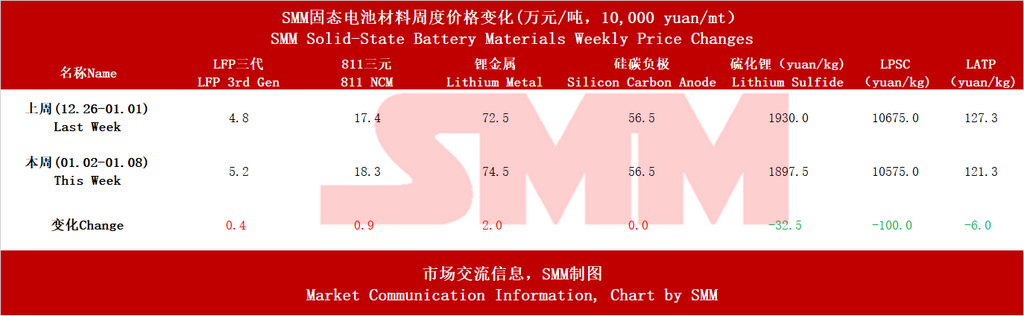
Introduction: Weekly price trends show that prices of traditional lithium battery materials shared with solid-state batteries rose to varying degrees due to rising lithium chemical prices, while prices of solid-state battery-specific materials such as lithium sulphide and electrolytes declined, meeting the long-term need for lower battery cell costs in downstream markets.
I. Materials: Progress in Three Key Materials
1. Cathode Materials: High-nickel ternary and lithium-rich manganese-based systems remain dominant, with LFP used in semi-solid-state batteries.
High-nickel ternary: Yixing Canmax + GEM
Yixing Canmax (controlled by Canmax) officially launched a 1.12 billion yuan project to produce 5.2kt of high-nickel ternary cathode material dedicated to solid-state batteries annually, and has completed a 200t pilot line. This marks the industry's first large-scale high-nickel cathode production line designed specifically for solid-state batteries, addressing the key bottleneck of material supply.
GEM confirmed it has shipped tonne-level quantities of high-nickel precursors and cathode materials for solid-state batteries to global customers (including LG Chem). Additionally, it may deepen efforts in the recycling sector.
Traditional LFP material: Gotion High-tech started construction on a 200,000t LFP cathode project. Semi-solid-state batteries will continue to widely adopt the mature and safe LFP system, forming diverse technology routes.
2. Electrolyte/Anode Materials: Accelerated industrialisation of sulphide electrolytes and silicon carbon anodes.
Sulphide electrolytes reached a key "sample testing" period: Yahua Group and Haichen Pharmaceutical both announced this week that their lithium sulphide products (core raw material for sulphide solid-state electrolytes) completed pilot tests and will soon be sent to third parties for detection and customer sampling. This signifies a substantive breakthrough in the large-scale, high-purity preparation of the most challenging raw material for the sulphide route.
Silicon carbon anode enters mass production via "CVD process": Zhengwang New Materials in production + Gotion High-tech starts construction.
Zhengwang New Materials produced its first batch of CVD silicon carbon anode products. This process effectively mitigates silicon volume expansion and is the mainstream technical direction for silicon carbon anodes. Its capacity layout in Qingdao, Neijiang, and Meishan indicates that large-scale supply of silicon carbon anodes is imminent.
Gotion High-tech started construction on a 10kt-level silicon carbon anode project, complementing its cathode project to form a complete solid-state battery materials layout.
II. Batteries and Vehicles: FAW Hongqi's solid-state battery car + Finnish Donut Lab's solid-state battery motorcycle.
The Hongqi Tiangong 06 was the most significant event this week: Hongqi's self-developed all-solid-state battery pack was successfully installed in a real vehicle and rolled off the production line, marking the entry of a major Chinese automaker into the real-vehicle testing phase for all-solid-state battery technology. This is a key milestone in industrial development, as technology verification advances from lab samples and single battery modules to a new stage of vehicle integration and performance testing.
Finland's Donut Lab launched the first mass-producible all-solid-state battery at CES and announced it will be installed in the Verge TS Pro electric motorcycle for delivery. Its claimed 400Wh/kg energy density, 5-minute fast charging, and ultra-wide temperature range performance, if validated in mass production, could have a huge impact on the industry. Its choice of two-wheelers as the first application scenario is a practical and low-risk commercialisation path.
III. Project Progress: Henan Pingdingshan + Jiangsu Yixing.
The Henan Pingdingshan solid-state battery and sodium-ion battery industrial park project (total investment about 600 million yuan) was publicly tendered, planning to include two solid-state battery production lines. This indicates that the industrial layout for solid-state batteries is expanding from the eastern coast to central regions, with local governments actively seizing new heights in the new energy industry.
Represented by the Canmax (Yixing) industrial park, the integrated park model combining R&D, pilot testing, and mass production is becoming a trend, benefiting industry chain collaboration and rapid iteration.
According to SMM forecasts, all-solid-state battery shipments will reach 13.5 GWh by 2028, while semi-solid-state battery shipments will reach 160 GWh. Global lithium-ion battery demand is projected to reach approximately 2,800 GWh by 2030, with the EV sector's lithium-ion battery demand showing a CAGR of around 11% from 2024 to 2030, ESS lithium-ion battery demand at a CAGR of about 27%, and consumer electronics lithium battery demand at a CAGR of roughly 10%. Global solid-state battery penetration is estimated at about 0.1% in 2025, with all-solid-state battery penetration expected to reach around 4% by 2030, and global solid-state battery penetration potentially approaching 10% by 2035.
**Note:** For further details or inquiries regarding solid-state battery development, please contact:
Phone: 021-20707860 (or WeChat: 13585549799)
Contact: Chaoxing Yang. Thank you!