SMM January 5 News:
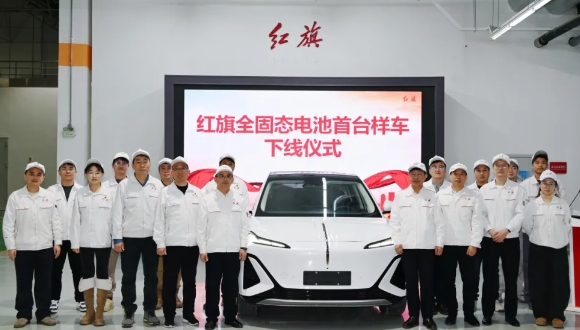
Key Point:On December 31, 2025, HONGQI's all-solid-state battery pack was installed in the Tian Gong 06 model for trial production. HONGQI adopted the sulphide electrolyte route and achieved key breakthroughs in materials, battery cells, and system integration. Globally, enterprises such as CATL, GAC, and Toyota are also accelerating their layouts, with the industrialisation of all-solid-state batteries moving from the laboratory to the engineering window period. However, challenges such as interface stability, mass production costs, and supply chain restructuring still exist. The MIIT special fund is accelerating technological breakthroughs, and the industry is shifting from "laboratory fever" to a rational and systematic race towards industrialisation.


On January 4, 2026, the HONGQI R&D New Vision official account announced the good news of the all-solid-state battery car being off the production line. On December 31, 2025, the first all-solid-state battery pack independently developed by HONGQI R&D Institute was successfully installed in the HONGQI Tian Gong 06 model for trial production. Combined with the R&D progress of domestic and overseas enterprises such as CATL, WELION New Energy, NIO, and Toyota, the global solid-state battery industrialisation competition has moved from a laboratory technology contest to a critical window period of engineering validation and early vehicle installation.
I. Global Solid-State Battery Industry: Progress of Automakers and Battery Enterprises
Apart from HONGQI, the progress of major global participants is gradually unfolding.
CATL: Condensed state batteries have been applied to civilian aircraft cooperation projects, and full solid-state battery R&D is advancing, with commercialisation expected before 2030.
WELION New Energy: Semi-solid-state batteries have been installed in models like the NIO ET7, with an energy density of 360Wh/kg; all-solid-state battery samples have been developed.
SAIC MG: On December 29, 2025, the semi-solid Anxin version of the MG4 was delivered (positive electrode material self-produced by Wu Hai Qing Tao).
GAC Group: On November 22, 2025, CCTV News reported that GAC Group had built its first large-capacity all-solid-state battery production line, currently undergoing small-scale testing. The energy density of the all-solid-state battery is 400Wh/kg, and after use in vehicles with over 500km driving range, it can achieve more than 1000km. GAC plans to conduct small-scale vehicle tests in 2026 and gradually move towards mass production from 2027 to 2030.
Chery Group: On October 18, 2025, at the 2025 Chery Global Innovation Conference, Chery Auto released the Rhino S all-solid-state battery module and announced plans to start the first batch of vehicle validation in 2027.
BYD: Laying out sulphide all-solid-state batteries, with an energy density of 400Wh/kg and a driving range exceeding 1000km. Plans to conduct small-scale vehicle installations in 2027 and achieve "solid-liquid parity" by 2030, promoting it to 40,000 vehicles.
Toyota: Plans to mass-produce all-solid-state batteries in 2027-2028, with a driving range target of 1000km and charging time within 10 minutes.
BMW: In collaboration with Solid Power, plans to launch a solid-state battery prototype vehicle before 2025 and mass-produce by 2030.
Volkswagen: Invested in QuantumScape, and solid-state battery samples have passed durability tests.
II. HONGQI All-Solid-State Battery Technology: Sulphide Electrolyte System
HONGQI adopted the sulphide electrolyte system, one of the mainstream global technical routes (also including oxide, polymer, and halide systems), and achieved three phased breakthroughs after 470 days of concentrated efforts:
1. Material Layer: Synthesis and stability improvement of sulphide electrolytes;
2. Cell Layer: Performance verification of 10Ah cells and process development of 60Ah cells;
3. System Layer: High-voltage module packaging and lightweight integration.
The all-solid-state battery is provided by Zhongqi Xinneng, a battery company under FAW Group.
III. Advantages and Disadvantages of Sulphide Solid-State Batteries: Elimination of Technical and Cost Shortcomings + Realistic Path to Mass Production
Sulphide all-solid-state batteries still face four core challenges: interface impedance control, cycle life, low-temperature performance, and mass production costs. HONGQI, through the "Solid-State Battery Innovation Consortium," integrates R&D resources across the industry chain and may quickly overcome the technical and cost issues from materials to cells, equipment, and vehicles.
Technically, the process needs to be restructured, and existing lithium battery production lines cannot be directly compatible, requiring the reconstruction of the supply chain and production standards. Raw materials, such as key raw material sulphide electrolytes, will become more stable and cost-effective with the iteration and scaling up of products like lithium sulfide and diphosphorus pentasulfide. The positive electrode can leverage current high-nickel ternary and lithium-rich manganese-based products, while the negative electrode can use silicon-carbon and lithium metal.
Cost-wise, there are two main issues: expensive raw materials and stringent processing techniques. Sulphide electrolytes require a strict inert atmosphere, leading to higher equipment investment and Wh costs compared to liquid batteries. The current cost of high-nickel ternary lithium-ion batteries is around 0.6 yuan/Wh, while sulphide solid-state batteries cost over 2 yuan/Wh.
For vehicle installation, the testing cycle takes time, and safety and economic aspects need to be verified. Vehicle-grade validation requires meeting safety, cycling (>1000 times), and all-scenario requirements for high and low temperatures, which typically take at least 2-3 years of comprehensive testing.
IV. Commercial Value Analysis: Rational Expectations for Technological Iteration
The MIIT has launched a 6 billion yuan special fund for all-solid-state batteries, setting clear goals to complete system-level validation by 2026 and achieve commercial deployment by 2027. As one of the participating enterprises in the special fund, HONGQI's real vehicle off the production line provides significant support for achieving policy goals. After a wave of enthusiasm in the domestic solid-state battery sector, the related concept stocks cooled down due to lower-than-expected test results from six top-tier enterprises by the end of 2025, which previously saw a surge of over 50% in the past year. HONGQI's technological breakthrough is expected to further stimulate investment enthusiasm in the industry chain, but the development of the solid-state battery industry requires time for accumulation and refinement, especially in terms of rigorous testing and validation. A rational approach to the solid-state battery vehicle installation event should shift from a laboratory investment mindset to focusing on the construction of large-scale production lines.
According to SMM forecasts, all-solid-state battery shipments will reach 13.5 GWh by 2028, while semi-solid-state battery shipments will reach 160 GWh. Global lithium-ion battery demand is projected to reach approximately 2,800 GWh by 2030, with the EV sector's lithium-ion battery demand showing a CAGR of around 11% from 2024 to 2030, ESS lithium-ion battery demand at a CAGR of about 27%, and consumer electronics lithium battery demand at a CAGR of roughly 10%. Global solid-state battery penetration is estimated at about 0.1% in 2025, with all-solid-state battery penetration expected to reach around 4% by 2030, and global solid-state battery penetration potentially approaching 10% by 2035.
**Note:** For further details or inquiries regarding solid-state battery development, please contact:
Phone: 021-20707860 (or WeChat: 13585549799)
Contact: Chaoxing Yang. Thank you!
![Solid-State Battery Next Decade Series, Part 7 of 9: Global Competitive Landscape—The "Patent Shadow War" and Industrialisation Race Among China, Japan and South Korea [SMM Analysis]](https://imgqn.smm.cn/usercenter/MyEcZ20251217171727.jpg)
![Solid-State Battery Next Decade Series, Part 6 of 9: Ternary Route May Become Great Again [SMM Analysis]](https://imgqn.smm.cn/usercenter/JSjkr20251217171728.jpg)