India aims for 68% renewable and nuclear power capacity by 2032 - what should aluminium smelters do about energy mix?

Published: Dec 3, 2025 10:42
India is exactly in the middle of energy transition, with its non-fossil fuel capacity exceeding 50 per cent of the national power mix.

India is exactly in the middle of energy transition, with its non-fossil fuel capacity exceeding 50 per cent of the national power mix. By 2032, the aim is to achieve 68 per cent of renewable and nuclear power capacity of the total energy mix. With this, the wake-up call for energy-intensive industries becomes explicit that the adoption of renewable energy is no longer optional. Particularly for the aluminium industry, which is one of the most electricity-hungry industrial sectors, the implications are sharp, but the path is far from straightforward.

India’s reliance on coal and why so

Not judging, but Indian aluminium industry is still heavily reliant on coal-fired electricity for its operations. Reasons are many, such as the need for round –the-clock power supply. An aluminium smelter typically needs 14-15 megawatt-hours of power per tonne of aluminium throughout the day, leaving no room for interruptions. Renewable sources, such as solar and wind, although cheaper per unit (INR 4–4.3 per kWh) than coal (INR 6 per kWh), are inherently intermittent. As Tata Power CEO Praveer Sinha pointed out, India’s climate variability is one of the main reasons for its reliance on coal or fossil-fueled electricity. Moreover, India has abundant and easy availability of coal, and thus smelters for decades have coal-integrated power infrastructure. These facilities cannot be retrofitted or replaced overnight. So, what should aluminium industry do now when the nation is eyeing to replace coal-fired power plants with renewable energy capacity?

India’s rapid shift to renewables and mandatory policy push

According to Mr Sinha, India’s target is to let go of coal-fired plants which are more than 40 years old, inefficient, and polluting after the scheduled renewable energy projects come online in next five years. Already India’s non-fossil fuel energy, including renewable and nuclear energy, accounts for more than half of the country’s total installed capacity of 501 GW, as of September 2025. According to the Ministry of Power, India’s non-fossil fuel capacity is 256.09 GW, in contrast to fossil fuel capacity of 244.80 GW, which is 49 per cent of the total.

By 2032, the aim is to take the carbon-free capacity to 615.955 GW, with nuclear contributing 19.680 GW, large hydro 62.178 GW, solar 364.566 GW, wind 121.895 GW, small hydro 54.50 GW, biomass 15.500 GW, and pump storage power of 26.686 GW. In contrast, only 90 gigawatts of additional coal-fired electricity capacity is planned to be added to the existing 244 GW of fossil fuel capacity, while one-fourth of the 290 fossil-fueled electricity plants that are more than 25 years old will be replaced with renewable. In simple terms, India aims to have 900.422 GW of installed power capacity by 2032, of which only 284.467 GW of capacity will be fossil-fueled.
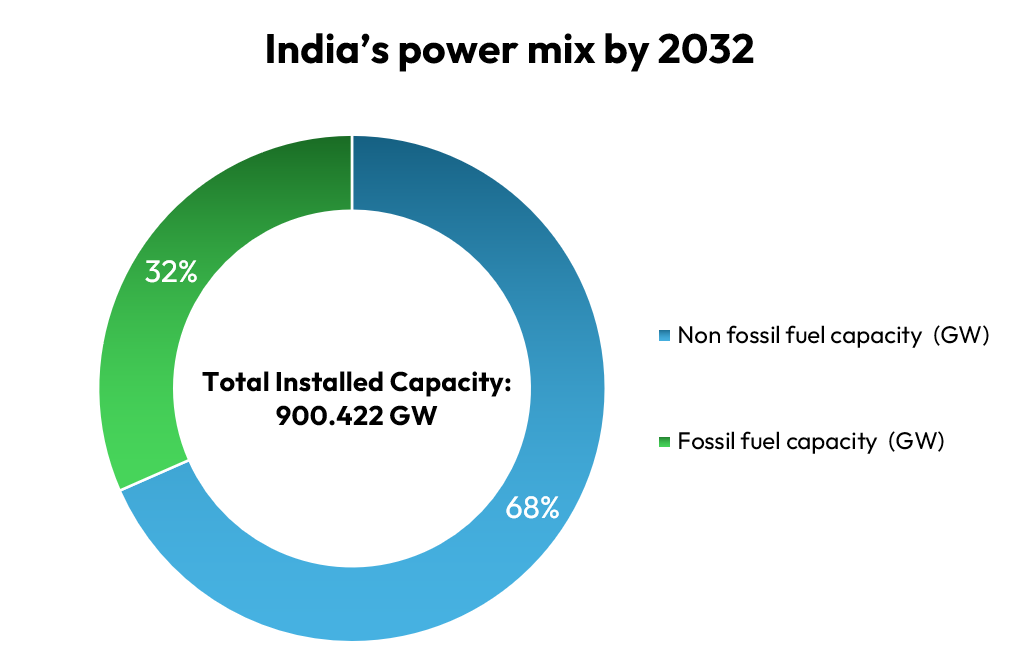
India's power mix by 2032

For full access, please log onto AlCircle

Source: https://www.alcircle.com/news/india-aims-for-68-renewable-and-nuclear-power-capacity-by-2032-what-should-aluminium-smelters-do-about-energy-mix-116386
Data Source Statement: Except for publicly available information, all other data are processed by SMM based on publicly available information, market communication, and relying on SMM‘s internal database model. They are for reference only and do not constitute decision-making recommendations.

For any inquiries or to learn more information, please contact: lemonzhao@smm.cn
For more information on how to access our research reports, please contact:service.en@smm.cn
Related News
Fed Governor Milan Pushes for Over 100 Basis Points Cut, Contradicts Barkin on Caution
19 hours ago
Fed Governor Milan Pushes for Over 100 Basis Points Cut, Contradicts Barkin on Caution
Read More
Fed Governor Milan Pushes for Over 100 Basis Points Cut, Contradicts Barkin on Caution
Federal Reserve Governor Milan pointed out that it is necessary for the US Fed to cut interest rates by more than 100 basis points this year. At the same time, he is very much looking forward to the performance of Kevin Warsh as Fed Chairman. However, Richmond Fed President Barkin emphasized that monetary policy must remain cautious until inflation fully pulls back to the target level, thereby ensuring the stability of the labour market.
19 hours ago
Democratic Senators Demand Delay in Fed Nomination Amid Criminal Investigation
19 hours ago
Democratic Senators Demand Delay in Fed Nomination Amid Criminal Investigation
Read More
Democratic Senators Demand Delay in Fed Nomination Amid Criminal Investigation
All 11 Democratic members of the US Senate Banking Committee jointly sent a letter to the committee's chairman, Tim Scott, requesting that all nomination processes for the prospective Fed Chairman, Kevin Warsh, be postponed until the criminal investigation into current Fed Chairman Powell and other board members is concluded. However, Scott stated that Warsh's confirmation was a done deal.
19 hours ago
Fed to Keep Large Banks' Capital Levels Unchanged, Postpones Stress Test Reforms Until 2027
19 hours ago
Fed to Keep Large Banks' Capital Levels Unchanged, Postpones Stress Test Reforms Until 2027
Read More
Fed to Keep Large Banks' Capital Levels Unchanged, Postpones Stress Test Reforms Until 2027
The US Fed has announced that it will maintain the capital levels of large banks unchanged during the upcoming stress test cycle (corresponding to the 2026 cycle). At the same time, the US Fed is planning multidimensional reforms to this annual test, aiming to enhance its transparency. The US Fed's Vice Chair for Supervision, Bowman, revealed that adjustments to the stress capital buffer requirements for large banks will be postponed until 2027. This move is intended to provide the US Fed with sufficient time to evaluate potential flaws that may be exposed in its testing models when assessing banks' financial conditions under simulated economic downturn scenarios.
19 hours ago