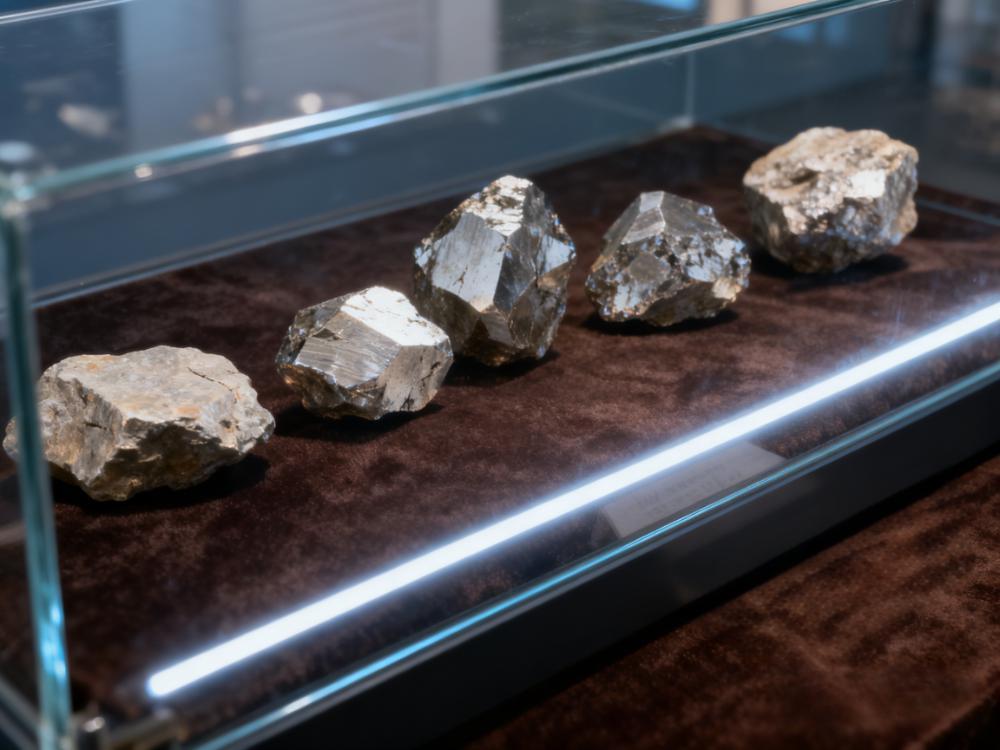
PrNd Price Surge and Terminal Wait-and-See Expected to Lower NdFeB Output in December【SMM Analysis】

Published: Dec 2, 2025 09:13
Source: SMM
Recent sharp price increases in Pr-Nd have significantly impacted the NdFeB permanent magnet industry chain. On the first day of December, spot Pr-Nd oxide quotes surged by 30,000 yuan/mt to 596,500 yuan/mt in a single day, while Pr-Nd alloy prices rose by 36,500 yuan/mt to 730,000 yuan/mt. This price surge is primarily driven by tightening supply expectations: rare earth supply is becoming constrained, while demand from sectors such as wind power and NEVs remains robust, leading to a pronounced supply-demand imbalance.
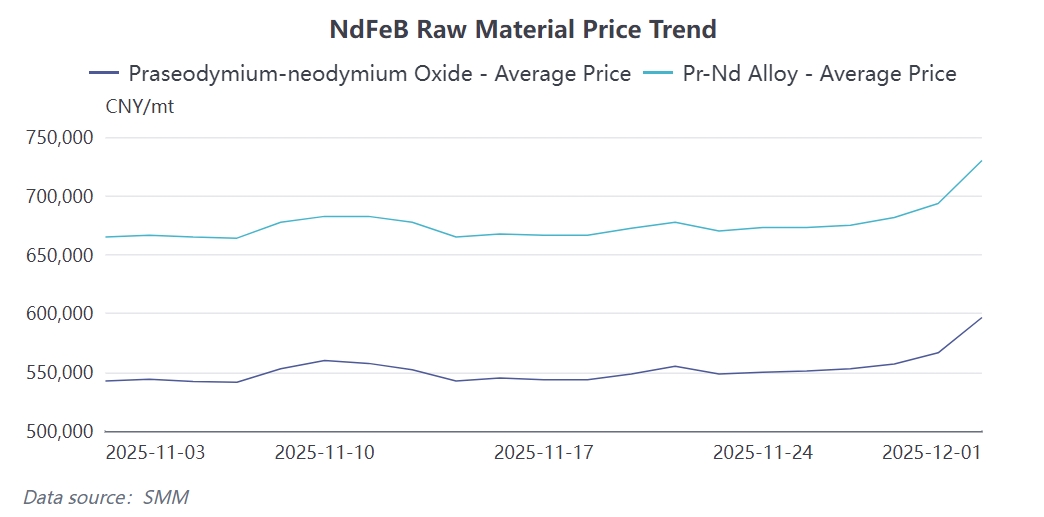
Recent sharp price increases in Pr-Nd have significantly impacted the NdFeB permanent magnet industry chain. On the first day of December, spot Pr-Nd oxide quotes surged by 30,000 yuan/mt to 596,500 yuan/mt in a single day, while Pr-Nd alloy prices rose by 36,500 yuan/mt to 730,000 yuan/mt. This price surge is primarily driven by tightening supply expectations: rare earth supply is becoming constrained, while demand from sectors such as wind power and NEVs remains robust, leading to a pronounced supply-demand imbalance.

Faced with cost pressures, magnetic material enterprises are showing a divergent trend: some small and medium-sized magnetic material factories have suspended quotations or are cautiously taking orders, while top-tier enterprises maintain stable shipments by leveraging their earlier inventory advantages. End-users, on the other hand, generally adopt a wait-and-see approach, with inquiries increasing but actual transactions remaining scarce, as they await price stabilization before making purchases.


NdFeB production in November increased by 9.55% MoM to 30,182 mt, with the operating rate rising to 70.18%. This round of growth primarily benefited from the combined effect of short-term policies and market sentiment. The easing of China-U.S. rare earth issues at the end of October boosted overseas inquiry activity, driving up the prices of raw materials such as Pr-Nd oxide, which in turn stimulated defensive purchasing by domestic motor enterprises. On November 8, new export control policies further spurred overseas stockpiling demand, while domestic NEV manufacturers ramped up procurement to meet annual targets, collectively pushing up production for the month. However, this growth partly relied on downstream "defensive purchasing" behavior, the sustainability of which is significantly affected by price fluctuations.
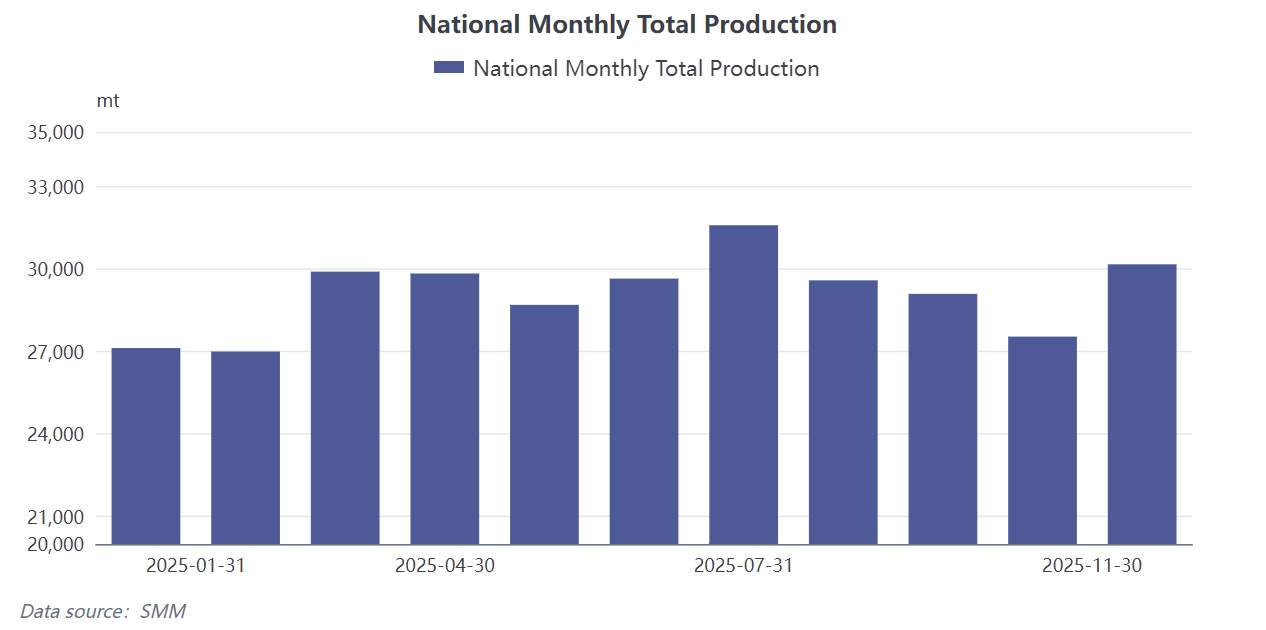
NdFeB production in December is expected to pull back to 29,540 mt, with the operating rate dropping to 69.1%, down approximately 2% MoM. This adjustment is primarily driven by three restraining factors:

First, the rapid short-term increase in Pr-Nd prices has led end-users to generally suspend the signing of long-term contracts, shifting toward consuming existing inventories, resulting in a noticeable contraction in new order volumes for magnetic material plants;

Second, some enterprises have completed their pre-year stockpiling plans ahead of schedule, leading to a natural contraction in production schedules toward year-end; third, in a high-price environment, magnetic material plants are selectively screening orders to protect profits, abandoning some low-margin product lines.

Notably, industry concentration continues to increase during this process, with the production share of top-tier enterprises reaching 73.5%, while the shares of mid- and lower-tier enterprises are further compressed, indicating that scaled enterprises exhibit stronger risk resistance amid cost fluctuations.


Despite short-term production being under pressure, the long-term demand fundamentals of the industry remain unchanged. Emerging sectors such as new energy vehicles, industrial robots, and the low-altitude economy continue to provide growth momentum. Current price fluctuations are accelerating industry consolidation, with top-tier enterprises leveraging their resource and technological advantages to continuously expand production (e.g., JL MAG Rare-Earth plans to increase its capacity to 40,000 mt by 2025). Industry concentration (CR4) is expected to rise from 29% in 2024 to 42% by 2026.

The market should monitor the outcome of the interplay between raw material supply control policies and end-user restocking pace after December, as well as the long-term risks associated with rare earth technology substitution.

Data Source Statement: Except for publicly available information, all other data are processed by SMM based on publicly available information, market communication, and relying on SMM‘s internal database model. They are for reference only and do not constitute decision-making recommendations.

For any inquiries or to learn more information, please contact: lemonzhao@smm.cn
For more information on how to access our research reports, please contact:service.en@smm.cn
Related News
Frontier Secures $20 Million and Signs Rare Earth Offtake Agreement
16 hours ago
Frontier Secures $20 Million and Signs Rare Earth Offtake Agreement
Read More
Frontier Secures $20 Million and Signs Rare Earth Offtake Agreement
Luxembourg-based Frontier Rare Earths today announced it successfully obtained a $20 million investment from South Africa's Industrial Development Corporation (IDS) and signed an offtake agreement with France's Carester. The company has now initiated the final feasibility study for its South African magnet-use rare earth and battery-grade manganese project. Frontier Rare Earths is currently advancing the development of the Zandkopsdrift project in South Africa. The project is expected to achieve an annual capacity of approximately 3,038 mt of Pr-Nd oxide, 114 mt of dysprosium oxide, and 25 mt of terbium oxide over the first 25 years.
16 hours ago
US Provides $565 Million in Financing for Brazilian Rare Earth Project
17 hours ago
US Provides $565 Million in Financing for Brazilian Rare Earth Project
Read More
US Provides $565 Million in Financing for Brazilian Rare Earth Project
Serra Verde, a Brazilian rare earth element producer, announced today that the US International Development Finance Corporation (DFC) offered it a financing package worth $565 million, which also includes an option for the US government to acquire a minority stake in the company. Serra Verde’s Pela Ema ionic clay deposit in Brazil is scheduled to begin commercial production in 2024, with an expected annual output of 5,000 mt of total rare earth oxides, including dysprosium, erbium, neodymium, and praseodymium. Serra Verde plans to use the funds to refinance existing loan facilities and expand production capacity. The project aims to increase total rare earth oxide production to 6,500 mt per year by 2027.
17 hours ago
US DFC Offers $565M Financing to Brazilian Rare Earth Project
17 hours ago
US DFC Offers $565M Financing to Brazilian Rare Earth Project
Read More
US DFC Offers $565M Financing to Brazilian Rare Earth Project
[SMM Flash: US Provides $565 Million in Financing for Brazilian Rare Earth Project] Serra Verde (a Brazilian rare earth element producer) announced today that the US International Development Finance Corporation (DFC) has provided it with a financing package worth $565 million, which also includes an option for the US government to acquire a minority stake in the company. Serra Verde's Pela Ema ionic clay deposit in Brazil is scheduled to commence commercial production in 2024, with an expected annual output of 5,000 mt of total rare earth oxides, including elements such as dysprosium, erbium, neodymium, and praseodymium. Serra Verde plans to use the funds to refinance existing loan facilities and expand production capacity. The project aims to increase the annual production of total rare earth oxides to 6,500 mt by 2027.
17 hours ago
PrNd Price Surge and Terminal Wait-and-See Expected to Lower NdFeB Output in December【SMM Analysis】 - Shanghai Metals Market (SMM)