

The National Bureau of Statistics (NBS) released data showing that in November, the manufacturing PMI stood at 49.2%, up 0.2 percentage points from the previous month, indicating an improvement in the level of prosperity. By enterprise size, the PMI for large enterprises was 49.3%, down 0.6 percentage points from the previous month, below the critical point; the PMI for medium and small enterprises was 48.9% and 49.1%, respectively, up 0.2 and 2.0 percentage points from the previous month, both below the critical point. In November, the non-manufacturing business activity index was 49.5%, down 0.6 percentage points from the previous month. By sector, the business activity index for the construction sector was 49.6%, up 0.5 percentage points from the previous month; the business activity index for the service sector was 49.5%, down 0.7 percentage points from the previous month. Looking at service industries, the business activity indices for industries such as railway transport, telecommunications, radio and television, and satellite transmission services, and monetary and financial services all remained in a relatively high prosperity range above 55.0%; the business activity indices for industries such as real estate and residential services were below the critical point. In November, the composite PMI output index was 49.7%, down 0.3 percentage points from the previous month.
China's Purchasing Managers' Index (PMI) Performance in November 2025
I. Performance of China's Manufacturing Purchasing Managers' Index
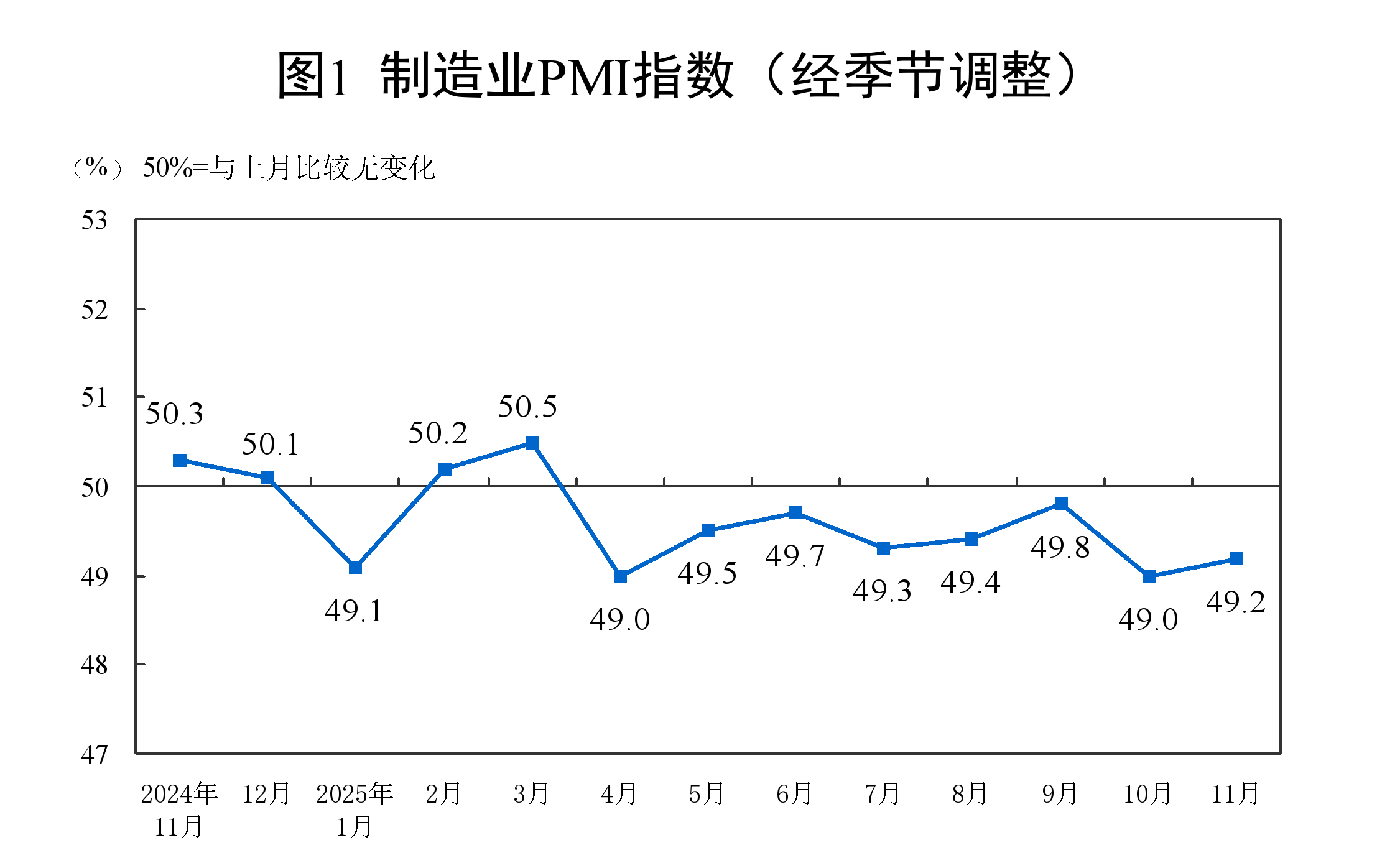
In November, the manufacturing PMI was 49.2%, up 0.2 percentage points from the previous month, indicating an improvement in the level of prosperity.
By enterprise size, the PMI for large enterprises was 49.3%, down 0.6 percentage points from the previous month, below the critical point; the PMI for medium and small enterprises was 48.9% and 49.1%, respectively, up 0.2 and 2.0 percentage points from the previous month, both below the critical point.
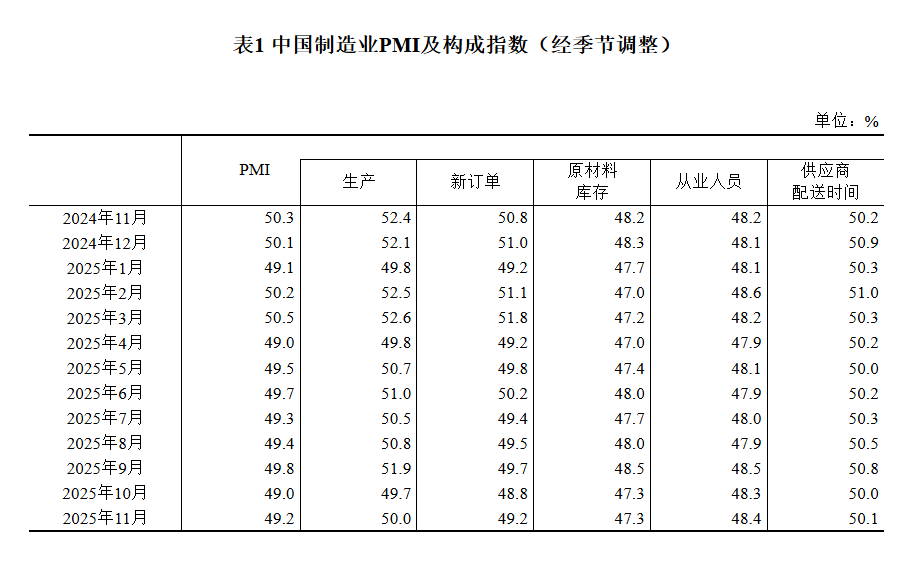
By sub-index, among the five sub-indices that constitute the manufacturing PMI, the supplier delivery time index was above the critical point, the production index was at the critical point, while the new orders index, raw material inventory index, and employment index were all below the critical point.
The production index was 50.0%, up 0.3 percentage points from the previous month, at the critical point, indicating overall stability in manufacturing production.
The new orders index was 49.2%, up 0.4 percentage points from the previous month, indicating an improvement in the level of prosperity for manufacturing market demand.
The raw material inventory index was 47.3%, unchanged from the previous month, below the critical point, indicating a continued reduction in the inventory of major raw materials in manufacturing.
The employment index was 48.4%, up 0.1 percentage points from the previous month, indicating a slight rebound in the employment prosperity level of manufacturing enterprises.
The supplier delivery time index was 50.1%, up 0.1 percentage points from the previous month, indicating a slight acceleration in the delivery times of raw material suppliers for manufacturing.
II. China's Non-Manufacturing PMI Performance
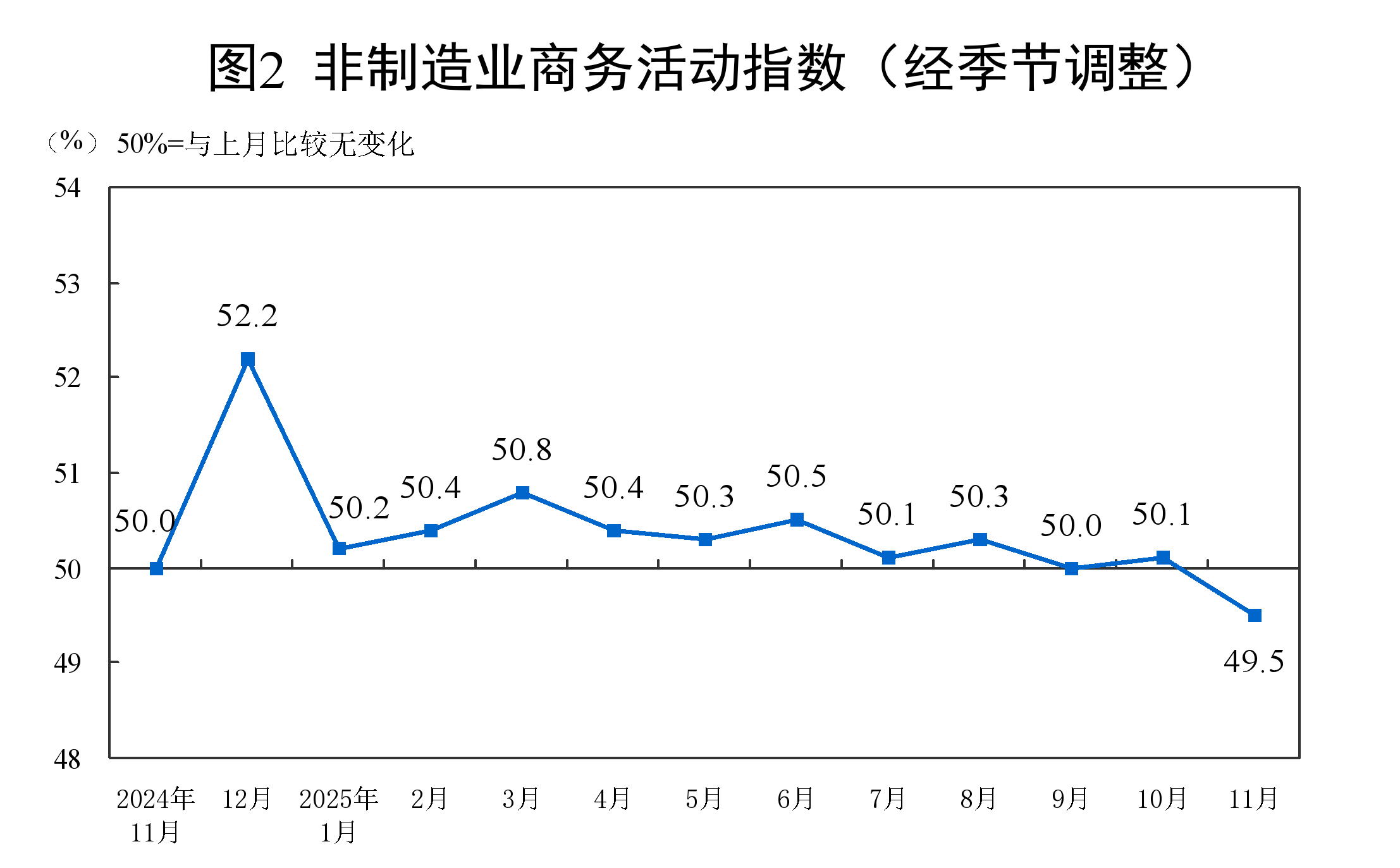
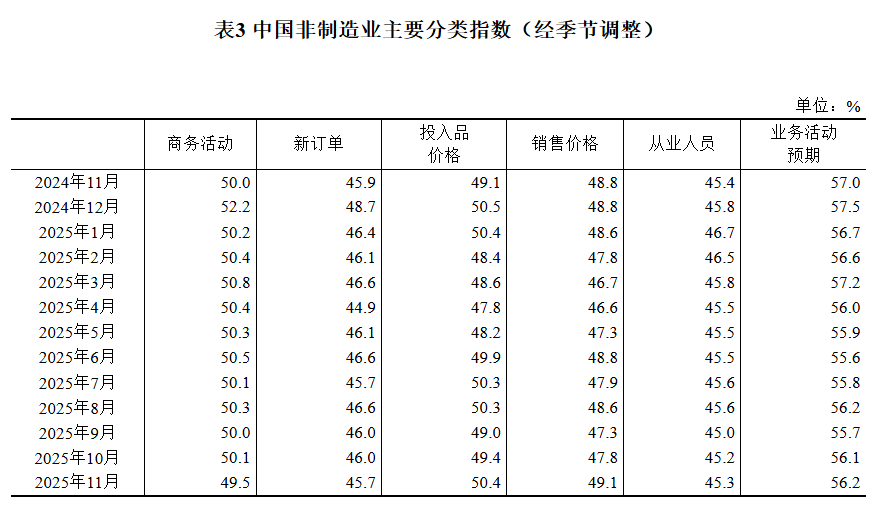
In November, the non-manufacturing business activity index was 49.5%, down 0.6 percentage points from the previous month.
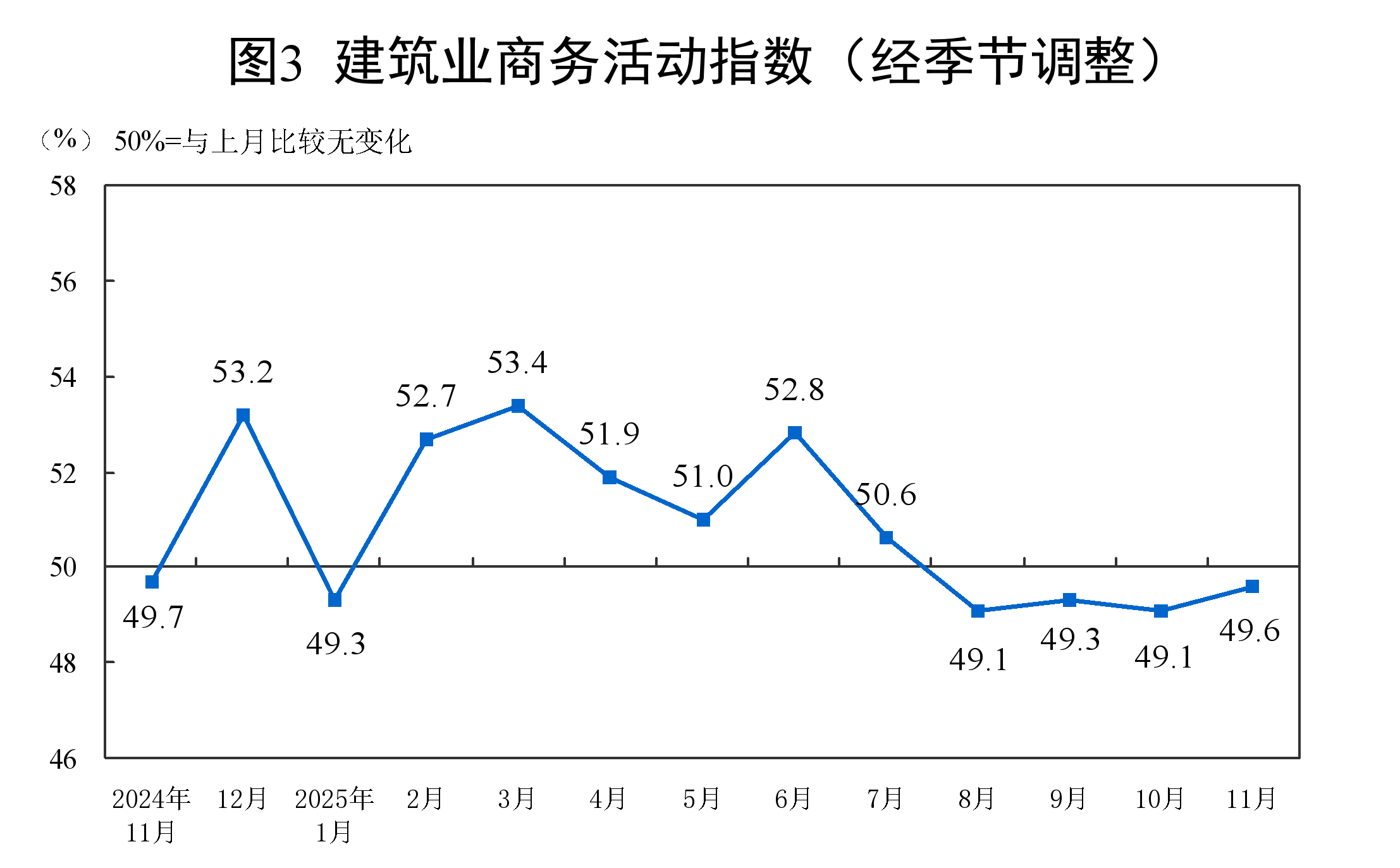
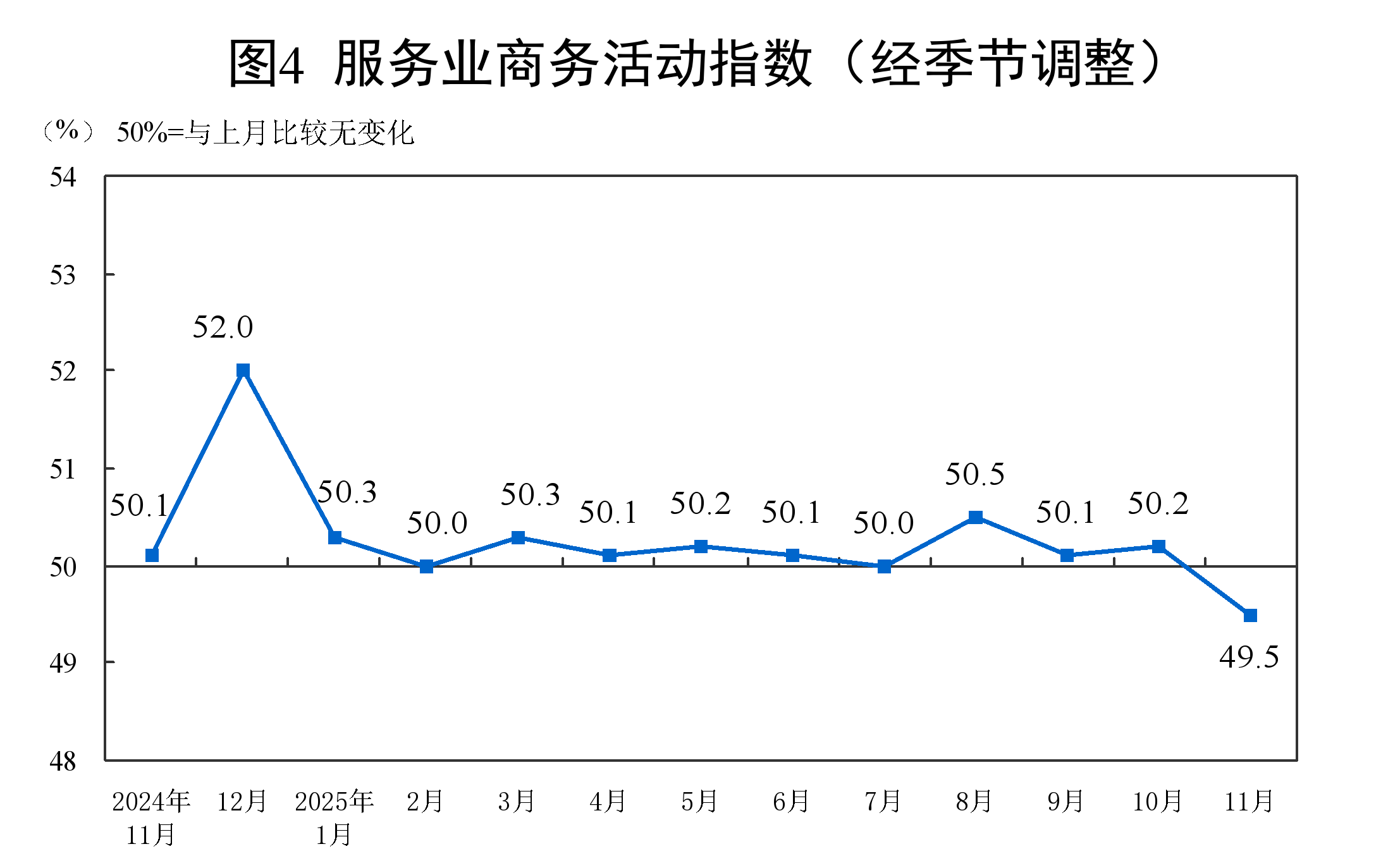
By sector, the business activity index for the construction industry was 49.6%, up 0.5 percentage points from the previous month; the business activity index for the service industry was 49.5%, down 0.7 percentage points from the previous month. In the service industry, sectors such as railway transport, telecommunications, radio and television, and satellite transmission services, and monetary and financial services all had business activity indices in the relatively high expansion zone above 55.0%; while sectors such as real estate and residential services had business activity indices below the threshold.
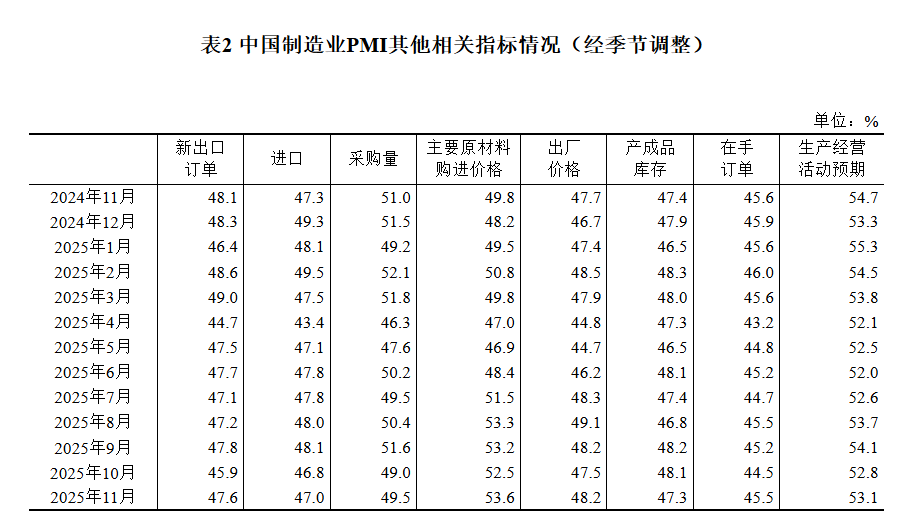
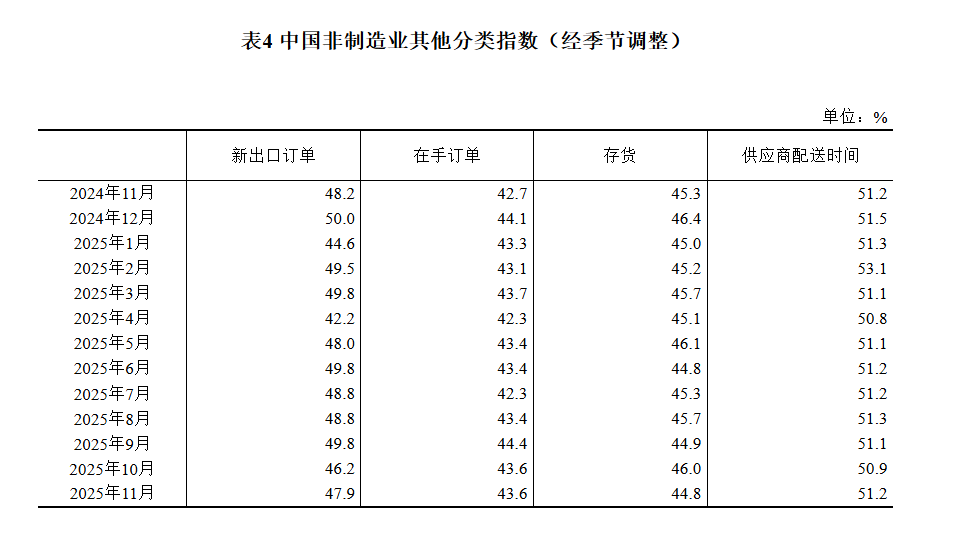
The new orders index was 45.7%, down 0.3 percentage points from the previous month, indicating a pull back in market demand in the non-manufacturing sector. By sector, the new orders index for the construction industry was 46.1%, up 0.2 percentage points from the previous month; the new orders index for the service industry was 45.6%, down 0.4 percentage points from the previous month.
The input price index was 50.4%, up 1 percentage point from the previous month, indicating an overall increase in the price level of inputs used by non-manufacturing enterprises for business activities. By sector, the input price index for the construction industry was 49.7%, up 0.1 percentage points from the previous month; the input price index for the service industry was 50.5%, up 1.1 percentage points from the previous month.
The selling price index was 49.1%, up 1.3 percentage points from the previous month, but still below the threshold, indicating a narrowing decline in the overall selling price level in the non-manufacturing sector. By sector, the selling price index for the construction industry was 48.4%, unchanged from the previous month; the selling price index for the service industry was 49.2%, up 1.5 percentage points from the previous month.
The employment index was 45.3%, up 0.1 percentage points from the previous month, indicating a slight improvement in the employment sentiment of non-manufacturing enterprises. By sector, the employment index for the construction industry was 41.8%, up 1.9 percentage points from the previous month; the employment index for the service industry was 45.9%, down 0.2 percentage points from the previous month.
The business activity expectations index was 56.2%, up 0.1 percentage points from the previous month, indicating that most non-manufacturing enterprises maintain optimism about market development. By sector, the business activity expectations index for the construction industry was 57.9%, up 1.9 percentage points from the previous month; the business activity expectations index for the service industry was 55.9%, down 0.2 percentage points from the previous month.
III. China's Composite PMI Output Index Performance
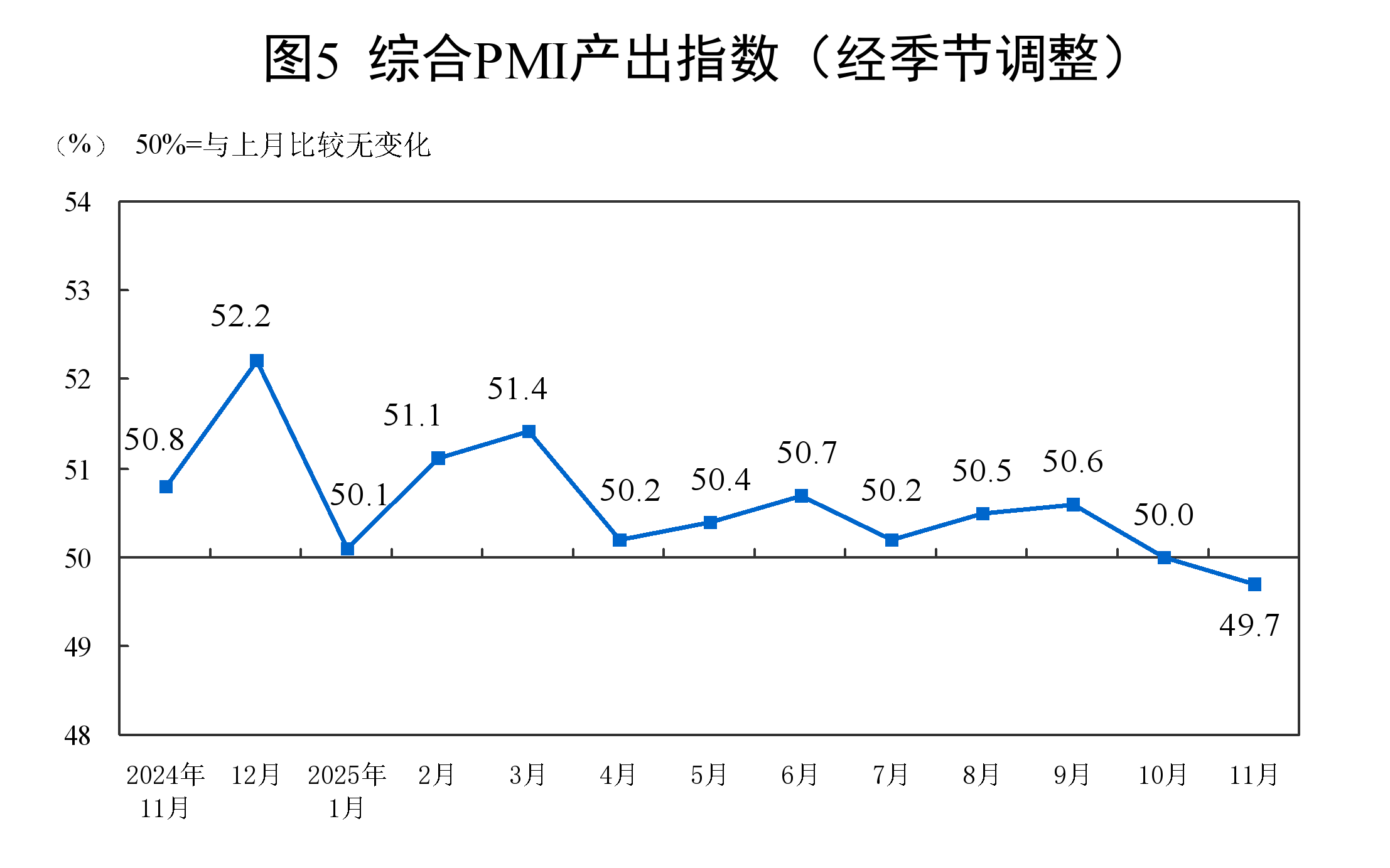
In November, the composite PMI output index was 49.7%, down 0.3 percentage points from the previous month.
Manufacturing PMI Rebounds Slightly in November
Non-manufacturing Business Activity Index Pulls Back
—Interpretation by NBS Senior Statistician Huo Lihui on China's PMI for November 2025
On November 30, 2025, the National Bureau of Statistics (NBS) Service Sector Survey Center and the China Federation of Logistics and Purchasing released China's PMI. NBS Senior Statistician Huo Lihui provided an interpretation.
In November, the manufacturing PMI was 49.2%, up 0.2 percentage points from the previous month; the non-manufacturing business activity index was 49.5%, down 0.6 percentage points from the previous month; the composite PMI output index was 49.7%, down 0.3 percentage points from the previous month, indicating that the overall economic prosperity level in China remained stable.
I. Manufacturing PMI Rebounds Slightly
In November, the manufacturing PMI rose to 49.2%, with an improvement in the prosperity level.
(i) Both supply and demand improved. The production index and new orders index were 50.0% and 49.2%, respectively, up 0.3 and 0.4 percentage points from the previous month. The production index reached the critical point, indicating improvements at both ends of supply and demand in the manufacturing sector. By industry, the production and new orders indices for agricultural and sideline food processing, non-ferrous metal smelting and rolling, and other industries were in the expansion territory, showing active supply and demand. In contrast, the two indices for petroleum, coal, and other fuel processing, chemical fiber, and rubber and plastic products industries were below the critical point, indicating a lower prosperity level.
(ii) The PMI for small enterprises rebounded significantly. The PMI for large enterprises was 49.3%, down 0.6 percentage points from the previous month, with a pullback in the prosperity level; the PMI for medium-sized enterprises was 48.9%, up 0.2 percentage points from the previous month, with some improvement in the prosperity level; the PMI for small enterprises was 49.1%, up 2 percentage points from the previous month, reaching the highest point in six months, with a significant rebound in the prosperity level.
(iii) High-tech manufacturing remained in expansion. The PMI for high-tech manufacturing was 50.1%, staying above the critical point for ten consecutive months, with related industries continuing to grow. The PMI for equipment manufacturing and consumer goods industries were 49.8% and 49.4%, respectively, down 0.4 and 0.7 percentage points from the previous month. The PMI for high energy-consuming industries was 48.4%, up 1.1 percentage points from the previous month, with a low-level rebound in the prosperity level.
(iv) Market expectations stabilized and increased. The business activity expectations index was 53.1%, up 0.3 percentage points from the previous month, indicating that manufacturing enterprises' confidence in the recent market development had strengthened. From an industry perspective, the business activity expectations index for non-ferrous metal smelting and rolling, as well as railway, ship, and aerospace equipment manufacturing, are all above 57.0%, indicating a high level of optimism among related enterprises regarding industry development.
II. The Non-Manufacturing Business Activity Index Pulled Back
In November, the non-manufacturing business activity index was 49.5%, a decrease of 0.6 percentage points from the previous month, indicating a pullback in the non-manufacturing sector's prosperity level.
(i) The Service Sector Business Activity Index Pulled Back. Affected by the fading holiday effect and other factors, the service sector business activity index was 49.5%, down 0.7 percentage points from the previous month. By industry, the business activity indices for railway transportation, telecommunications, broadcasting, and satellite transmission services, and monetary financial services were all above 55.0%, maintaining a relatively fast growth in total business volume; whereas, the real estate and resident services industries had business activity indices below the critical point, indicating weaker market activity. In terms of market expectations, the business activity expectations index was 55.9%, down 0.2 percentage points from the previous month but still within a high prosperity range, suggesting that service sector enterprises remain optimistic about future market development.
(ii) The Construction Industry Business Activity Index Rebounded. The construction industry business activity index was 49.6%, up 0.5 percentage points from the previous month, showing an improvement in the construction industry's prosperity level. Regarding market expectations, the business activity expectations index was 57.9%, up 1.9 percentage points from the previous month, indicating a rebound in confidence among construction enterprises about recent industry development.
III. The Composite PMI Output Index Dropped Back Slightly
In November, the composite PMI output index was 49.7%, a decrease of 0.3 percentage points from the previous month. The manufacturing production index and the non-manufacturing business activity index, which constitute the composite PMI output index, were 50.0% and 49.5%, respectively.