According to a document released by South Korea's Ministry of Economy and Finance on November 26, the "Perovskite-Silicon Tandem Solar Cell" (hereinafter referred to as the "Tandem cell") has been officially designated as the 15th National Leading Project. A budget of 33.6 billion won has been allocated in the 2026 fiscal year for technology R&D, standard establishment, and market creation, with the goal of achieving the world's first commercialization by 2030, targeting a cell efficiency of 35% and a module efficiency of 28%.
The document outlines the following timetable:
- 2026: Complete development and demonstration of commercial modules with an area of 1.7 m² or larger.
- 2028: Achieve cell efficiency of 32% and module efficiency of 26%.
- 2030: Achieve cell efficiency of 35% and module efficiency of 28%, realizing the world's first commercialization.
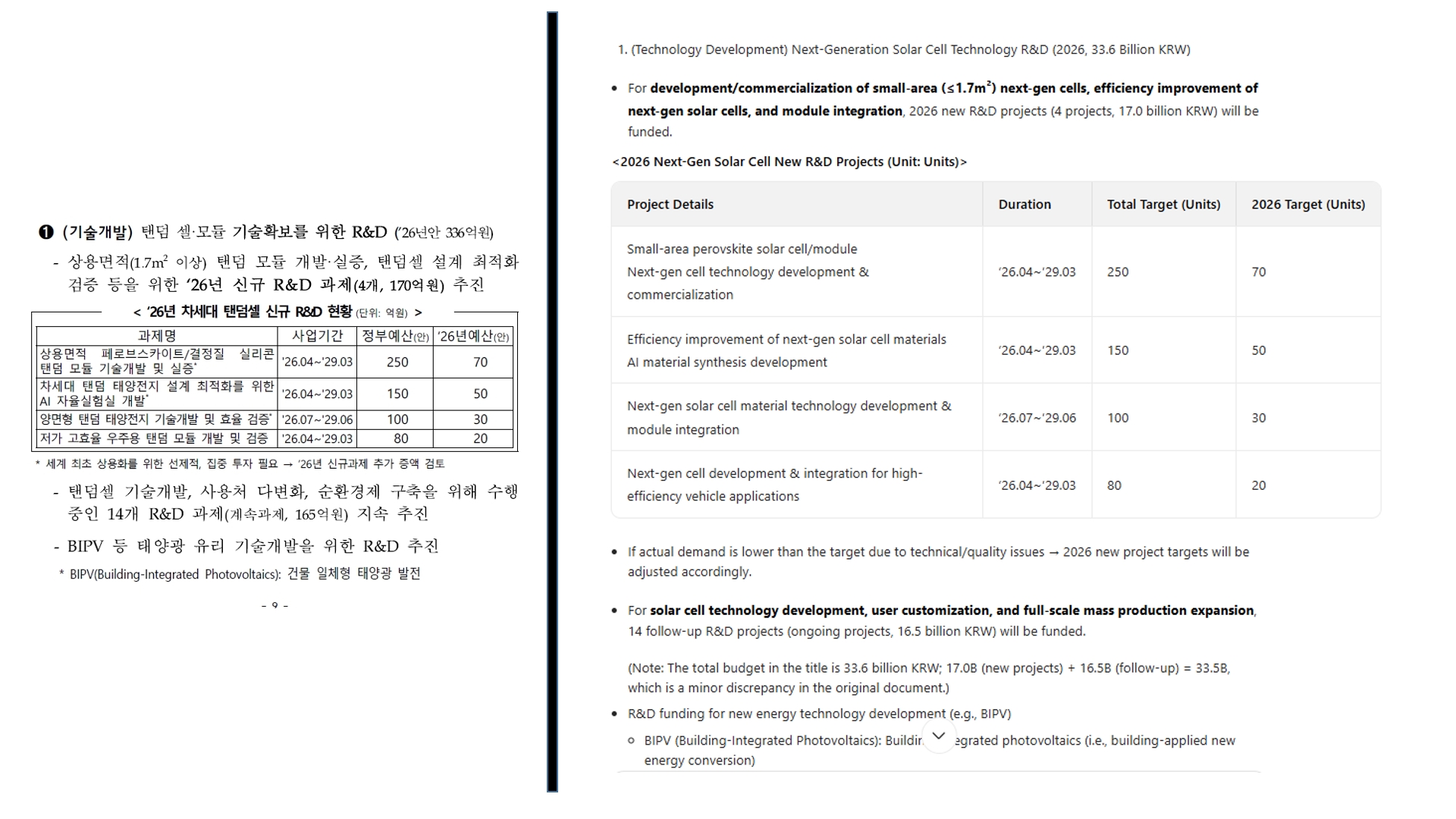
The total 2026 budget of 33.6 billion won will be allocated across three main areas: 17 billion won is designated for four new projects, specifically including 7 billion won for developing and demonstrating perovskite-silicon tandem solar modules suitable for commercial sizes, 5 billion won for establishing an autonomously operating AI laboratory to accelerate the iteration of materials and devices, 3 billion won for tackling double-sided light-receiving tandem cell technology, and 2 billion won for R&D on cost-effective tandem modules for space applications; an additional 16.5 billion won will continue to support 14 ongoing projects to ensure steady progress on existing technology pathways; the remaining 2.2 billion won is specifically earmarked for establishing domestic and overseas standards and certification systems, concurrently carrying out initial market cultivation work to lay the foundation for subsequent large-scale commercial use.
Regarding policy positioning and implementation mechanisms, the government has formally included the perovskite-silicon tandem cell project, alongside core industries such as high-voltage DC power transmission, small modular reactors, and offshore wind power, within the national strategic framework of "Carbon Neutrality and Energy Transition." Led by the Ministry of Trade, Industry and Energy and the Ministry of Environment, a permanent public-private consultation platform will be established to conduct monthly rolling reviews of project progress. Support will cover the entire value chain from "wafer–cell–module–building integration," aiming to achieve technology implementation and scaled production rapidly through full-chain coordination.
Concerning standards and market building, the document provides a clear timetable: complete the establishment of a unified domestic and overseas standards and certification system by 2027, open module certification testing to the industry in 2028, and promote the priority adoption of tandem modules in areas such as public buildings and low-carbon power tenders, thereby creating substantial and sustainable initial market demand and providing the industry with real application scenarios and feedback data.
The technology roadmap and key directions focus on four major tasks: developing tandem modules with a monolithic area of no less than 1.7 m² that can be immediately used in commercial installations; building AI-driven autonomous experimental platforms to significantly shorten the iteration cycles for material verification, cell fabrication, and module testing; continuously tackling new-type tandem module technologies such as double-sided light reception, low reflection, and low carbon emissions to further reduce the carbon footprint per kilowatt-hour; and simultaneously advancing the localisation of key raw materials and core manufacturing equipment to reduce external dependence and ensure supply chain security and cost competitiveness. The document asserts that, at this stage, South Korea faces technological hegemony competition and global supply chain uncertainties, necessitating industrial transformation through super-gap technology. Tandem cells are regarded as the next-generation core PV technology and a critical pathway for achieving carbon neutrality and new growth momentum.
The South Korean government has officially designated the industrialisation of perovskite-silicon tandem solar cells as a national strategic project, advancing it with a clear timetable, budget allocation, and policy mechanisms. This initiative not only aims to achieve technological breakthroughs but also seeks to establish a self-sufficient industrial ecosystem through standard-setting and public market guidance, thereby securing a leading position in next-generation PV technology. Whether the 2030 commercialisation target can be achieved as scheduled will depend on the actual progress in technology validation, standard formulation, and industrial coordination.
![[SMM PV News] US Solar Faces Labor Shortage Ahead of 'OBBBA' Deadline](https://imgqn.smm.cn/usercenter/xBtJB20251217171738.jpg)
![[SMM PV News] France Unveils 2026 Solar Auction Calendar and New Supply Rules](https://imgqn.smm.cn/usercenter/CpbPE20251217171736.jpg)
![[SMM PV News] Gulf Conflict Shifts Energy Markets, Impacting 'PPAs' and 'BESS'](https://imgqn.smm.cn/usercenter/xAoMy20251217171743.jpg)