DRC Situation Under Scrutiny: What Risks Loom for China’s Tantalum Ore Supply Chain? [SMM Analysis]

Published: Nov 26, 2025 17:54
Source: SMM
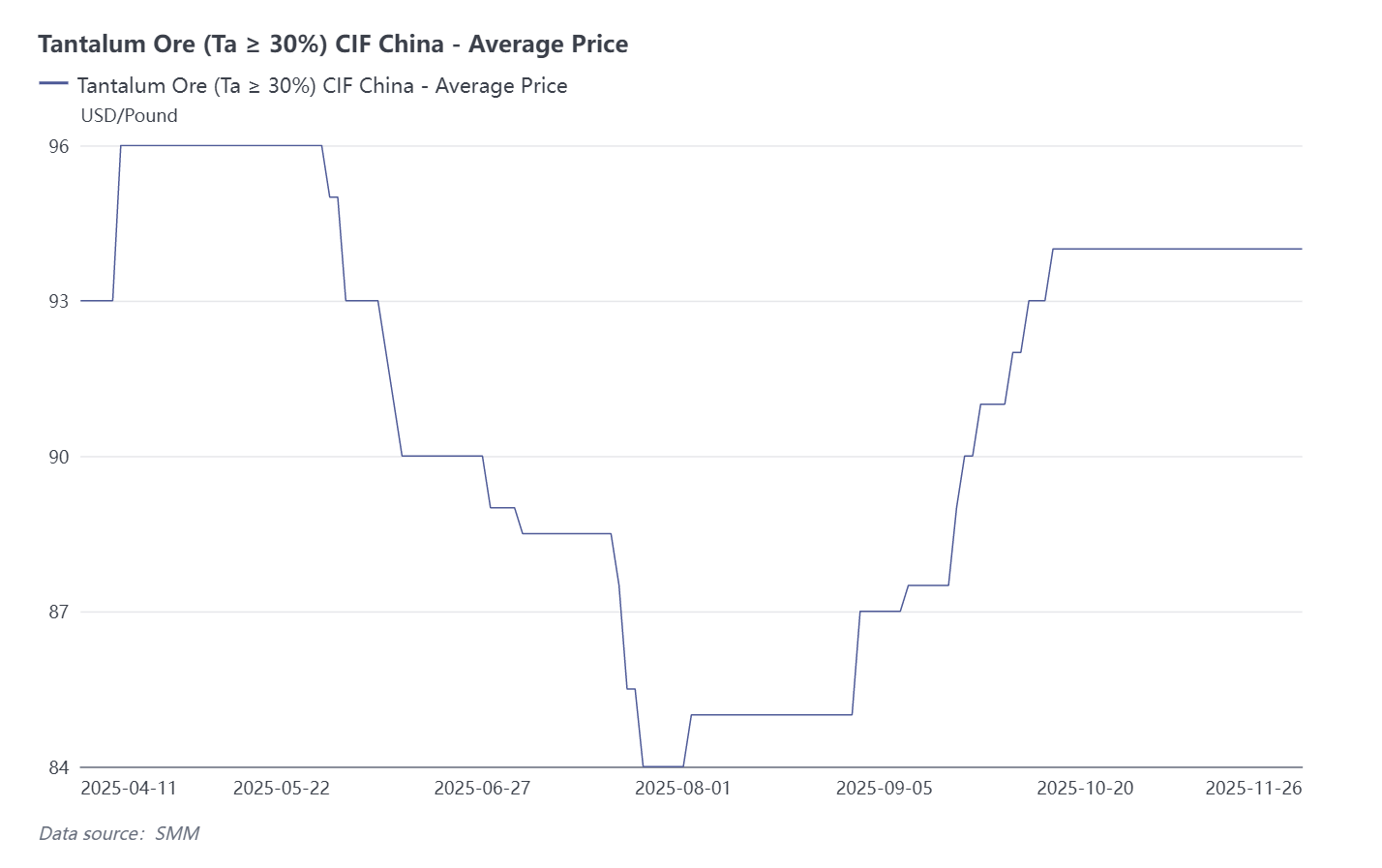
Recently, the situation in the Democratic Republic of the Congo (DRC) has escalated again, adding further uncertainty to the market supply of tantalum ore. Upon the release of this news, bullish sentiment among industry insiders has reignited. Can the CIF price of Chinese tantalum ore (Ta2O5≥30%) sustain the upward trend seen at the start of the year and break through the "100$ mark" in one fell swoop?

Recently, the situation in the Democratic Republic of the Congo (DRC) has escalated again, adding further uncertainty to the market supply of tantalum ore. Upon the release of this news, bullish sentiment among industry insiders has reignited. Can the CIF price of Chinese tantalum ore (Ta2O5≥30%) sustain the upward trend seen at the start of the year and break through the "100$ mark" in one fell swoop?
News Background

On November 16th, the DRC's Ministry of Mines announced that it had extended by six months the ban on mineral trade at 38 small-scale mines in North Kivu and South Kivu provinces affected by conflicts. The ban prohibits the mining and export of minerals from these mining areas, and the ministry stated that these sites may face independent audits by the Ministry of Mines or international bodies including the United Nations (UN) and the Organisation for Economic Co-operation and Development (OECD).

First implemented in February this year, the ban will remain in effect due to evidence that illegal supplies from these mines are funding armed groups in the eastern region. These mines produce tantalum-niobium ore, cassiterite, and wolframite (raw materials for tin, tantalum, and tungsten), and the extension will increase compliance pressures on the global supply chains of tin, tantalum, and tungsten. The Rwanda-supported M23 rebels and other armed groups have occupied mineral-rich areas in eastern DRC.

On November 23rd, the Chinese Ministry of Foreign Affairs and the Chinese Embassy in the DRC issued an urgent security alert, requiring Chinese citizens and enterprises remaining in high-risk areas of eastern DRC to evacuate immediately. This comes as armed conflicts in the region occur frequently, and incidents of attacks and kidnappings targeting Chinese citizens have surged.

Market Outlook Analysis

As core strategic minerals for the semiconductor, new energy, and other sectors, tantalum-niobium ore supply chains have seen significantly heightened instability globally due to the M23 armed group's control over relevant mining areas in the DRC. The scramble for mineral interests is the core of the conflict between the M23 armed group, the DRC government, and neighboring Rwanda, and this key divergence is further exacerbating the security situation on the ground. Meanwhile, the DRC accounts for 43% of global tantalum ore supply, and the border area between North Kivu and South Kivu provinces controlled by the M23 is precisely the core enrichment zone for coltan (columbite-tantalite). Among these, the Rubaya Tantalum Mine, one of the largest tantalum mines in the DRC, contributes 15%-20% of global coltan production. As a result, the ongoing conflict in the DRC has dealt a severe blow to the stability of global tantalum ore supplies. According to local tantalum ore miners, the current transportation of minerals out of the DRC faces significant obstacles, and relevant parties are still negotiating transportation arrangements.

Notably, data released by the General Administration of Customs shows that currently, 9% of China's total tantalum ore imports come from the DRC, meaning the direct impact is relatively limited. While some DRC tantalum ore is smuggled to Nigeria before entering China, the specific proportion of such sources remains unclear. Additionally, considering that China's import dependence on overseas tantalum ore is as high as 78%, leading domestic tantalum smelting enterprises have stockpiled raw materials in advance to ensure stable production. Public information indicates that the raw material inventories of some leading enterprises can support stable production for up to one year. In this context, fluctuations in DRC's tantalum ore supply may drive up tantalum ore prices due to tight supply expectations, but from the current market structure, this conflict will not trigger a shortage crisis for downstream end products for the time being.

Data Source Statement: Except for publicly available information, all other data are processed by SMM based on publicly available information, market communication, and relying on SMM's internal database model. They are for reference only and do not constitute decision-making recommendations.

For any inquiries or for more information, please contact: lemonzhao@smm.cn
For more information on how to access our research reports, please contact:service.en@smm.cn
Related News
Zimbabwe's Chrome Beneficiation Strategy Remains in Focus
Jul 24, 2026 23:38
Zimbabwe's Chrome Beneficiation Strategy Remains in Focus
Read More
Zimbabwe's Chrome Beneficiation Strategy Remains in Focus
[SMM Express] Zimbabwe's long-standing strategy to expand domestic chrome beneficiation continues to attract industry attention as the country seeks to increase local ferrochrome production and capture more value from its abundant chromite resources. The policy direction remains centered on encouraging in-country processing while gradually reducing reliance on exports of unprocessed chrome ore. Market participants continue to monitor investment in new smelting capacity and the implementation of beneficiation measures, as these developments could progressively reshape regional chrome ore trade flows. If Zimbabwe succeeds in increasing ferrochrome production, a larger share of domestically mined chrome ore would be consumed locally, potentially reducing ore availability for export while increasing the country's presence in the global ferrochrome market.
Jul 24, 2026 23:38
South Africa's Ferrochrome Recovery Remains Under Market Watch
Jul 24, 2026 23:28
South Africa's Ferrochrome Recovery Remains Under Market Watch
Read More
South Africa's Ferrochrome Recovery Remains Under Market Watch
[SMM Express] South Africa's ferrochrome industry remains under close market watch as producers gradually advance production recovery following the implementation of preferential electricity tariffs for major smelters. The lower power tariff has improved the operating environment, supported the restart of some idle furnace capacity and eased immediate pressure on the sector after a prolonged period of production cuts driven by high electricity costs. Market participants, however, remain cautious over the pace of recovery. Although the tariff relief is expected to support higher ferrochrome output in the short term, producers continue to face challenges from global price competition and operating costs. The speed at which additional smelting capacity returns to operation will be closely monitored, as stronger ferrochrome production could gradually increase domestic chrome ore consumption and influence South Africa's export mix.
Jul 24, 2026 23:28
Chinese Titanium Suppliers Eye Global Aerospace Markets
Jul 24, 2026 19:28
Chinese Titanium Suppliers Eye Global Aerospace Markets
Read More
Chinese Titanium Suppliers Eye Global Aerospace Markets
[SMM Express] Chinese titanium suppliers are expanding their focus towards international aerospace markets as global demand for the critical metal remains supported by aircraft manufacturing growth and supply chain constraints. Several Chinese companies showcased titanium sponge, ingots and other advanced materials at the Farnborough International Airshow in July 2026, seeking to strengthen relationships with overseas aerospace customers. Titanium is widely used in aerospace applications due to its high strength-to-weight ratio, corrosion resistance and ability to withstand extreme conditions. The metal is essential for aircraft components including airframes, landing gear and jet engine parts. The global titanium supply chain has faced disruptions in recent years, including the impact of the COVID-19 pandemic, sanctions affecting Russian supply and trade restrictions on Chinese materials. These factors have increased interest in alternative suppliers as aerospace manufacturers seek greater supply chain resilience. China remains one of the world’s leading titanium producers, with a growing domestic aerospace sector supported by companies such as COMAC. However, intense competition within the domestic market is encouraging Chinese suppliers to pursue export opportunities, particularly in Europe and other regions where aerospace-grade titanium supply remains constrained.
Jul 24, 2026 19:28