SMM November 21 News:
Highlight Toyota has been deeply engaged in sulphide solid-state batteries, achieving an energy density of 450-500 Wh/kg, with fast charging enabling a 1,200-km driving range in 10 minutes. Mass production and installation in vehicles is planned for 2027, and Toyota is collaborating with Sumitomo and Idemitsu Kosan to overcome material and cost bottlenecks.

Toyota's solid-state battery strategy primarily focuses on the sulphide electrolyte route, with mass production planned for 2027. Some reports mention 2026 or 2028, depending on technological progress and collaboration advancement. The actual progress is as follows, providing an overview of Toyota's solid-state battery layout in Japan.
Solid-State Battery Technology: Sulphide Electrolyte Route
The energy density reaches as high as 450-500 Wh/kg, more than double that of current ternary lithium batteries. Through the jointly developed "high-durability cathode material" with Sumitomo Metal Mining, the issue of material degradation during repeated charge-discharge cycles has been successfully resolved. The battery lifespan can exceed 15 years, with capacity retention remaining over 90% after 2,000 cycles.
More revolutionary is its fast-charging performance: it can charge from 0% to 80% in just 10 minutes. Coupled with an 800V high-voltage platform, the charging speed is four times faster than existing fast-charging technologies.
Mass Production Timeline
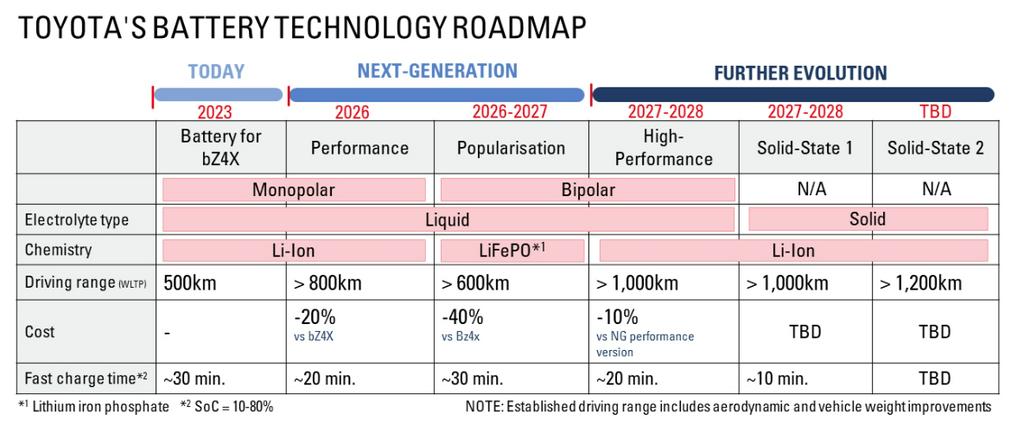
According to Toyota's plan, a solid-state battery factory with an annual production capacity of 10 GWh will be built in Japan in 2026. Initial capacity will be prioritized for high-end Lexus car models, with an expected selling price of 800,000 to 1 million yuan. The target users at this stage are tech early adopters and high-end business professionals, aiming to capture the market through the differentiated experience of "no driving range anxiety."
By 2030, as the mass production cost of lithium sulphide decreases, Toyota plans to reduce the cost of solid-state batteries to within 1.5 times that of liquid batteries, gradually popularizing them in mid-end car models.
2026: Some reports indicate Toyota plans small-scale mass production in 2026, but actual progress is affected by technical bottlenecks.
2027: Toyota, in collaboration with Sumitomo Metal Mining and Idemitsu Kosan, plans to commence mass production of lithium sulphide materials in 2027 and equip them in high-performance EVs, achieving a driving range of approximately 1,200 km.
2028: Some reports mention 2028 as the final commercialization target, overlapping with the 2027 mass production plan.
Collaborations and Progress
Collaboration with Sumitomo Metal Mining on cathode material development, and joint establishment of a lithium sulphide factory with Idemitsu Kosan (scheduled for operation in 2027). Prototype battery packs have been demonstrated, but large-scale production still requires resolving material stability and cost issues.
On October 7, 2025, Toyota's solid-state battery officially received production approval in Japan. Mass production is set to begin in 2026, and in 2027, it will first be equipped in Lexus flagship models, achieving the epic breakthrough of "charging for 10 minutes for a 1,200-km driving range."
Toyota's Patents
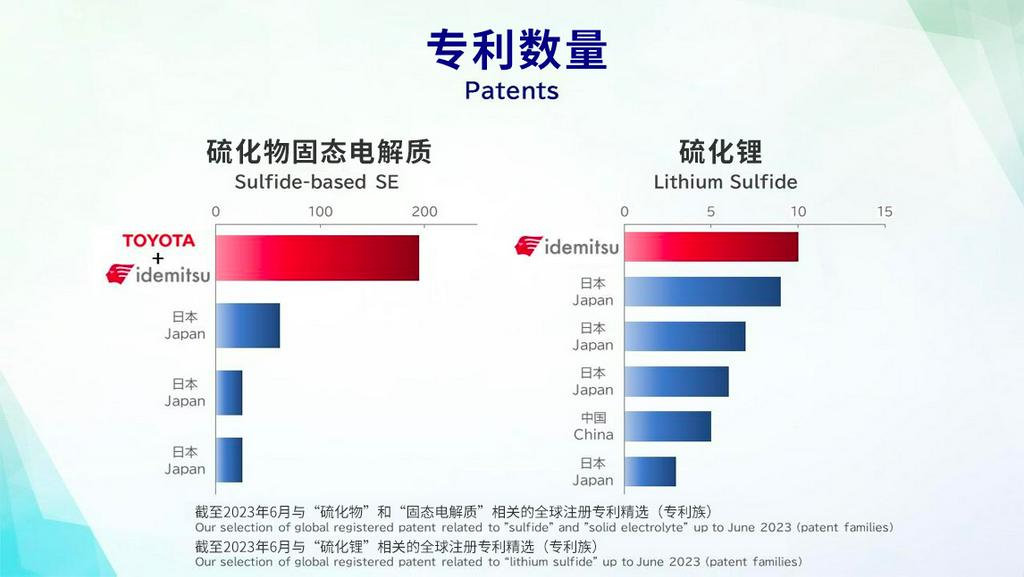
Toyota holds over 1,000 solid-state battery patents globally, ranking among the world's leaders and establishing a strong technological barrier.
Toyota Profile
Toyota Motor Corporation is one of the world's largest automobile manufacturers and the largest enterprise in Japan.
Automotive Brands: Toyota, covering a full range of models from family sedans to luxury SUVs. Luxury Brand: Lexus, targeting the high-end market. Other affiliated brands: Daihatsu, Hino. Product Lines: Traditional internal combustion engine vehicles: such as global popular models like the Camry, Corolla, and RAV4. New Energy Vehicles: hybrid Prius, pure electric bZ series, and hydrogen fuel cell model Mirai.
Partners: Prime Planet Energy & Solutions (under Panasonic), Idemitsu Kosan, etc.
[Overseas Solid-State Battery: Sumitomo and Toyota Reach Cooperation Agreement on All-Solid-State Battery Cathode Materials] On October 8, 2025, it was announced that Sumitomo Metal Mining Co., Ltd. and Toyota Motor Corporation reached a cooperation agreement on mass-producing cathode materials for all-solid-state batteries used in battery electric vehicles (BEVs). Both parties will jointly advance the R&D process. Toyota reiterated its plan to launch BEVs equipped with all-solid-state batteries between 2027 and 2028.
According to SMM projections, all-solid-state battery shipments are expected to reach 13.5 GWh by 2028, while semi-solid-state battery shipments are forecast to reach 160 GWh. By 2030, global lithium-ion battery demand is estimated to be around 2,800 GWh, with the compound annual growth rates from 2024 to 2030 for lithium-ion battery demand in EVs, ESS, and consumer electronics at approximately 11%, 27%, and 10%, respectively. The global penetration rate of solid-state batteries is projected to be around 0.1% in 2025, and is expected to reach about 4% for all-solid-state batteries by 2030. By 2035, the global penetration rate of solid-state batteries may approach 10%.
**Note:** For further details or inquiries regarding solid-state battery development, please contact:
Phone: 021-20707860 (or WeChat: 13585549799)
Contact: Chaoxing Yang. Thank you!
![Solid-state Battery September Analysis and Quarterly Review: Policy and Capital Heat Up, Material Spot Cools Down, Industrialisation Moves from "kg" to "mt" [SMM Analysis]](https://imgqn.smm.cn/usercenter/olwlF20251217171731.jpg)
![Solid-State Battery Next Decade Series, Part 4 of 9: Will It Be Crushed Under the Wheels of PV-Style Industry-Wide Involution? [SMM Analysis]](https://imgqn.smm.cn/usercenter/lzgUR20251217171731.jpg)