October Phosphate Ore Output Hits Record High; New Energy Demand Drives Phosphorus Chemical Industry Transformation

Published: Nov 19, 2025 17:23
Source: SMM
In October 2025, the phosphorus chemical industry operated against a backdrop of subdued traditional agricultural demand and robust new energy demand. The industry-wide production of phosphate ore (converted to P₂O₅ 30%) climbed to a record high of approximately 14 million mt, while the consumption index for the new energy sector rose to 6.2, with robust demand for products such as LFP being the primary driver.

SMM November 19 News:
Highlights: Phosphate ore maintained a tight supply-demand balance with firm prices. Sulfur raw material prices surged 46% due to tight global supply, pushing up the costs of sulfuric acid and downstream products. Coupled with robust demand from the new energy sector for phosphoric acid and industrial-grade MAP, prices of phosphorus chemical products rose across the board, resulting in a stronger-than-usual off-season market.

In Q4 2025, the phosphorus chemical market experienced a strong rally. Upstream phosphate ore maintained a tight balance supported by winter fertilizer stocking and new energy demand; midstream sulfur raw material prices soared due to international supply shortages, significantly raising production costs of core product sulfuric acid. At the same time, robust demand from the LFP industry strongly boosted phosphoric acid and industrial-grade MAP. Driven by both cost and demand factors, prices across the phosphorus chemical industry chain rose comprehensively.

I. Phosphate Ore: Firm Prices and Tight Supply-Demand Balance
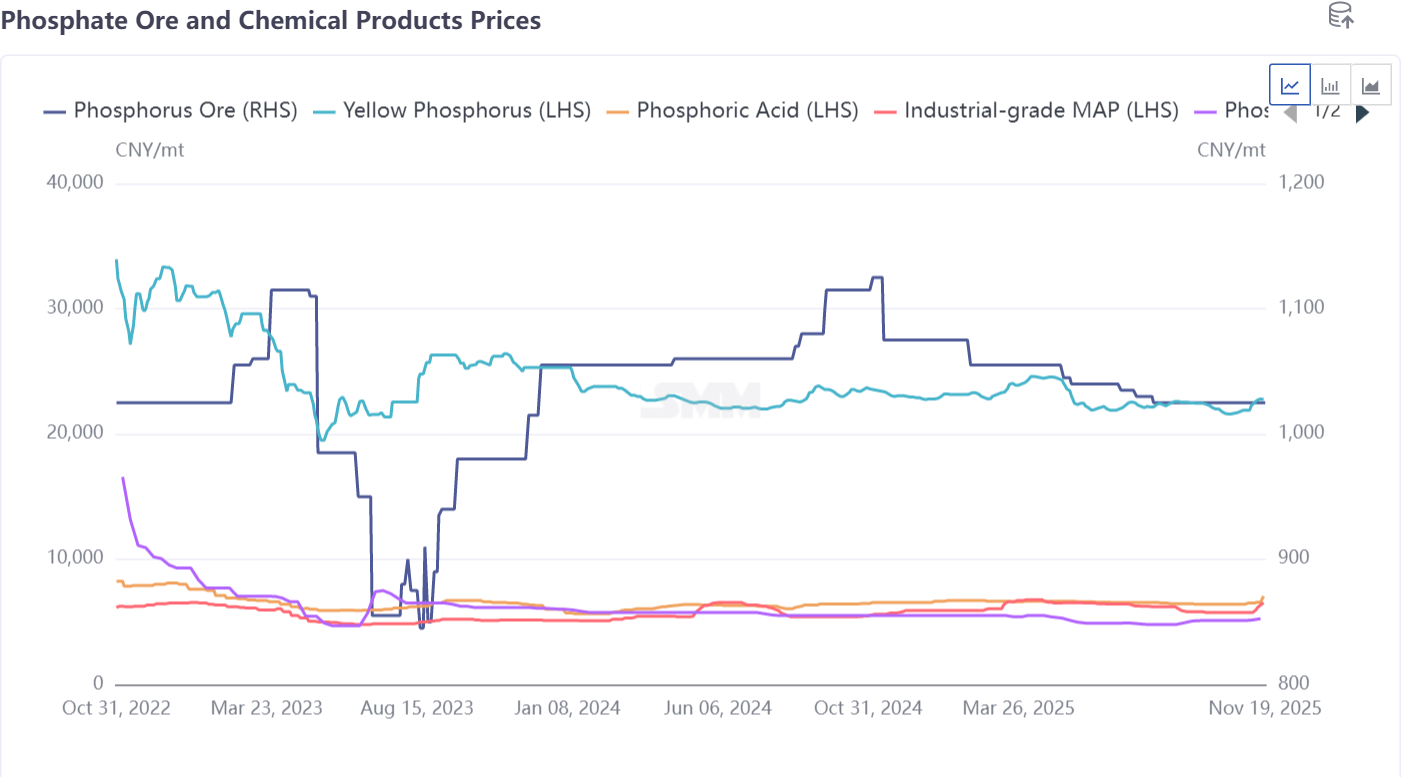
Phosphate ore prices remained firm, influenced by winter fertilizer stocking and strong new energy demand.
Supply side, periodic mining suspensions in some regions affected supply, while newly commissioned mines ramping up capacity helped alleviate tightness. Due to high cross-regional sales costs, supply-demand imbalances persisted in various regions. Demand side, robust demand from the new energy sector increased demand for iron phosphate, LFP, and LiPF6, driving up phosphate resource consumption.
II. Phosphorus Chemical Products: Rising Sulfur Raw Material Prices and Strong Downstream Demand Drive Broad-Based Price Increases

In Q4 2025, the phosphorus chemical market saw some changes in winter fertilizer stocking due to the later timing of the Chinese New Year holiday; on the new energy side, strong demand from the LFP industry for phosphoric acid and industrial-grade MAP led to a stronger-than-usual off-season for phosphorus chemical products. Simultaneously, rising production costs of sulfuric acid driven by sulfur price increases contributed to a wave of price hikes across phosphorus chemical products.

Sulfur prices surged 46%, rising from 2,600 yuan/mt in October to 3,800 yuan/mt currently, transforming sulfur from a mild performer into a sharp riser.
The continuous climb in sulfur prices increased sulfuric acid prices, with 1 mt of sulfur producing 3 mt of 98% sulfuric acid. For every 100 yuan/mt increase in sulfur, the per-ton cost of sulfuric acid rose by 33 yuan; from October to present, sulfuric acid costs increased by 400 yuan/mt.
Sulfur supply: Supply tightened due to production cuts at Russian refineries, reducing sulfur availability as a by-product. In other regions, slight production decreases at Canadian sulfur mines and in the Middle East affected global sulfur market demand. Sulfur's main downstream use is in producing sulfuric acid via the thermal process; sulfuric acid is a fundamental chemical raw material with high demand and broad applications.
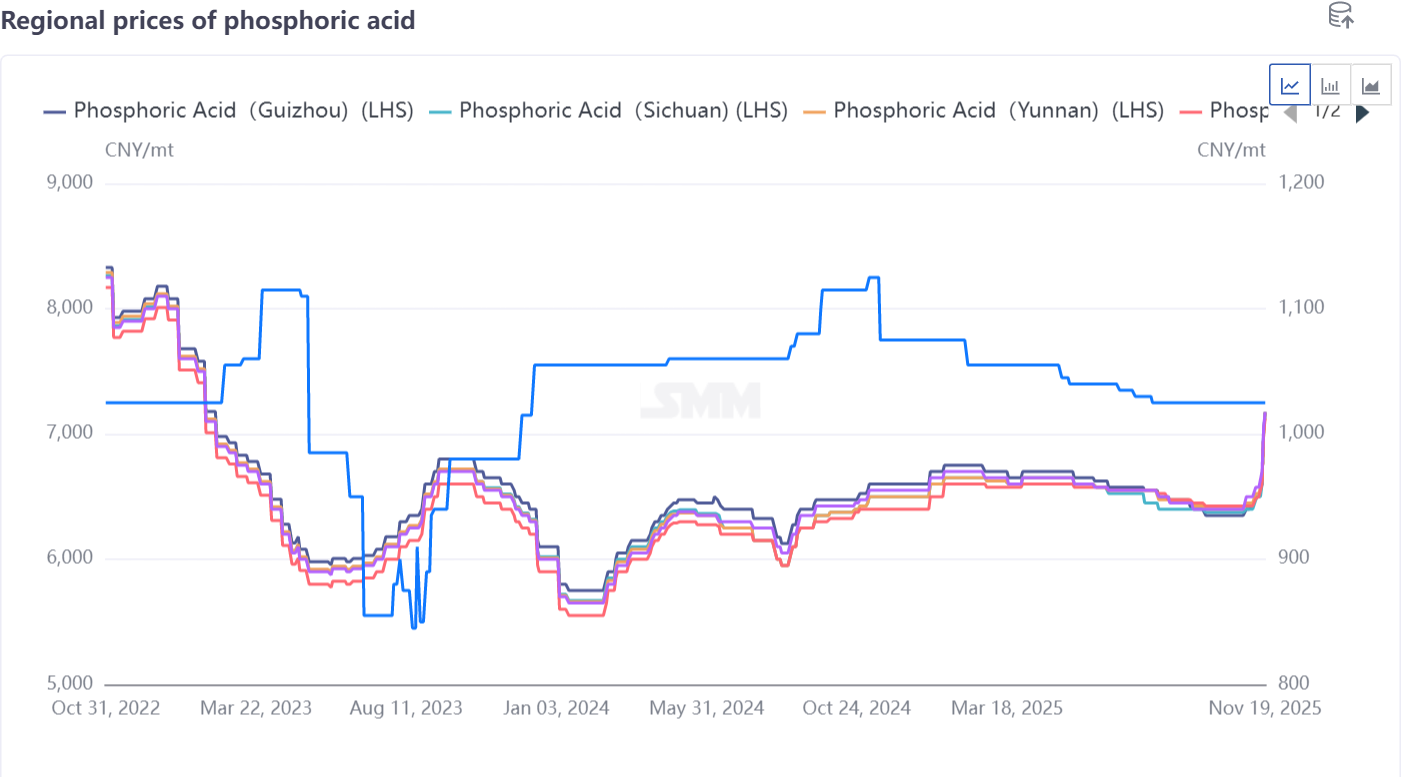
Due to rising costs and strong new energy demand, the price of 85% phosphoric acid increased from 6,400 yuan/mt in October to 7,000 yuan/mt in November.

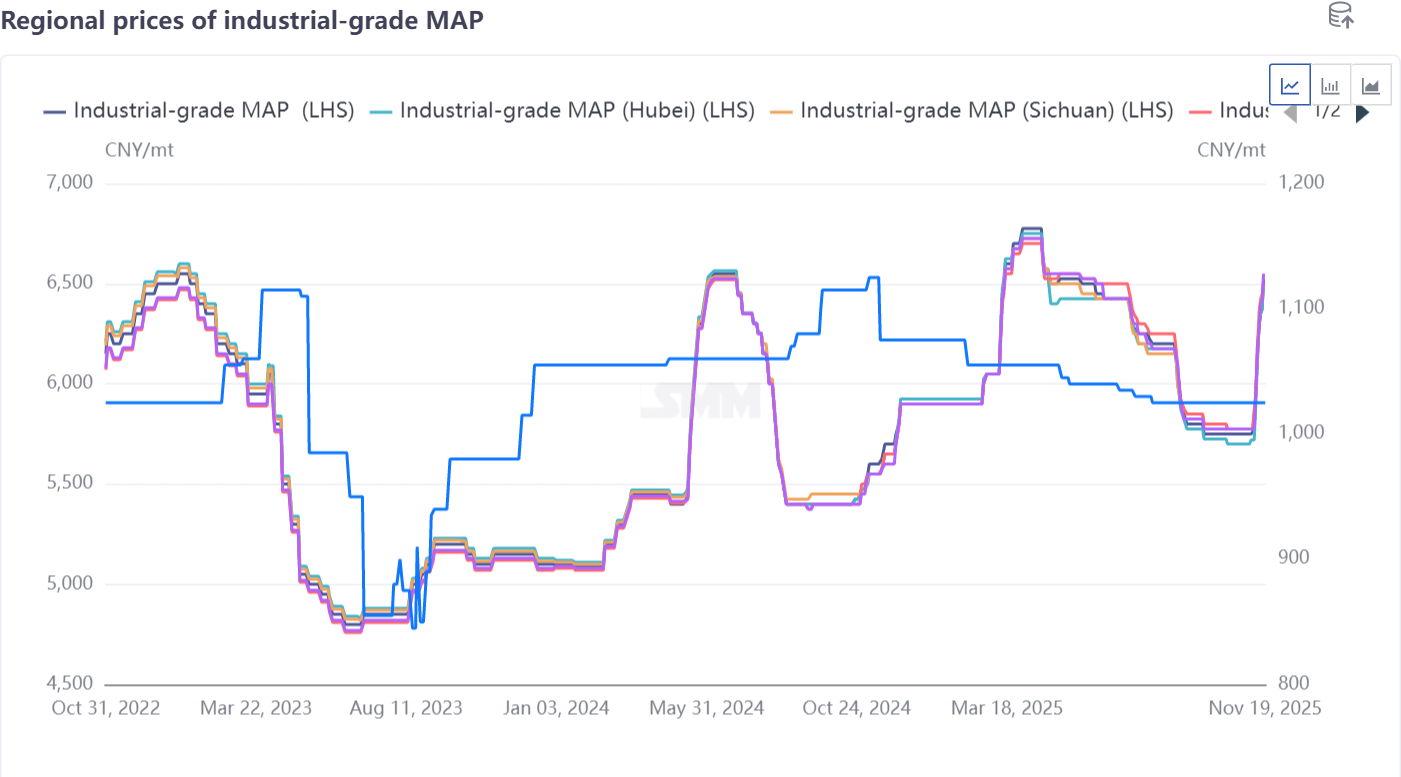
The price of industrial-grade MAP rose from 5,700 yuan/mt in October to 6,300 yuan/mt in November.

Data Source Statement: Except for publicly available information, all other data are processed by SMM based on publicly available information, market communication, and relying on SMM's internal database model. They are for reference only and do not constitute decision-making recommendations.

For any inquiries or for more information, please contact: lemonzhao@smm.cn
For more information on how to access our research reports, please contact:service.en@smm.cn
Related News
 Solid-State Battery  Accelerates, Supply Chain Diverge Sharply – Review of Listed Companies' H1 2026 Performance
19 mins ago
 Solid-State Battery Accelerates, Supply Chain Diverge Sharply – Review of Listed Companies' H1 2026 Performance
Read More
 Solid-State Battery  Accelerates, Supply Chain Diverge Sharply – Review of Listed Companies' H1 2026 Performance
 Solid-State Battery Accelerates, Supply Chain Diverge Sharply – Review of Listed Companies' H1 2026 Performance
H1 2026, performance of listed companies in the solid-state battery supply chain showed stark divergence. Traditional lithium battery material suppliers reaped huge profit growth (Tinci Materials +>900%) due to price rebounds, while overseas start-ups remained deep in the red (QuantumScape net loss $199M).
19 mins ago
[Lithium Battery: Mitsubishi Motors Plans To Build Battery Plant In Philippines]
1 hour ago
[Lithium Battery: Mitsubishi Motors Plans To Build Battery Plant In Philippines]
Read More
[Lithium Battery: Mitsubishi Motors Plans To Build Battery Plant In Philippines]
[Lithium Battery: Mitsubishi Motors Plans To Build Battery Plant In Philippines]
Recently, Mitsubishi Motors Philippines Corporation disclosed that it is planning to construct a new, modern electric vehicle battery assembly facility. The total investment scale for the project reaches 7 billion Philippine pesos, all of which will be incorporated into the Philippines' new Electric Vehicle Incentive Strategy (EVIS) support framework. The chairman of Mitsubishi Motors Philippines clearly stated that this planned project focuses on the localized assembly of batteries for hybrid models, with no plans to include battery research and development at this stage. The primary bottleneck currently hindering project progress is the pending official release of the detailed implementing rules for the EVIS policy. At the technology and industry chain planning level, Mitsubishi aims to position this Philippines battery factory as a benchmark production line in Southeast Asia, with technical standards aligned with its existing production bases in Thailand and Indonesia, and overall competitiveness benchmarked against its domestic factories in Japan. At the same time, the company will progressively advance localization support and has already initiated cooperation discussions with several local Philippine automotive parts companies to build a local supply chain system.
1 hour ago
[Lithium Battery: Environmental Impact Assessment For A Lithium Battery Anode Material Project In Guizhou Announced]
1 hour ago
[Lithium Battery: Environmental Impact Assessment For A Lithium Battery Anode Material Project In Guizhou Announced]
Read More
[Lithium Battery: Environmental Impact Assessment For A Lithium Battery Anode Material Project In Guizhou Announced]
[Lithium Battery: Environmental Impact Assessment For A Lithium Battery Anode Material Project In Guizhou Announced]
The second public notice for the environmental impact assessment of the Gui'an New Area annual 200,000-ton high-end lithium battery material intelligent manufacturing project in Guizhou has been released. The project has a total investment of 3.5549 billion yuan. Construction is scheduled to commence in 2026, with a construction period of 24 months. The project's first environmental impact assessment notice was issued in April 2026, and this is the second notice. The production target is an annual output of 200,000 tons of lithium battery anode materials.
1 hour ago