1. Company Outlook
Anglo-American
Anglo American is headquartered in London, UK, and its history can be traced back to 1917, when Sir Ernest Oppenheimer founded the Anglo-American Corporation of South Africa to mine gold in the East Rand region of South Africa. The company was approved to start with a capital of £1 million. The company was named Anglo American because the capital came mainly from the United Kingdom and the United States. In May 1999, Anglo American Corporation of South Africa (AACSA) and Minorco merged. It has now grown into a leading global mining company with operations in 45 countries. The company's products include diamonds (De Beers), copper, platinum group metals, iron ore and metallurgical coal, and nickel. Anglo American's iron ore production reached 63.8 million tons in 2021, making it one of the largest producers among non-mainstream mining companies. Iron ore is also the second largest commodity in Anglo American's revenue. At the end of 2024, Anglo American carried out asset restructuring, divested coking coal, precious metals and nickel mining businesses, and began to focus on iron ore and copper mining businesses. In September 2025, it announced a merger with Teck Resources to become "Anglo Teck". The transaction is expected to be completed within 12-18 months, at which time Anglo Teck will become one of the top ten miners in the world.
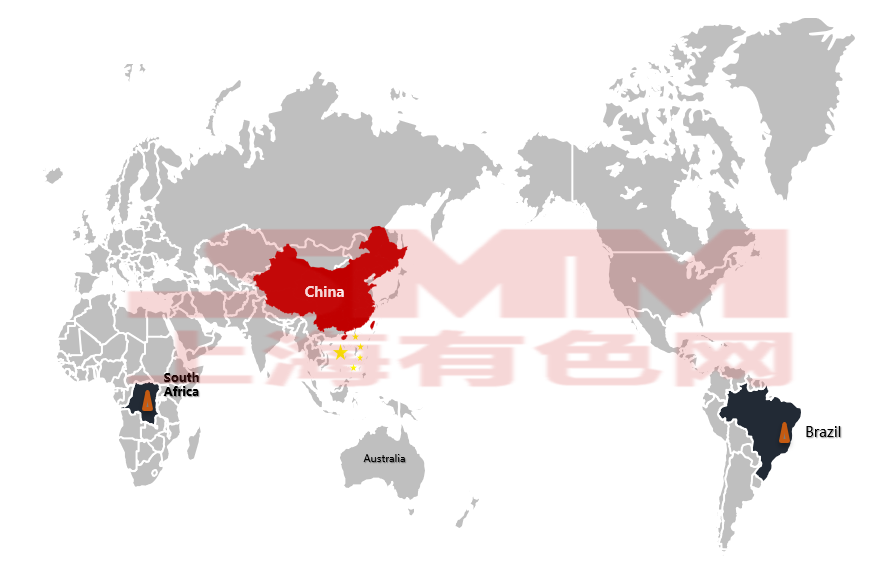
Anglo American's iron ore business provides customers with specialty, high-grade iron ore. Most of it is direct feed to blast furnaces. Anglo American has significant high-quality iron ore resources in South Africa and Brazil. It holds a majority stake (69.7%) in Kumba Iron Ore in South Africa and operates and develops the Minas-Rio project (85% stake) in Brazil with Vale.
Business In China
Anglo American opened a representative office in Beijing in 2002. This marked the beginning of Anglo American's long-term commitment to China, to become a world-class, long-term and stable partner of China. Since then, Anglo American Coal, AngloGold Ashanti, Anglo American Platinum and De Beers have opened representative offices in Beijing. Currently, all of the Group's business units are actively engaged in business in China. Anglo American currently employs 1,600 people in China, working in 18 different units, including Beijing, Shanghai, Inner Mongolia, Zhejiang, Gansu, Xinjiang and Shaanxi. Anglo American's sales in the Chinese market are mainly platinum, gold, diamonds, iron ore and non-ferrous metals.
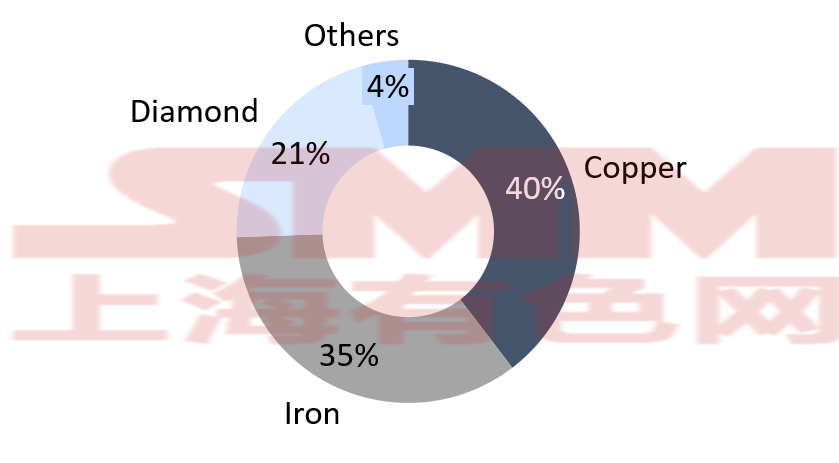
Anglo American Revenue by Segements (Q3 2025)
Sources:Anglo American Annual Report, SMM
2. Iron ore production, shipment and main products
Kumba Company
Iron Ore About 70% of the iron ore is exported overseas, of which about 60% is shipped to China. The remaining Asian countries account for about 19%. Europe accounted for about 12%. Kumba also supplies other steel companies in the country. Kumba's iron ore is transported by rail to Saldanha Bay and then shipped around the world. Kumba's iron ore production is currently constrained by poor rail performance. The local Transnet rail system is old, so equipment frequently fails and transport speeds and turnover are limited. In addition, irregular strikes have made the overall logistics performance poor. Anglo American is also cautious about the production plan of Kumba in South Africa. It is expected that the output in 2025 will be 35-37 million tonnes, and the guiding capacity will be reduced to 31-33 million tonnes in 2026 due to the transition period of new technology production.
Minas-Rio, Brazil
Minas-Rio experienced a serious pipeline leak in the first quarter of 2018, and then experienced an eight-month shutdown before resuming production, and then inspected every five years. Anglo American is relatively positive about the production plan of Minas-Rio in Brazil. In the fourth quarter of 2024, it replaced Vale's Serpentina iron ore resources with 15% of Minas-Rio's equity. Minas-Rio's guidance production for 2025 is 22-24 million tonnes due to pipeline inspection, while that for 2026 is 23-25 million tonnes.
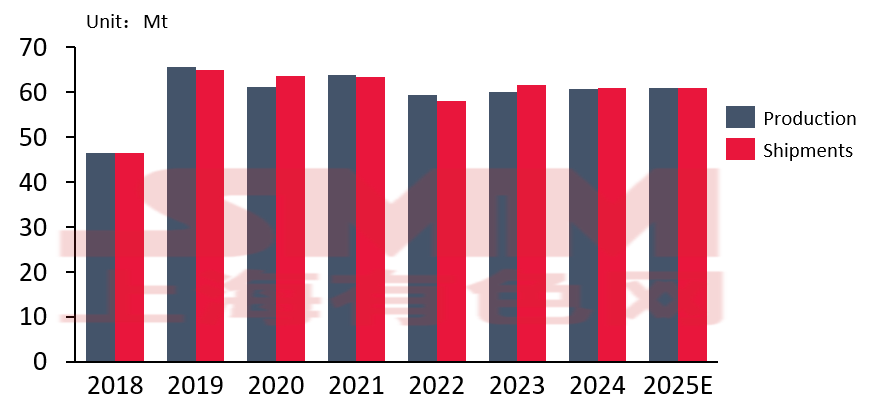
Production and shipment
Sources:Anglo American Annual Report, SMM
3. Operating Mines
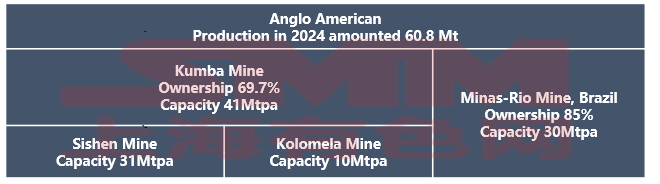
Kumba Mine has two sub-mines in South Africa:
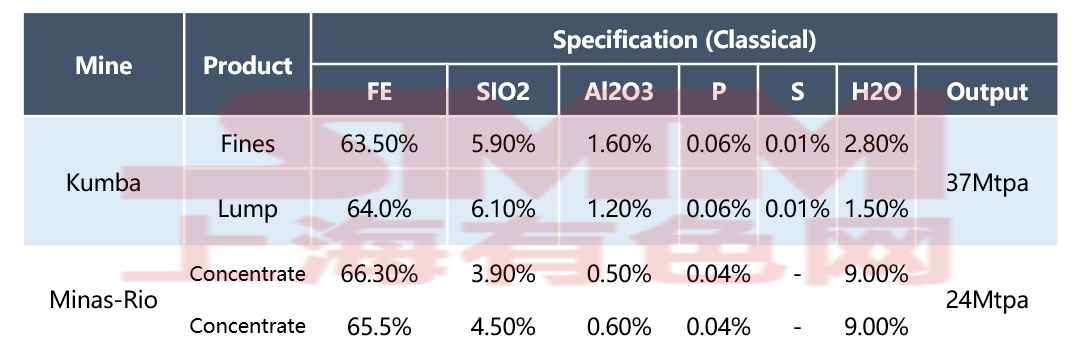
Kumba Iron Ore of South Africa currently has two mines, Sishen and Kolomela, in production, both in Northern Cape province. The Thabazimbi mine, previously located in Limpopo province, was closed in 2016 and subsequently sold. Kumba Iron Ore produces high-grade (64-65%) lump and fine ore, with lump ore being the main product, accounting for 67% of total output.
Anglo American holds 73.9% and 51.5% of the shares respectively, of which Sishen mine is the core business and has a large output.
Minas-Rio, Brazil:
The Minas-Rio mine is located in the state of Minas Gerais, Brazil, and the project scope covers the mine, concentrator, 529-kilometer slurry pipeline, and a 50% stake in the Açu port facility. Minas-Rio suffered a major pipeline leak in the first quarter of 2018, and the plant has been inspected every five years since the accident. The most recent pipeline inspection is scheduled for the third quarter of 2025.
Main Product
4.Future Project
There is no major development projects undergoing for Iron ore production by Anglo American.
Anglo American has no major iron ore development projects, and is currently focused on the integration of resources in the Minas-Rio mining area and the efficiency optimisation of Kumba.
Kumba Iron Mine: Sishen mine is expected to put the "ultra-high density medium separation (UHDMS)" technology into production in 2026, which will increase the proportion of high-quality minerals from 18% to 55% and focus on increasing the output of high-grade block ore. During the transition period in 2026, the guided output of Kumba mine area is 31-33 million tonnes, and it will return to 35-37 million tonnes in 2027.
Minas-Rio mine: The combination of Minas-Rio and Serpentina offers the potential to double the output of the Minas-Rio mine, and Vale will have the right to acquire an additional 15% stake in the expanded Minas-Rio. But the Serpentina development is not yet permitted in the short term.
![[SMM Iron & Steel] India Records 7.7% Growth in Steel Output Amid Global Decline](https://imgqn.smm.cn/usercenter/ocJKj20251217171717.jpg)
![[SMM Iron & Steel] Mesabi Metallics Secures $520 Million for Minnesota Iron Ore Project](https://imgqn.smm.cn/usercenter/niwZw20251217171715.jpg)
![[SMM Iron & Steel] European Commission Launches Investigation into Grain-Oriented Electrical Steel Imports](https://imgqn.smm.cn/usercenter/ikbxI20251217171718.jpg)