

SMM October 31 News:
Highlights: In October 2025, global total lithium sulphide production exceeded 4 mt. The solid-state battery industry landscape has shifted from "single-point technological breakthroughs" to "industry chain ecosystem competition," especially among overseas enterprises. Overseas giants are forming alliances through a "materials-cells-vehicles" approach, while China demonstrates a powerful momentum of policy guidance, capital drive, and full-chain advancement.
In October, China made intensive progress in material mass production, battery cell manufacturing, policy support, and technology patents. However, the progress speed of the annual major assessment for six major solid-state battery enterprises did not meet the expected rapid pace, and results are expected to be announced by year-end.
I. Lithium Sulphide Market Analysis
1. Lithium Sulphide Price Approaches 2,000 yuan/kg
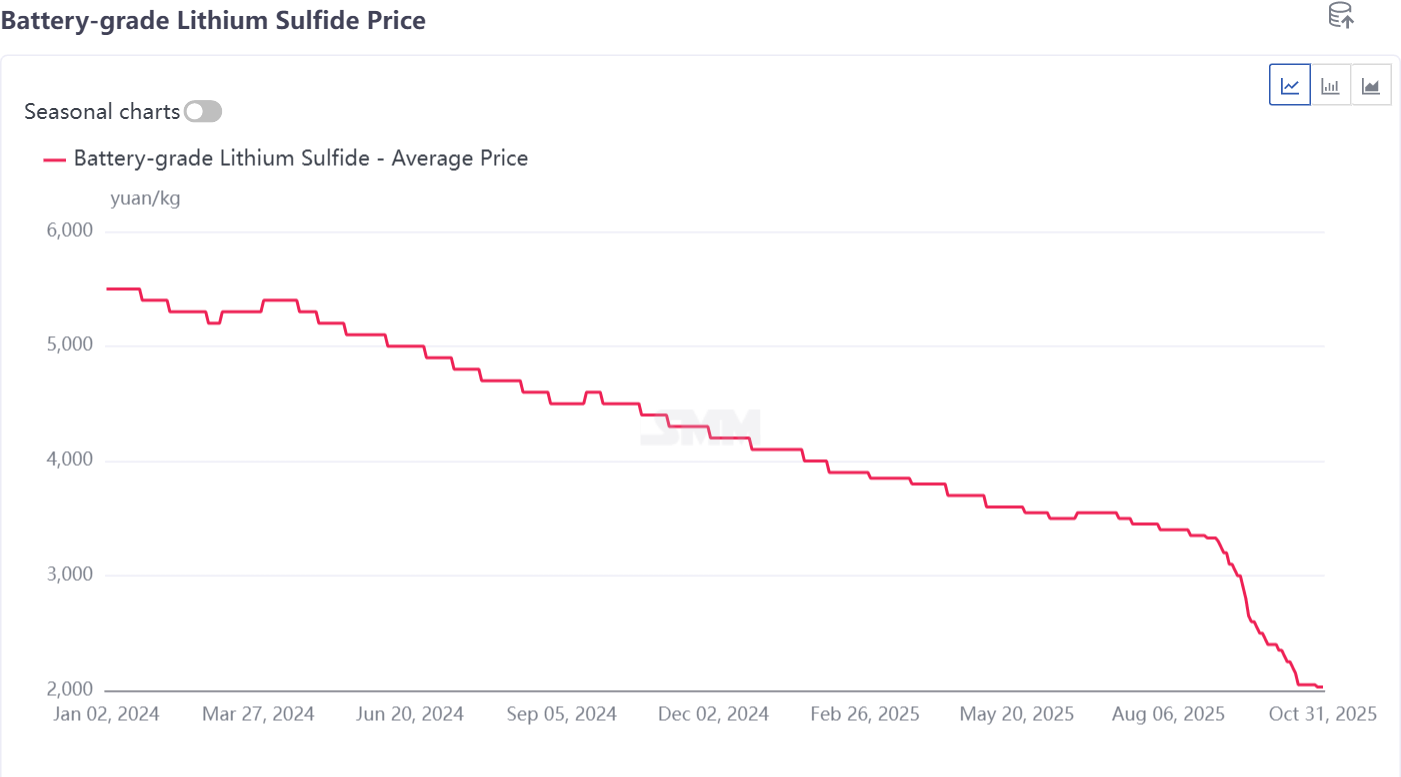
The average price of battery-grade lithium sulphide has steadily pulled back to around 2,000 yuan/kg in October 2025, after several fluctuations from a high of 5,500 yuan/kg in early 2024. The continuous price decline has paved the way for cost reduction in the upcoming industrialization of sulphide-route solid-state batteries.
Prices are expected to break through the 2,000 yuan threshold and enter the thousand-yuan era in November-December.
2. Lithium Sulphide Supply Enters a Rapid Growth Phase
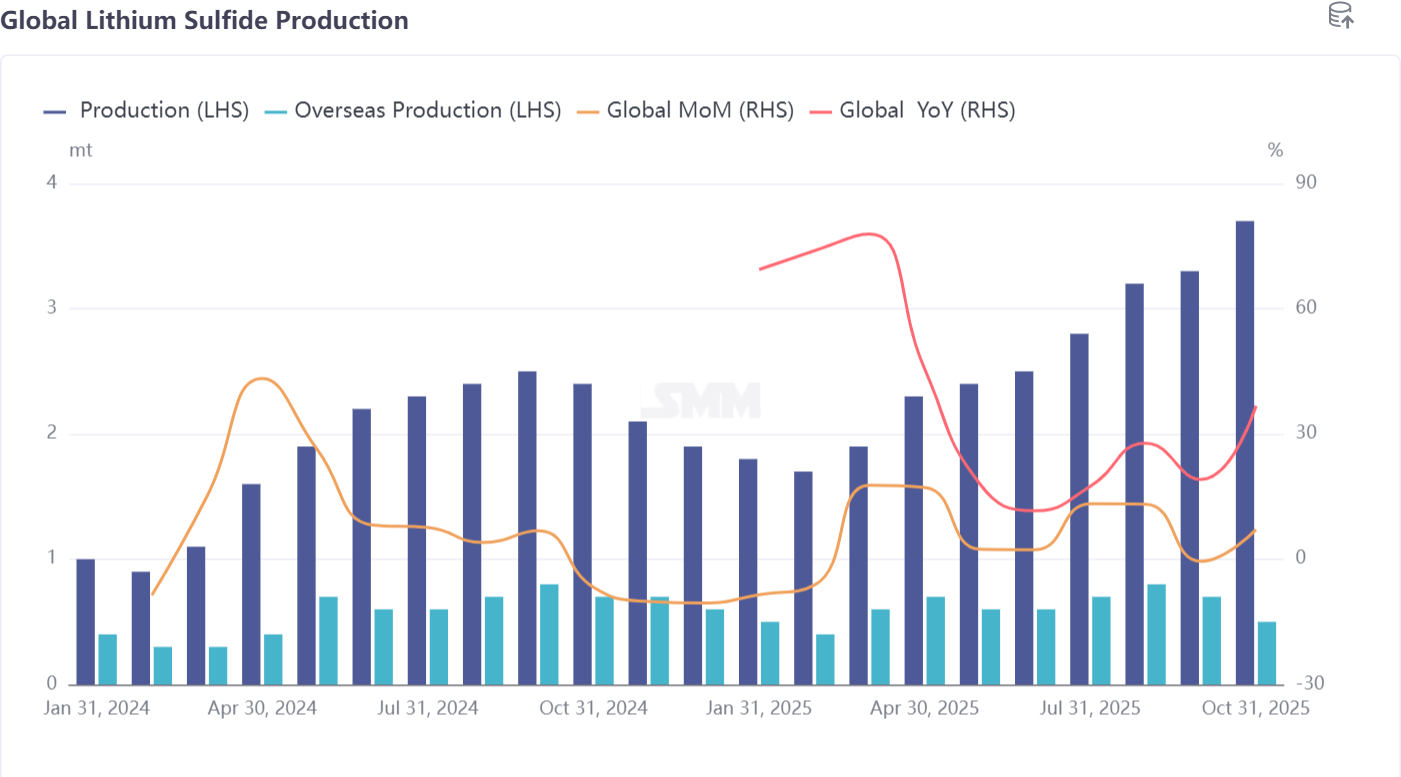
Global total production exceeded 4 mt in October, up 7% MoM and 37% YoY. Domestic and overseas sulphide electrolyte enterprises accelerated material verification and downstream sampling, maintaining incremental market demand. In November-December, lithium sulphide production is estimated to fluctuate around 4 mt; downstream technology iteration and verification require time to digest, and production may decrease MoM. Monthly production in 2026 is projected to fluctuate between 6 mt and 10 mt.
II. Solid-State Battery Market Analysis
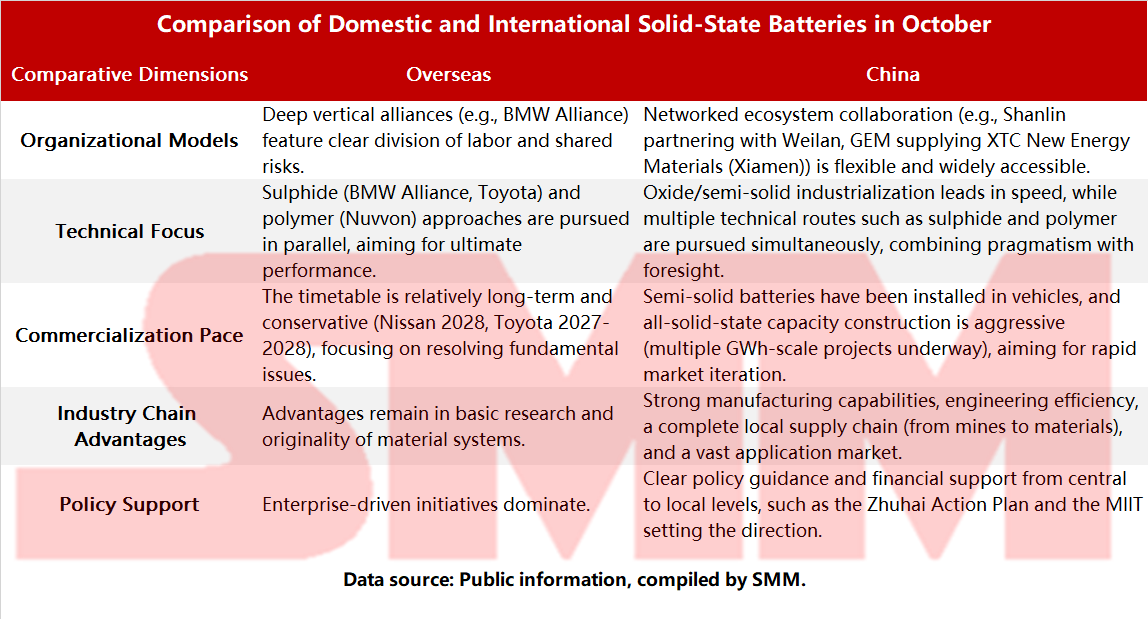
1. Domestic: Multi-Party Collaborative Layouts, Policy Continues to Drive Acceleration
Policy: The MIIT has clarified a systematic layout for all-solid-state R&D, and Zhuhai City took the lead in issuing an industry action plan, providing clear policy expectations.
Capital: Lion City State Capital invested in Qingtao Energy's 4 GWh production line, indicating state capital is actively guiding the industrialization of cutting-edge technology.
Industry Chain: Projects are flourishing everywhere, from Haochen Xinghui's 8 GWh large project to Sanwei Battery's 2 GWh smart manufacturing, with capacity layout taking the lead. Easpring Technology signed the project for an annual production of 3,000 mt of solid-state electrolyte materials and achieved 20 mt-scale shipments of specialized cathodes for all-solid-state batteries.
Sulfide: SVOLT Energy Technology partnered with HSC New Energy Materials for development, Ronbay Technology is constructing a pilot line, and SEMCORP announced that its 10 mt-scale production line for solid-state electrolyte powder has commenced operation with shipment capability. Upstream, Xingfa Group’s key additive, phosphorus pentasulfide, with an annual capacity of 10,000 mt, is expected to commence production in 2026.
Polymer: Sunwoda unveiled the "Xin·Bixiao" battery cell with an energy density of 400 Wh/kg and plans to complete a pilot line by year-end.
2. Overseas: Multi-Nation Collaborations Form Distinct Alliances Compared to China
The BMW–Samsung SDI–Solid Power partnership is a typical example, forming a closed loop from Solid Power’s sulfide electrolyte to Samsung SDI’s cell manufacturing and BMW’s vehicle validation, aiming to integrate the entire industry chain value.
Nissan Motor, through its collaboration with LiCAP on dry electrode technology, focuses on overcoming core bottlenecks in cost and efficiency for mass production, paving the way for its 2028 production target.
Summary: In October 2025, solid-state batteries made breakthroughs in corporate cooperation, technological advancements, and in-depth collaborations, but high-quality products still require time for refinement, and downstream markets need patience.
According to SMM forecasts, all-solid-state battery shipments will reach 13.5 GWh by 2028, while semi-solid-state battery shipments will reach 160 GWh. Global lithium-ion battery demand is projected to reach approximately 2,800 GWh by 2030, with the EV sector's lithium-ion battery demand showing a CAGR of around 11% from 2024 to 2030, ESS lithium-ion battery demand at a CAGR of about 27%, and consumer electronics lithium battery demand at a CAGR of roughly 10%. Global solid-state battery penetration is estimated at about 0.1% in 2025, with all-solid-state battery penetration expected to reach around 4% by 2030, and global solid-state battery penetration potentially approaching 10% by 2035.
**Note:** For further details or inquiries regarding solid-state battery development, please contact:
Phone: 021-20707860 (or WeChat: 13585549799)
Contact: Chaoxing Yang. Thank you!



