Historic Price Trends and Current Market Position
The latest market data shows alumina FOB Indonesia at $325 per metric ton, compared to the SMM Alumina Index for China at $357.34 per metric ton, creating a $32.34 per ton price differential that favors Indonesian exporters. This pricing represents a dramatic transformation from the previous year, with a 55.48% year-on-year decrease from October 2024’s $730 per metric ton.
The current price trend reveals an accelerated downward movement, with the current October's price marking a 12.16% decrease from early September's $370 per metric ton. This follows a month-on-month decline from August to September, indicating rapid market adjustments that have strengthened Indonesia's export positioning.
Figure 1: Alumina FOB Indonesia Price Trend (1-Year View)
30 Oct 2024 – 29 Oct 2025 | Source: SMM (Shanghai Metals Market)
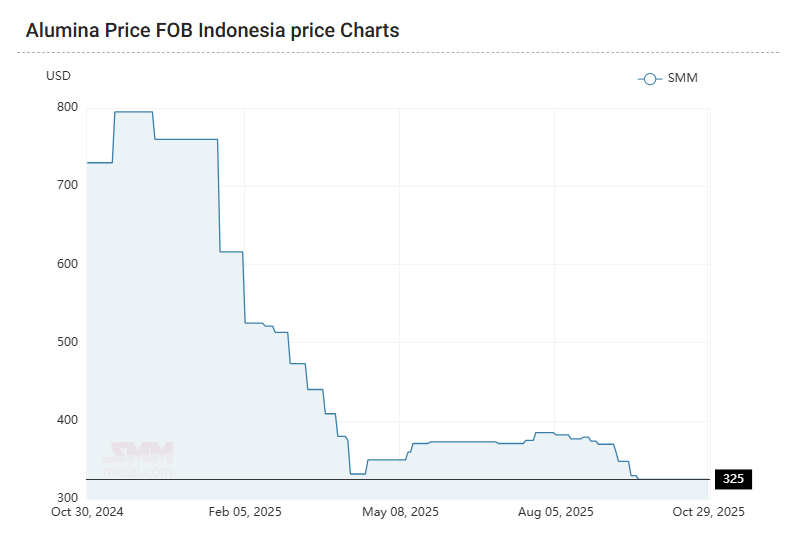
Key Price Levels (from chart):
- Nov 2024 Peak: ~$795/mt
- Oct 2024 (YoY base): $730/mt
- Early Sep 2025: ~$370/mt
- Current (Oct 2025): $325/mt
→ -59.12% from Nov peak | -55.48% YoY | -12.16% from early Sep
The current price trend reveals an accelerated downward movement, with October 2025 marking a 12.16% decline from early September 2025’s ~$370 per metric ton. This follows a month-on-month decline from August to September, signaling rapid market adjustments that have strengthened Indonesia’s export positioning.
Factors Driving the Price Trend
Several structural forces are reshaping the global alumina market:
- Global economic slowdown has reduced aluminum demand, pressuring alumina prices worldwide.
- Surplus supply from new refining capacity in Indonesia and other regions.
- Indonesia’s downstream policy banning raw bauxite exports since 2023 and mandating domestic processing, has unlocked massive alumina production growth.
Major Production Expansion Underway
The Indonesian alumina sector is witnessing simultaneous expansion across multiple major projects:
| Project | Status | Capacity Addition | Timeline |
| PT Bintan Alumina Indonesia (PT BAI) | Expansion Approved | 1 million tpa | Completion 2025 (Expected) |
| PT Borneo Alumina Indonesia | Commissioning Started | Full Plant | Operational 2025 |
| PT Borneo Alumindo Prima | Phase 1 Construction | 1 million tpa | Completion 2025 (Expected) |
PT Bintan Alumina Indonesia (PT BAI) is advancing plans to increase its production capacity by 1 million tons per annum in 2025, representing one of the most significant single expansions in the country's alumina history. This expansion comes as the company seeks to capitalize on Indonesia's strategic position in the global market.
Meanwhile, PT Borneo Alumina Indonesia has reached a crucial milestone, having begun commissioning operations in the fourth quarter of 2024. The company is targeted to achieve full operational status by the first quarter of 2025, adding substantial new capacity to Indonesia's production profile.
Complementing these developments, PT Borneo Alumindo Prima is progressing with its construction phase, with the 1,000,000-ton phase one facility expected to be completed by 2025. Although the commissioning timeline remains unconfirmed, the project represents another critical component of Indonesia's comprehensive capacity expansion strategy.
Factors Driving Market Transformation
The convergence of policy, investment, and timing is reshaping the industry:
- Indonesia’s downstreaming strategy has shifted the country from raw bauxite exporter to refined alumina powerhouse.
- China’s domestic challenges (property slowdown, energy costs) have pushed the SMM Alumina Index down 49.13% from its December 2024 peak of $702.37/mt.
- This has narrowed the Indonesia-China price gap, making Indonesian material increasingly competitive.
Export Opportunities and Competitive Advantages
The simultaneous increase in production capacity and competitive pricing creates multiple opportunities for Indonesian exporters. The significant price advantage, currently $32.34 per ton below Chinese benchmarks, makes Indonesian alumina particularly attractive to price-sensitive markets across Asia, including Japan, South Korea, and India.
The geographical advantage of Indonesian suppliers provides an additional competitive edge, with proximity to major Asian markets might be reducing shipping costs and delivery times. This logistics benefit becomes increasingly valuable as global shipping costs remain volatile and supply chain reliability grows in importance.
Planned production increases could position Indonesia to capture market share from traditional suppliers in Australia and other established producing regions. The scale of the expansions, totaling several million tons annually when all projects reach full capacity, represents a substantial addition to global supply.
Market Considerations
Despite the momentum, challenges remain:
- Price volatility: -59.12% from November 2024 peak creates investment uncertainty.
- Logistics bottlenecks: Port, rail, and shipping capacity must scale in parallel.
- Quality consistency: New plants must meet international specs to secure long-term contracts.
Future Outlook and Global Implications
Indonesia's production expansion could significantly impact global alumina trade patterns. The combination of competitive pricing and increased supply availability may create sustained pressure on global benchmarks, potentially leading to a structural adjustment in regional pricing differentials.
The successful implementation of these expansion plans could elevate Indonesia to the ranks of major global alumina exporters, fundamentally altering the global supply landscape. Beyond immediate export revenues, the growth of the alumina sector supports the development of technical expertise and industrial infrastructure that could facilitate future moves into aluminum smelting and other downstream activities.
Indonesian producers should focus on building diversified market relationships and developing a reputation for reliability and quality consistency. These factors will help sustain export growth even when pure price advantages diminish or market conditions change.
The coming quarters will be critical for assessing how effectively Indonesia can translate its production expansion and current price advantage into sustainable market position. Export volume data through 2025 and into 2026 will provide clearer indicators of the sector's ability to compete effectively in the global alumina marketplace.
As the market continues to evolve, stakeholders across the value chain are closely monitoring how Indonesian producers manage the simultaneous challenges of rapid expansion, quality assurance, and market development in an increasingly competitive global environment.
Recommendation to Producers:
Focus on quality certification, diversified offtake, and logistics partnerships to lock in market share beyond the current price cycle.
Key Monitoring Points (2025–2026)
| Metric | Impact |
| Export volume data |
Proof of market capture |
| New plant ramp-up schedules | Supply reliability |
| China demand recovery | Risk of price rebound |
| Freight & port throughput | Logistics ceiling |

![Geopolitical Disruptions and a Stronger Dollar Combined to Keep Aluminum Prices Volatile Under Pressure [SMM Aluminum Morning Meeting Summary]](https://imgqn.smm.cn/usercenter/TFHUe20251217171651.jpg)
![Futures Rebound Drove Quote Increases, While Weak Transactions Capped Gains [SMM Cast Aluminum Alloy Morning Comment]](https://imgqn.smm.cn/usercenter/fFkYh20251217171651.jpg)