Tendances historiques des prix et position actuelle du marché
Les dernières données du marché indiquent que l'alumine FOB Indonésie se négocie à 325 dollars par tonne métrique, contre 357,34 dollars par tonne métrique pour l'indice SMM de l'alumine en Chine, créant un écart de prix de 32,34 dollars par tonne favorable aux exportateurs indonésiens. Ce prix représente une transformation radicale par rapport à l'année précédente, avec une baisse de 55,48 % en glissement annuel par rapport aux 730 dollars par tonne métrique d'octobre 2024.
La tendance actuelle des prix révèle une accélération de la baisse, le prix d'octobre affichant une diminution de 12,16 % par rapport aux 370 dollars par tonne métrique du début septembre. Cela fait suite à une baisse mensuelle d'août à septembre, indiquant des ajustements rapides du marché qui ont renforcé la position à l'exportation de l'Indonésie.
Figure 1 : Tendances du prix de l'alumine FOB Indonésie (vue sur 1 an)
29 oct. 2024 – 29 oct. 2025 | Source : SMM (Shanghai Metals Market)
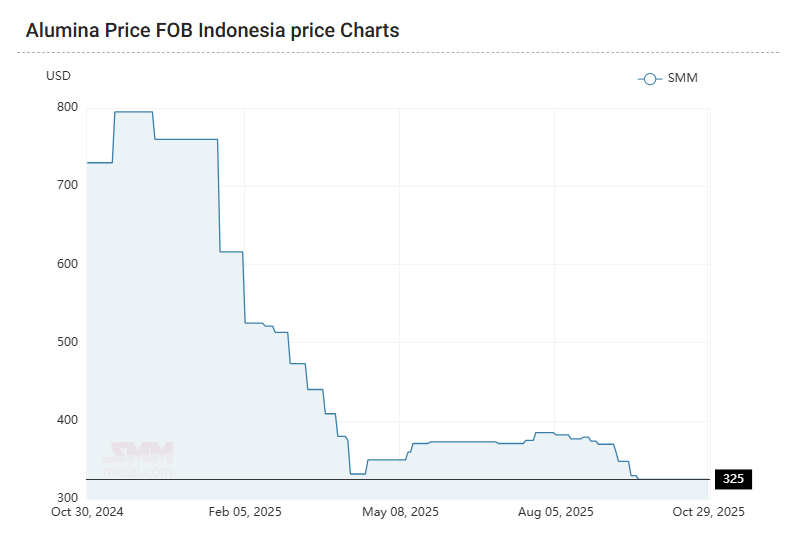
Niveaux de prix clés (d'après le graphique) :
- Pic de nov. 2024 : ~795 $/t
- Oct. 2024 (base annuelle) : 730 $/t
- Début sept. 2024 : ~370 $/t
- Actuel (oct. 2025) : 325 $/t
→ -59,12 % depuis le pic de nov. | -55,48 % en glissement annuel | -12,16 % depuis le début sept.
La tendance actuelle des prix révèle une accélération de la baisse, octobre 2025 marquant un recul de 12,16 % par rapport aux ~370 dollars par tonne métrique du début septembre 2024. Cela fait suite à une baisse mensuelle d'août à septembre, signalant des ajustements rapides du marché qui ont renforcé la position à l'exportation de l'Indonésie.
Facteurs influençant la tendance des prix
Plusieurs forces structurelles remodèlent le marché mondial de l'alumine :
- Le ralentissement économique mondial a réduit la demande d'aluminium, exerçant une pression sur les prix de l'alumine à l'échelle mondiale.
- Une offre excédentaire due aux nouvelles capacités de raffinage en Indonésie et dans d'autres régions.
- La politique indonésienne d'aval, interdisant depuis 2023 l'exportation de bauxite brute et imposant une transformation locale, a déclenché une croissance massive de la production d'alumine.
Expansion majeure de la production en cours
Le secteur indonésien de l'alumine assiste à une expansion simultanée de plusieurs grands projets :
| Projet | Statut | Ajout de capacité | Calendrier |
| PT Bintan Alumina Indonesia (BAI) | Expansion approuvée | 1 million de tonnes par an | 2025 |
| PT Borneo Alumina Indonesia | Mise en service démarrée | Usine complète | 2025 |
| PT Borneo Alumindo Prima | Construction de la phase 1 | 1 million de tonnes par an | Achèvement 2025 |
PT Bintan Alumina Indonesia (PT BAI) avance ses plans pour augmenter sa capacité de production de 1 million de tonnes par an en 2025, ce qui représente l'une des expansions individuelles les plus significatives de l'histoire de l'alumine dans le pays. Cette expansion intervient alors que l'entreprise cherche à tirer parti de la position stratégique de l'Indonésie sur le marché mondial.
Parallèlement, PT Borneo Alumina Indonesia a atteint une étape cruciale, ayant commencé les opérations de mise en service au quatrième trimestre 2024. La société vise à atteindre son plein statut opérationnel au premier trimestre 2025, ajoutant une capacité nouvelle substantielle au profil de production indonésien.
Complétant ces développements, PT Borneo Alumindo Prima progresse dans sa phase de construction, l'installation de la première phase d'une capacité de 1,000,000 de tonnes devant être achevée d'ici 2025. Bien que le calendrier de mise en service reste non confirmé, le projet représente un autre élément critique de la stratégie d'expansion globale des capacités de l'Indonésie.
Facteurs conduisant la transformation du marché
La convergence de la politique, l'investissement et le calendrier re façonne l'industrie :
- La stratégie d'aval de l'Indonésie a fait passer le pays d'exportateur de bauxite brute à une puissance de l'alumine raffinée.
- Les défis intérieurs de la Chine (ralentissement immobilier, coûts de l'énergie) ont fait chuter l'indice SMM de 49,13 % depuis son pic de décembre 2024 à 702,37 $/tonne.
- Cela a réduit l'écart de prix Indonésie-Chine, rendant la matière indonésienne de plus en plus compétitive.
Opportunités d'exportation et avantages concurrentiels
L'augmentation simultanée de la capacité de production et la tarification concurrentielle créent de multiples opportunités pour les exportateurs indonésiens. L'avantage prix significatif, actuellement de 32,34 $ par tonne en dessous des références chinoises, rend l'alumine indonésienne particulièrement attractive pour les marchés sensibles aux prix à travers l'Asie, notamment le Japon, la Corée du Sud et l'Inde.
L'avantage géographique des fournisseurs indonésiens constitue un atout concurrentiel supplémentaire, la proximité avec les principaux marchés asiatiques pouvant réduire les coûts d'expédition et les délais de livraison. Cet avantage logistique devient de plus en plus précieux alors que les coûts maritimes mondiaux restent volatils et que la fiabilité de la chaîne d'approvisionnement gagne en importance.
Les augmentations de production planifiées pourraient permettre à l'Indonésie de capturer des parts de marché auprès des fournisseurs traditionnels en Australie et dans d'autres régions productrices établies. L'ampleur des expansions, totalisant plusieurs millions de tonnes annuellement lorsque tous les projets atteindront leur pleine capacité, représente un ajout substantiel à l'offre mondiale.
Considérations de marché
Malgré la dynamique, des défis persistent :
- Volatilité des prix : -59,12 % par rapport au pic de novembre 2024 crée une incertitude pour les investissements.
- Goulots d'étranglement logistiques : La capacité portuaire, ferroviaire et maritime doit augmenter parallèlement.
- Cohérence de la qualité : Les nouvelles usines doivent répondre aux spécifications internationales pour sécuriser des contrats à long terme.
Perspectives futures et implications mondiales
L'expansion de la production indonésienne pourrait impacter significativement les modèles du commerce mondial de l'alumine. La combinaison d'une tarification concurrentielle et d'une disponibilité accrue de l'offre pourrait exercer une pression soutenue sur les références mondiales, conduisant potentiellement à un ajustement structurel des écarts de prix régionaux.
La mise en œuvre réussie de ces plans d'expansion pourrait élever l'Indonésie au rang des principaux exportateurs mondiaux d'alumine, modifiant fondamentalement le paysage de l'offre mondiale. Au-delà des revenus d'exportation immédiats, la croissance du secteur de l'alumine soutient le développement de l'expertise technique et des infrastructures industrielles, ce qui pourrait faciliter de futures incursions dans la fusion de l'aluminium et d'autres activités en aval.
Les producteurs indonésiens devraient se concentrer sur la construction de relations de marché diversifiées et sur le développement d'une réputation de fiabilité et de cohérence qualitative. Ces facteurs aideront à soutenir la croissance des exportations même lorsque les avantages purement prix diminuent ou que les conditions de marché changent.
Les prochains trimestres seront critiques pour évaluer dans quelle mesure l'Indonésie peut transformer son expansion de la production et son avantage prix actuel en une position de marché durable. Les données sur les volumes d'exportation jusqu'en 2025 et en 2026 fourniront des indicateurs plus clairs de la capacité du secteur à rivaliser efficacement sur le marché mondial de l'alumine.
Alors que le marché continue d'évoluer, les acteurs de toute la chaîne de valeur surveillent de près la manière dont les producteurs indonésiens gèrent les défis simultanés de l'expansion rapide, de l'assurance qualité et du développement commercial dans un environnement mondial de plus en plus compétitif.
Recommandation aux producteurs :
Se concentrer sur la certification qualité, la diversification des débouchés, et les partenariats logistiques pour verrouiller des parts de marché au-delà du cycle de prix actuel.
Points de surveillance clés (2025–2026)
| Métrique | Impact |
| Données sur le volume des exportations |
Preuve de la captation de marché |
| Calendriers de montée en puissance des nouvelles usines | Fiabilité de l'approvisionnement |
| Reprise de la demande chinoise | Risque de rebond des prix |
| Fret & débit portuaire | Plafond logistique |

![La vigueur du dollar pèse sur les valorisations des métaux de base, l'aluminium au SHFE se consolide à des niveaux bas avec une résistance des moyennes mobiles [Résumé de la réunion matinale sur l'aluminium du SMM]](https://imgqn.smm.cn/usercenter/gdRUL20251217171651.jpg)