China’s One-Year Delay on Rare Earth Export Controls Lifts Market – Will Magnetic Materials Exports Surge?【SMM Analysis】

Published: Oct 30, 2025 13:19
Source: SMM
On October 26, 2025, the China-US economic and trade talks concluded in Kuala Lumpur, with the US pledging to suspend the planned 100% tariff hike on Chinese goods. In response, China decided to postpone its rare earth export control measures by one year. The news directly boosted market confidence. On October 27, the price of Pr-Nd oxide, a benchmark in the rare earth market, rose by approximately 9,000 yuan/mt in a single day, with spot quotations approaching the 510,000 yuan/mt mark. Subsequently, on October 30, Chinese leaders departed for Busan, South Korea, to attend the APEC meeting and are scheduled to hold talks with US President Donald Trump, where the two sides are expected to further discuss issues such as semiconductor and rare earth trade. According to an SMM survey, recent inquiries for NdFeB permanent magnets and Pr-Nd alloy, both at home and abroad, have shown a significant increase, and purchase willingness among end-users has also improved compared to the previous period.
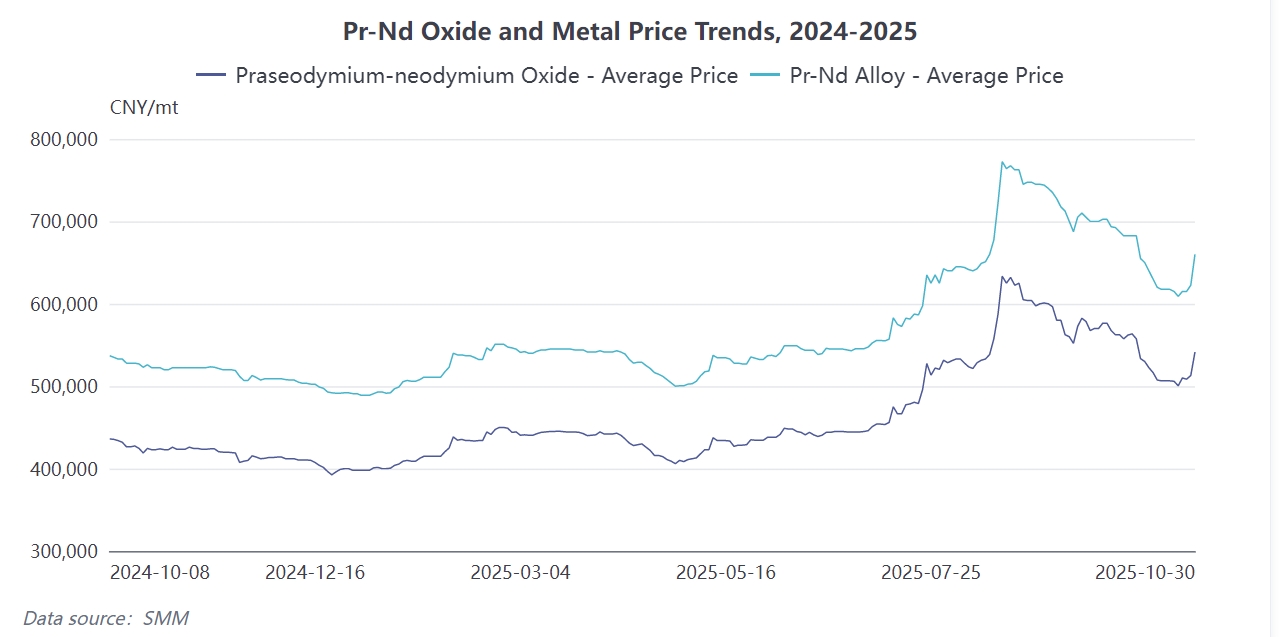
On October 26, 2025, the China-US economic and trade talks concluded in Kuala Lumpur, with the US pledging to suspend the planned 100% tariff hike on Chinese goods. In response, China decided to postpone its rare earth export control measures by one year. The news directly boosted market confidence. On October 27, the price of Pr-Nd oxide, a benchmark in the rare earth market, rose by approximately 9,000 yuan/mt in a single day, with spot quotations approaching the 510,000 yuan/mt mark. Subsequently, on October 30, Chinese leaders departed for Busan, South Korea, to attend the APEC meeting and are scheduled to hold talks with US President Donald Trump, where the two sides are expected to further discuss issues such as semiconductor and rare earth trade. According to an SMM survey, recent inquiries for NdFeB permanent magnets and Pr-Nd alloy, both at home and abroad, have shown a significant increase, and purchase willingness among end-users has also improved compared to the previous period.

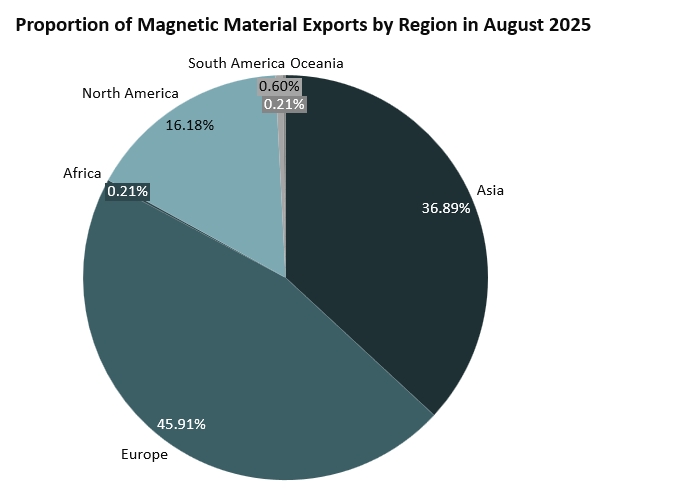
Although the two high-level meetings released positive signals, SMM believes that the market still needs to rationally assess the actual growth potential of subsequent magnetic material exports. Historical data show that the US is not the primary export destination for China's NdFeB permanent magnet materials, with its share remaining stable between 9% and 13% over the long term. Even in August this year, when exports saw significant growth, the proportion of exports to the US remained around 12%. In contrast, the European market serves as the ballast for China's magnetic material exports, typically accounting for 40% to 45% of total exports, and reaching 48% to 50% during peak demand periods. Geopolitically, Europe often adopts a balancing strategy between China and the US. China's postponement of export controls undoubtedly brought relief to European enterprises, enabling them to maintain relations with the US while continuing to secure magnetic material supplies from China.
In addition, the easing of China-US relations also benefits economies like Malaysia, which possess rare earth resources but have relatively weak processing technologies, providing them with a more stable external environment to seek economic development amid the rivalry between major powers.

Looking ahead at the export trend of magnetic materials, SMM analysis believes that in the short term, it is difficult for NdFeB permanent magnet exports to experience explosive growth. As November approaches, the European market is about to enter the Christmas holiday season one after another, with overall industrial activity slowing down. Although end-users show increased willingness to inquire about orders, the urgency for downstream enterprises to stockpile has diminished as export controls have been confirmed to be extended for one year. Most European and American companies may choose to conduct inquiries and place initial orders in November-December, while large-volume actual deliveries are expected to materialize only in Q1 of next year. Although Asian customers (such as Japan, South Korea, and Southeast Asian countries) may have short-term stockpiling needs, the total demand remains limited due to the traditional off-season in Q4. Some magnetic material enterprises have also reported that currently, European and American customers "inquire a lot but place relatively few actual orders."

It should be noted that the US compromise with China on the rare earth issue is, to some extent, a pragmatic choice after facing challenges in its efforts to promote the "de-Sinicization" of the rare earth supply chain. However, this does not mean that the US will abandon its long-term strategy of building an independent or diversified rare earth supply chain. The exploration of rare earth resource extraction and commercial utilization worldwide will remain a mainstream trend. SMM will continue to monitor the evolution of the global rare earth industry landscape and the specific outcomes of this high-level China-US dialogue.
Data Source Statement: Except for publicly available information, all other data are processed by SMM based on publicly available information, market communication, and relying on SMM‘s internal database model. They are for reference only and do not constitute decision-making recommendations.

For any inquiries or to learn more information, please contact: lemonzhao@smm.cn
For more information on how to access our research reports, please contact:service.en@smm.cn
Related News
Lindian Resources Acquires SARECO Rare Earth Plant in Kazakhstan for $15M, Enhancing Malawi Project Integration
Mar 3, 2026 10:04
Lindian Resources Acquires SARECO Rare Earth Plant in Kazakhstan for $15M, Enhancing Malawi Project Integration
Read More
Lindian Resources Acquires SARECO Rare Earth Plant in Kazakhstan for $15M, Enhancing Malawi Project Integration
LIN (Lindian Resources, ASX: LIN) acquired the core of SARECO, which can be summarized as: through a joint venture with RA, acquiring 100% interest in SARECO's rare earth separation plant (MREC hydrometallurgy plant) located in Kazakhstan for approximately $15 million, providing ready downstream processing capacity for the Kangankunde project in Malawi and accelerating an integrated layout from mine to separated products. The SARECO MREC plant is located in Kazakhstan, where it benefits from low-cost power, water, sulphuric acid, reagents, and skilled labor, facilitating the control of operating costs.
Mar 3, 2026 10:04
Malaysia Renews Lynas Rare Earths' License for 10 Years to Import and Process Radioactive Materials
Mar 2, 2026 12:01
Malaysia Renews Lynas Rare Earths' License for 10 Years to Import and Process Radioactive Materials
Read More
Malaysia Renews Lynas Rare Earths' License for 10 Years to Import and Process Radioactive Materials
Malaysia has renewed Lynas Rare Earths'LYC.AX opeating licence for 10 more years to import raw materials containing natural radioactive material and process rare earths,the Australian miner said on Monday.The Malaysian Department of Atomic Energy is expected to issue the formal licence soon,Lynas said,adding that it would come into effect from March 3.
Mar 2, 2026 12:01
Iran Conflict Has Minimal Impact on Rare Earth Industry, May Affect European Prices
Feb 28, 2026 19:31
Iran Conflict Has Minimal Impact on Rare Earth Industry, May Affect European Prices
Read More
Iran Conflict Has Minimal Impact on Rare Earth Industry, May Affect European Prices
SMM News: The conflict in Iran that began on the afternoon of February 28, 2026, has not yet had a significant impact on the rare earth industry chain. According to SMM data, China exported approximately 67 mt of rare earth permanent magnets to Iran throughout 2025, accounting for 0.11% of total exports, and about 746 mt to all Middle Eastern countries, representing 1.1% of total exports. It is expected that the situation will mainly affect ocean freight rates, subsequently impacting rare earth prices in Europe and further intensifying the upward trend in European rare earth prices.
Feb 28, 2026 19:31
China’s One-Year Delay on Rare Earth Export Controls Lifts Market – Will Magnetic Materials Exports Surge?【SMM Analysis】 - Shanghai Metals Market (SMM)