SMM October 24 News:
Highlights: Sunwoda announced a major technological breakthrough at the Zaozhuang New Energy Battery Conference on October 23, 2025: the "Xin·Bixiao" polymer solid-state battery cell with an energy density of 400 Wh/kg, and also announced the successful trial production of a 520 Wh/kg lithium-metal battery.

Sunwoda Achieves Key Breakthrough in Solid-State Battery Technology, Combining 400Wh/kg Energy Density with Ultra-High Safety.
A Pragmatic Step-by-Step Strategy from Semi-Solid to All-Solid-State Is Progressing Steadily, with the Pilot Line Set for Completion by Year-End to Accelerate Industrialisation.
Deep Collaboration with Automakers Such as Li Auto and Dongfeng Paves the Way for Commercialisation.
On October 23, 2025, at the Zaozhuang 2025 New Energy Battery Industry Development Conference, Sunwoda Unveiled a Polymer Solid-State Battery Cell with an Energy Density of up to 400Wh/kg and Announced Plans to Build 0.2GWh of Capacity by Year-End.
Xu Zhongling, Dean of the Central Research Institute at SEVB, Revealed That Sunwoda Successfully Trial-Produced a Lithium-Metal Battery with an Energy Density of 520Wh/kg in Q4.
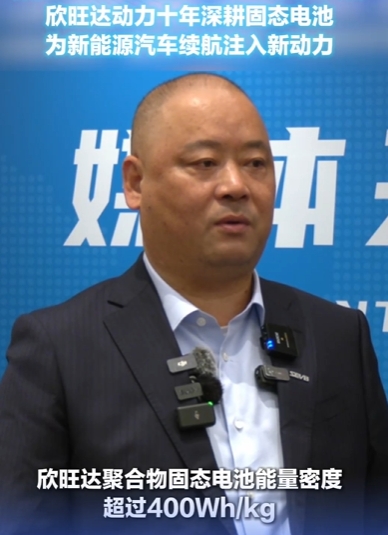
Sunwoda's solid-state battery cell, named the "Xin·Bixiao" polymer solid-state battery cell, achieves an energy density of 400 Wh/kg, a cell capacity of 20 Ah, a cycle life of 1,200 cycles, and demonstrates ultra-high safety by passing a 200°C hot box test.
In terms of solid-state battery performance, Sunwoda introduced innovations in raw materials. This polymer solid-state battery cell employs an ultra-dense solid-state electrode, reducing the pole piece porosity to 5% (compared to 25% in conventional cathodes), and enhances cathode ion conduction by three orders of magnitude. It utilizes a nano-structured high-entropy anode, achieving a specific capacity of 2,700 mAh/g—equivalent to 7.2 times that of graphite anodes—with a first-cycle efficiency of 96% and a doubled cycle life. The ultra-thin polymer composite electrolyte membrane represents the battery's most significant technological breakthrough, addressing shortcomings in ionic conductivity and mechanical strength. The cell also features a super-elastic interface coating that enables high ion conduction, strong adhesion, high ductility, and self-healing.
Additionally, Xu Zhongling announced that Sunwoda has successfully trial-produced a lithium-metal battery with an energy density of 520 Wh/kg. This battery also incorporates two innovative materials: a lightweight three-dimensional composite anode and a microcapsule slow-release layer. The three-dimensional composite anode establishes an unobstructed ion transport network, while the interface repair agent within the microcapsule slow-release layer is gradually released to regulate the battery's SEI film, suppress lithium dendrite growth, and mitigate interfacial side reactions.
Sunwoda Solid-State Battery R&D History
2015: Initiated solid-state battery layout
2020: Developed semi-solid-state battery
July 5, 2024: Sunwoda's subsidiary, SEVB, and the Songshan Lake Materials Laboratory formally signed the "Framework Agreement on Co-establishing the Dongguan Songshan Lake Solid-State Battery Public R&D Platform" in Dongguan. This marks the beginning of in-depth collaboration between SEVB and the Songshan Lake Materials Laboratory in the field of solid-state batteries, jointly promoting the commercial development and market application of solid-state battery technology.
2025: Q1 release of Xin·Yunxiao 1.0 aviation power battery, Q2 release of Xin·Yunxiao 2.0 soft solid-state battery
October 23, 2025: Release of the "Xin·Bixiao" polymer solid-state battery cell with an energy density of 400 Wh/kg and a cell capacity of 20 Ah
Production line: Sunwoda plans to complete a 0.2 GWh polymer solid-state battery cell pilot production line by the end of 2025.
According to SMM projections, all-solid-state battery shipments are expected to reach 13.5 GWh by 2028, while semi-solid-state battery shipments are forecast to reach 160 GWh. By 2030, global lithium-ion battery demand is estimated to be around 2,800 GWh, with the compound annual growth rates from 2024 to 2030 for lithium-ion battery demand in EVs, ESS, and consumer electronics at approximately 11%, 27%, and 10%, respectively. The global penetration rate of solid-state batteries is projected to be around 0.1% in 2025, and is expected to reach about 4% for all-solid-state batteries by 2030. By 2035, the global penetration rate of solid-state batteries may approach 10%.
**Note:** For further details or inquiries regarding solid-state battery development, please contact:
Phone: 021-20707860 (or WeChat: 13585549799)
Contact: Chaoxing Yang. Thank you!
![Solid-State Battery Next Decade Series, Part 6 of 9: Ternary Route May Become Great Again [SMM Analysis]](https://imgqn.smm.cn/usercenter/JSjkr20251217171728.jpg)
![Solid-state Battery September Analysis and Quarterly Review: Policy and Capital Heat Up, Material Spot Cools Down, Industrialisation Moves from "kg" to "mt" [SMM Analysis]](https://imgqn.smm.cn/usercenter/olwlF20251217171731.jpg)