Boost in Automotive Consumption Aids Rebound in Operating Rate of Secondary Aluminum Producers in September [SMM Analysis]

Published: Oct 17, 2025 11:46
Source: SMM
[SMM Analysis]Boost in Automotive Consumption Drives Rebound in Operating Rate of Secondary Aluminum Producers in September, Multiple Factors to Constrain Performance in October

Survey Data on Operating Rates of Secondary Aluminum Alloy Enterprises by Region and Scale in October 2025:
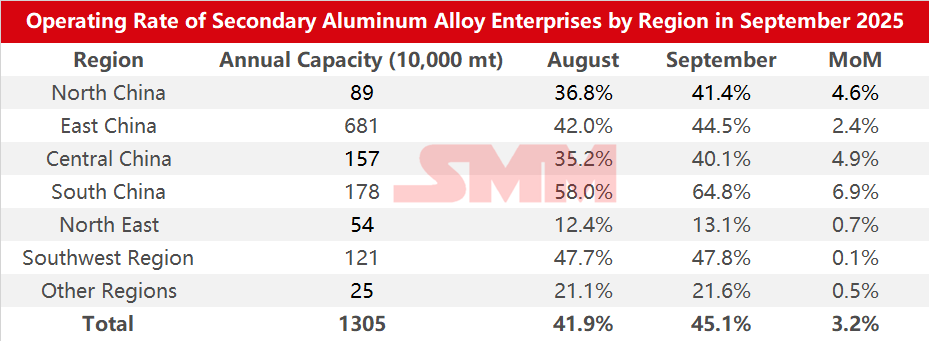
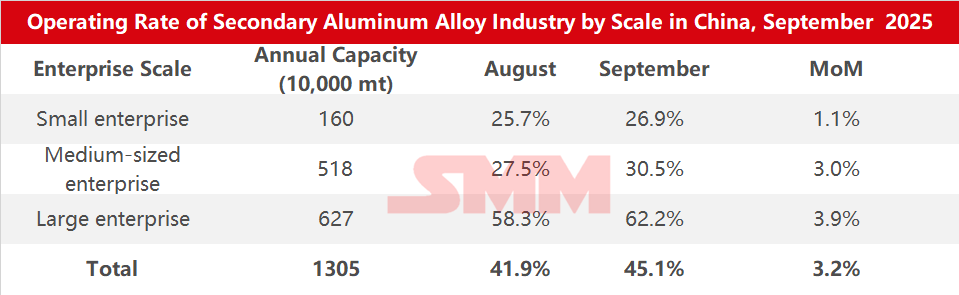
According to the SMM survey, the operating rate in the secondary aluminum industry rose by 3.2 percentage points MoM to 45.1% in September 2025, up 3.8 percentage points YoY.

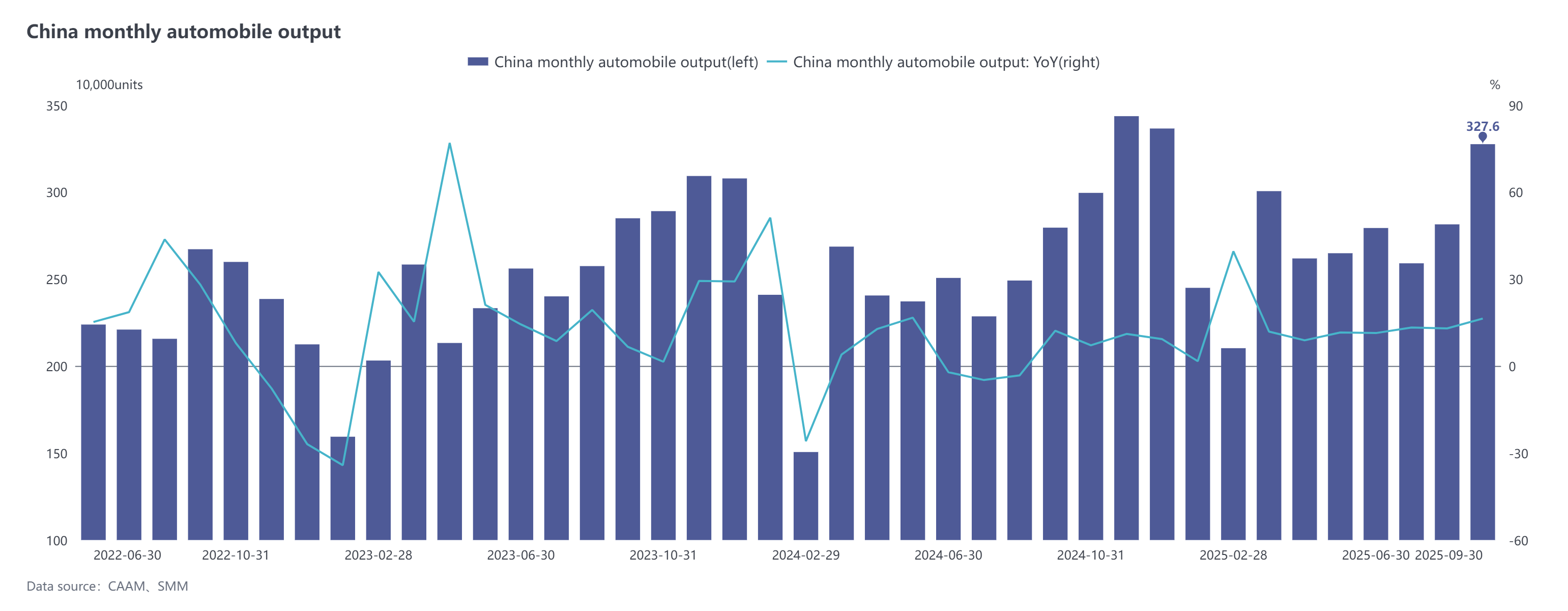
With improved end-use consumption in sectors such as automobiles, the operating rates of secondary aluminum plants, especially large ones, rebounded significantly, with orders related to aluminum liquid performing notably well. According to CAAM statistics, automobile production and sales in September reached 3.276 million units and 3.226 million units, up 16.4% and 12.9% MoM, and up 17.1% and 14.9% YoY, respectively.
Recently, the automotive trade-in policy continued to show effects, with some suspended regions resuming the policy. Positive progress has been made in comprehensive industry governance to address involution, local auto shows are in full swing, and enterprises are intensively launching new products. The overall automotive market maintained a favorable trend, with monthly YoY growth rates in production and sales exceeding 10% for five consecutive months. Moreover, new momentum accelerated, and foreign trade demonstrated resilience.
However, the growth in industry supply in September remained constrained by multiple factors, including tight raw material supply, policy uncertainties, and regional typhoon impacts. Among these, the supply deficit of aluminum scrap was particularly prominent, with the circulation of aluminum scrap remaining persistently tight. Market competition for goods drove prices to rise rapidly, forcing secondary aluminum enterprises to either purchase at high prices across regions or increase the proportion of wrought aluminum used. Although a mid-month correction in aluminum prices led to a marginal improvement in aluminum scrap circulation, the tight supply situation had not yet eased. Coupled with the concentrated release of stocking demand ahead of the month-end holiday, procurement pressure was further heightened.

Entering October, affected by the holiday factor, production pace at some enterprises slowed down temporarily, but most maintained continuous production or only halted briefly for 1–3 days, resulting in limited impact on the overall production side. On the policy front, production at secondary aluminum plants remained somewhat constrained, with some enterprises in Jiangxi and Anhui indicating that they needed to wait for further clarity on local policies before resuming production, leading to continued limitations on capacity release. Demand side, post-holiday downstream consumption performance was moderate, but the MoM improvement was limited, with overall demand recovery falling short of expectations. Overall, the industry operating rate in October is expected to show a slight correction.
Data Source Statement: Except for publicly available information, all other data are processed by SMM based on publicly available information, market communication, and relying on SMM‘s internal database model. They are for reference only and do not constitute decision-making recommendations.

For any inquiries or to learn more information, please contact: lemonzhao@smm.cn
For more information on how to access our research reports, please contact:service.en@smm.cn
Related News
Fed Governor Milan Pushes for Over 100 Basis Points Cut, Contradicts Barkin on Caution
Feb 7, 2026 17:24
Fed Governor Milan Pushes for Over 100 Basis Points Cut, Contradicts Barkin on Caution
Read More
Fed Governor Milan Pushes for Over 100 Basis Points Cut, Contradicts Barkin on Caution
Federal Reserve Governor Milan pointed out that it is necessary for the US Fed to cut interest rates by more than 100 basis points this year. At the same time, he is very much looking forward to the performance of Kevin Warsh as Fed Chairman. However, Richmond Fed President Barkin emphasized that monetary policy must remain cautious until inflation fully pulls back to the target level, thereby ensuring the stability of the labour market.
Feb 7, 2026 17:24
Democratic Senators Demand Delay in Fed Nomination Amid Criminal Investigation
Feb 7, 2026 17:23
Democratic Senators Demand Delay in Fed Nomination Amid Criminal Investigation
Read More
Democratic Senators Demand Delay in Fed Nomination Amid Criminal Investigation
All 11 Democratic members of the US Senate Banking Committee jointly sent a letter to the committee's chairman, Tim Scott, requesting that all nomination processes for the prospective Fed Chairman, Kevin Warsh, be postponed until the criminal investigation into current Fed Chairman Powell and other board members is concluded. However, Scott stated that Warsh's confirmation was a done deal.
Feb 7, 2026 17:23
Fed to Keep Large Banks' Capital Levels Unchanged, Postpones Stress Test Reforms Until 2027
Feb 7, 2026 17:23
Fed to Keep Large Banks' Capital Levels Unchanged, Postpones Stress Test Reforms Until 2027
Read More
Fed to Keep Large Banks' Capital Levels Unchanged, Postpones Stress Test Reforms Until 2027
The US Fed has announced that it will maintain the capital levels of large banks unchanged during the upcoming stress test cycle (corresponding to the 2026 cycle). At the same time, the US Fed is planning multidimensional reforms to this annual test, aiming to enhance its transparency. The US Fed's Vice Chair for Supervision, Bowman, revealed that adjustments to the stress capital buffer requirements for large banks will be postponed until 2027. This move is intended to provide the US Fed with sufficient time to evaluate potential flaws that may be exposed in its testing models when assessing banks' financial conditions under simulated economic downturn scenarios.
Feb 7, 2026 17:23