How Does the Resumption of Production at Secondary Lead Smelters in October Affect Lead Prices?【SMM Analysis】

Published: Oct 14, 2025 15:31
Source: SMM
In mid-October, lead prices continued to fluctuate rangebound, while downstream consumption remained moderate. Secondary lead smelters resumed production in October, leading to a gradual increase in supply. However, most of the earlier production was allocated to long-term contracts, leaving spot orders relatively limited, which had a relatively small dampening effect on lead prices.

Mid-October has arrived, yet lead prices continue to fluctuate rangebound. Downstream lead-acid battery consumption remains lukewarm, providing insufficient momentum for lead price increases. Additionally, from late August to early-mid September, multiple secondary lead smelters halted production.

As production resumption plans progress in October, the supply of secondary lead in circulation is gradually increasing, which may exert some pressure on lead prices. According to SMM data derived from market communication and processing at the end of September, secondary refined lead production in October is expected to increase by approximately 20,000 mt.

Following the National Day and Mid-Autumn Festival holidays, some smelters in East China have officially resumed production with stable output, and a few enterprises even exceeded production expectations.
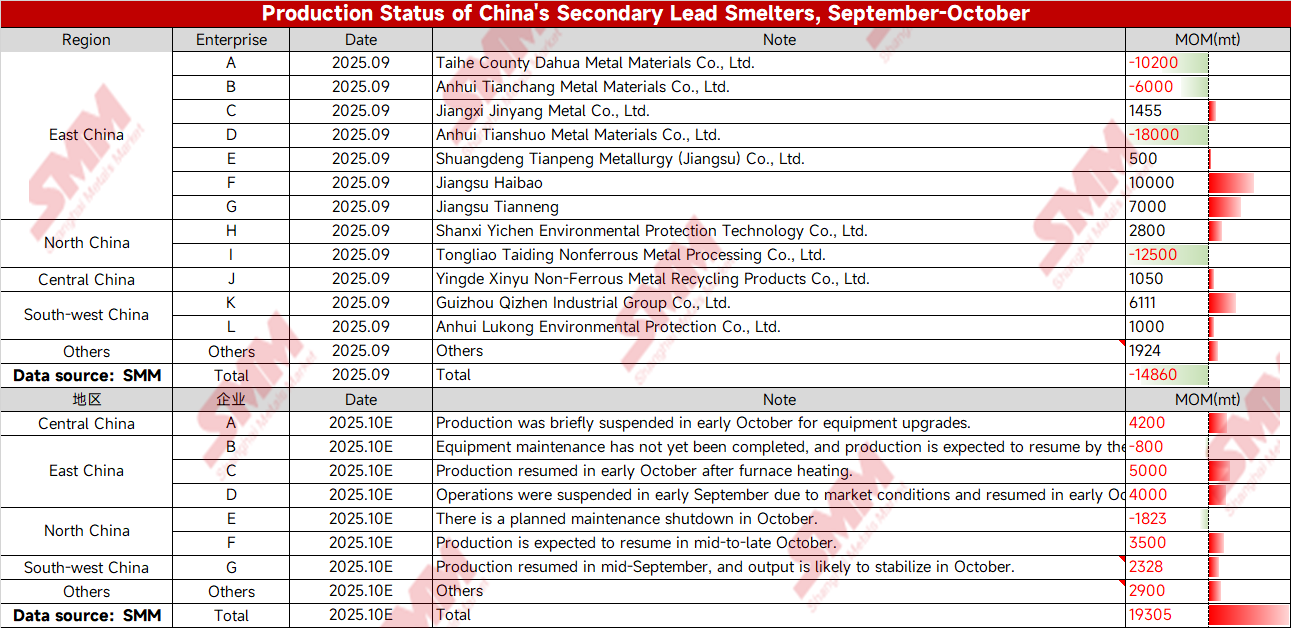
Although the resumption of production at secondary lead smelters is relatively concentrated, factors such as raw material supply, prices, and smelting profits continue to affect their production enthusiasm. In September, sales of replacement batteries for two-wheeled e-bikes increased, but the volume of retired waste lead-acid batteries did not show significant growth.

Since secondary lead smelters that halted production in September did not stop purchasing raw materials, raw material inventories have accumulated at various plants, and the supply-demand imbalance for scrap batteries is not yet prominent. With the resumption of production at secondary lead smelters, demand for waste lead-acid batteries has increased, leading to a slight rise in scrap battery prices recently. However, the cost pressure from raw materials remains within an acceptable range for smelters. Currently, smelters that have not resumed production due to a wait-and-see sentiment are more focused on lead price trends and smelting profit margins.

According to feedback from some idled secondary lead smelters in North and East China, furnace heating is expected to begin in late October, with spot orders of refined lead available for sale likely in November. Overall, while the resumption of production at secondary lead smelters in October contributes significantly to the production increase, the initial output is primarily allocated to fulfilling long-term contracts, leaving limited spot orders available for sale. Consequently, the downward pressure on lead prices remains relatively small.

Data Source Statement: The data is processed by SMM based on publicly available information, market exchanges, and internal database models, and is for reference only.

Data Source Statement: Except for publicly available information, all other data are processed by SMM based on publicly available information, market communication, and relying on SMM‘s internal database model. They are for reference only and do not constitute decision-making recommendations.

For any inquiries or to learn more information, please contact: lemonzhao@smm.cn
For more information on how to access our research reports, please contact:service.en@smm.cn
Related News
Lead Prices Stagnant, Smelters Maintain Firm Offers Amid Losses
Feb 6, 2026 19:50
Lead Prices Stagnant, Smelters Maintain Firm Offers Amid Losses
Read More
Lead Prices Stagnant, Smelters Maintain Firm Offers Amid Losses
Lead prices were in the doldrums, while secondary lead smelters maintained firm offers due to losses. The mainstream spot order ex-factory prices including tax narrowed the discount to the SMM #1 lead average price by 100 yuan/mt, shifting to a premium of 0–25 yuan/mt, with some smelters halting offers and sales.
Feb 6, 2026 19:50
"Domestic Secondary Crude Lead Market Slows as Holidays Approach, Smelters Halt Production"
Feb 6, 2026 19:49
"Domestic Secondary Crude Lead Market Slows as Holidays Approach, Smelters Halt Production"
Read More
"Domestic Secondary Crude Lead Market Slows as Holidays Approach, Smelters Halt Production"
Pre-holiday stockpiling by downstream enterprises had largely concluded, and a few had already entered the holiday period, completely suspending procurement. Next week, secondary lead smelters will enter a concentrated wave of production halts and holidays, resulting in sluggish trading activity in the spot market. Offers for spot refined lead orders were sparse, with prices moving in line with the market.
Feb 6, 2026 19:49
Sluggish Transactions in Domestic Secondary Crude Lead Market, Prices at 15,250-15,400 Yuan/mt
Feb 6, 2026 19:48
Sluggish Transactions in Domestic Secondary Crude Lead Market, Prices at 15,250-15,400 Yuan/mt
Read More
Sluggish Transactions in Domestic Secondary Crude Lead Market, Prices at 15,250-15,400 Yuan/mt
The domestic secondary crude lead market experienced sluggish transactions. As of February 6, 2026, the ex-factory tax-exclusive offers for domestic secondary crude lead stood at 15,250-15,400 yuan/mt. Downstream refined lead and alloy smelters gradually entered the holiday period, showing weak stockpiling willingness. Overseas lead ingot suppliers basically halted transactions with China due to poor consumption in the Chinese market, with only some previously concluded shipments maintaining normal in-transit transportation. The trading atmosphere in the secondary crude lead market will continue to weaken next week.
Feb 6, 2026 19:48