SMM September 30 News:
Highlights: In September 2025, China's solid-state battery sector reached a significant milestone. The MIIT initiated a 6-billion-yuan special mid-term review, while eight departments jointly issued a non-ferrous metals stabilization and growth plan to support core material R&D. Concurrently, ten solid-state battery standards completed review, and Tsinghua University developed a new-type fluorine-containing polyether electrolyte, marking continuous technological breakthroughs. Globally, enterprises such as Panasonic and Samsung SDI accelerated their strategic deployments, with the capital market responding enthusiastically—the average annual increase of solid-state battery concept stocks exceeded 50%. Driven by both policy support and technological breakthroughs, the industry is transitioning from laboratory R&D to scaled production, with the penetration rate of all-solid-state batteries projected to potentially reach 4% by 2030.
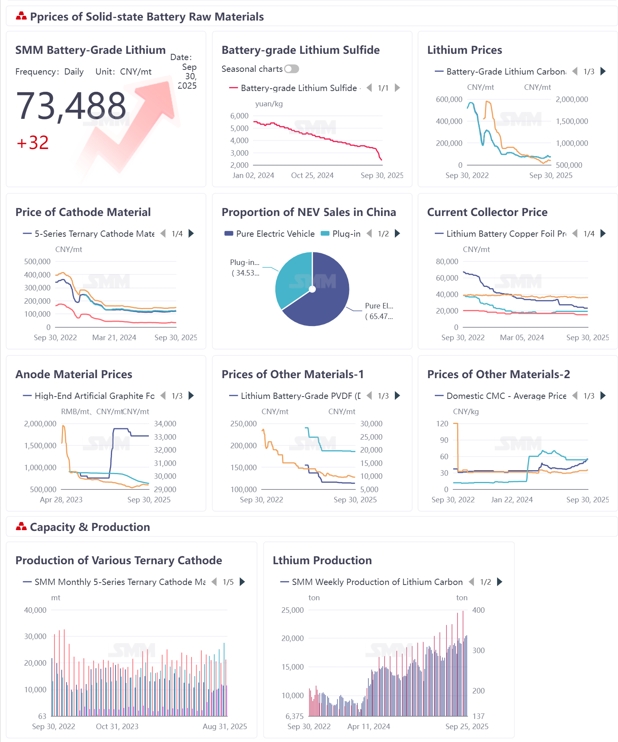
In September 2029, as tender processes advanced for a certain solid-state battery enterprise, the price of battery-grade lithium sulfide declined, with the average price falling below 2,500 yuan/kg.
In September 2025, the "mid-term evaluation of national subsidies" in the field of solid-state batteries—specifically, the MIIT's mid-term review of the RMB 6 billion major solid-state battery R&D initiative launched in 2024—was confirmed to commence and proceed in September. The key metal materials prioritized and covered by the "Work Plan for Stabilizing Growth in the Nonferrous Metals Industry (2025–2026)" are precisely the core upstream raw materials urgently needed for the development of the solid-state battery industry, making them highly relevant and closely linked to the sector.
I. Policy Dynamics
Domestic Policy Support: On September 28, eight departments, including the Ministry of Industry and Information Technology, issued the "Work Plan for Stabilizing Growth in the Nonferrous Metals Industry (2025–2026)," which emphasizes support for and involvement in several key metal materials that are critical upstream raw materials for the development of the solid-state battery industry. On September 22, four national departments jointly released the "Guiding Opinions on Promoting the High-Quality Development of Energy Equipment," explicitly listing key equipment for solid-state batteries as a priority R&D direction.
Policy Follow-Up: In September, the MIIT conducted a mid-term review of the RMB 6 billion major solid-state battery R&D initiative launched in 2024. Projects passing the review will receive subsequent funding and may initiate a second round of subsidy application windows. The six enterprises involved are CATL, BYD, FAW Group, SAIC, WELION New Energy, and Geely Group. After rigorous screening, the project was divided into seven sub-projects, focusing on different technical routes such as polymers and sulphides.
Regulatory Standards: On September 10–11, the Solid-State Battery Standards Review Meeting and Standards Project Kick-off Meeting, organized by the China Society of Automotive Engineers, were successfully held in Beijing. The following ten standards were submitted for review:
- "Assembly Method for Mold Batteries Used in Testing Solid-State Battery Materials,"
- "Test Method for Density of Solid Electrolytes,"
- "Test Method for Electronic Conductivity of Solid Electrolytes—DC Polarization Method,"
- "Test Method for Ionic Conductivity of Solid Electrolytes—AC Impedance Method,"
- "Chemical Analysis Methods for Sulphide Solid Electrolytes—Part 1: Determination of Lithium Content by Inductively Coupled Plasma Optical Emission Spectrometry,"
- "Chemical Analysis Methods for Sulphide Solid Electrolytes—Part 2: Determination of Phosphorus and Sulfur Content by Gravimetric Method,"
- "Chemical Analysis Methods for Sulphide Solid Electrolytes—Part 3: Determination of Potassium, Sodium, Calcium, Iron, Copper, Aluminum, Magnesium, Zinc, Manganese, Nickel, Chromium, and Lead Content by Inductively Coupled Plasma Optical Emission Spectrometry,"
- "Test Method for Air Stability of Sulphide Solid Electrolytes,"
- "Test Method for Ion Transference Number of Solid Electrolytes—DC Polarization Method,"
- "Test Method for Thermal Stability of Electrodes in All-Solid-State Batteries."
Additionally, five standards were drafted:
- "Evaluation Method for Hydrogen Sulfide Gas Generation in Sulphide All-Solid-State Batteries,"
- "Polymer Composite Solid Electrolytes for All-Solid-State Lithium Batteries,"
- "Single Cell Specification Dimensions for All-Solid-State Batteries in Electric Vehicles,"
- "Test Method for Electrical Performance of Cathode Materials in Sulphide All-Solid-State Batteries,"
- "Technical Guidelines for Performance Modeling and Simulation of All-Solid-State Batteries."II. Technological Breakthroughs
1. Domestic Technological Progress: On September 25, the Department of Chemical Engineering at Tsinghua University announced that Zhang Qiang’s team has made progress in the research of polymer electrolytes for solid-state batteries, successfully developing a new-type fluorine-containing polyether electrolyte. This provides new ideas and technical support for the development of practical high-safety, high-energy-density solid-state lithium batteries.
2. International Technological Breakthrough: Panasonic announced that it will mass-produce small all-solid-state batteries from 2025 to 2029, which can be charged to 80% in 3 minutes and have a cycle life exceeding 30,000 cycles. Initially applied in drones, the technology will later be extended to the NEV sector. Samsung SDI has established an electrode research department to develop dry electrode technology for all-solid-state batteries. Its sulfide-based electrolyte achieves an energy density of 500 Wh/kg, with plans for mass production and installation in luxury car models by 2027.
III. Industry Dynamics
1. Domestic Enterprise Developments: Zhan Xiaoyun, Chief Engineer of BAK Electronic Technology, disclosed that the company’s semi-solid-state batteries for digital security applications are already being supplied to an internationally renowned supplier of explosion-proof safety mobile communication equipment, with annual sales exceeding 20 million yuan. Related products for magnetic power banks have been sampled to domestic mid-to-high-end enterprises, with shipments expected in Q4 2025. A 43 Ah capacity battery for the EV sector has met electrical performance standards, been sampled to domestic clients, and is expected to receive bulk orders in H1 2026. Products for the eVTOL sector have also met electrical performance standards, been sampled to leading international enterprises, and are anticipated to secure bulk orders in H1 2026. Lead Intelligent Equipment has mastered the full-line process for mass production of all-solid-state batteries, delivering core equipment to top-tier clients in Europe, the U.S., Japan, South Korea, and domestically, and has received repeat orders.
2. International Enterprise Developments: Rimac Technology unveiled a new generation of solid-state batteries at the Munich International Auto Show. The battery adopts a Cell-to-Pack design, paired with an NMC cathode and a 100% silicon anode, achieving an energy density of 260 Wh/kg and supporting fast charging to 80% in 6.5 minutes. Rimac has signed a memorandum of understanding with ProLogium Technology to jointly develop a new-generation battery platform, with plans for initial deployment in high-performance EVs in Q4 2027. IV. Market Analysis
The commercialization process is accelerating, with 2025 being a pivotal year for the industrialisation of solid-state batteries. Driven by policy support and technological breakthroughs, the industry is transitioning from laboratory R&D to large-scale production competition. Following the mid-term review of the MIIT project by the end of 2025, the sulfide electrolyte route is expected to dominate mass production trends. 2026 will see a peak in the commissioning of pilot lines, with technical feasibility verified through prototype vehicle road tests. Small-scale vehicle integration will begin in 2027, initiating the commercialization process, ultimately achieving a market size of hundreds of GWh by 2030.
According to SMM forecasts, all-solid-state battery shipments will reach 13.5 GWh by 2028, while semi-solid-state battery shipments will reach 160 GWh. Global lithium-ion battery demand is projected to reach approximately 2,800 GWh by 2030, with the EV sector's lithium-ion battery demand showing a CAGR of around 11% from 2024 to 2030, ESS lithium-ion battery demand at a CAGR of about 27%, and consumer electronics lithium battery demand at a CAGR of roughly 10%. Global solid-state battery penetration is estimated at about 0.1% in 2025, with all-solid-state battery penetration expected to reach around 4% by 2030, and global solid-state battery penetration potentially approaching 10% by 2035.
Medium and long-term challenges persist in the market: all-solid-state batteries still face issues such as short-term difficulties in mass production, high costs, an incomplete industry chain, and high interfacial impedance. For instance, solid-state batteries require significantly higher pressure than liquid batteries, and traditional fixed structural solutions for liquid batteries cannot meet these demands. Additionally, as the core material of all-solid-state batteries, solid electrolytes face long-term challenges in performance enhancement, miniaturization, and cost reduction.
In terms of capital markets, the solid-state battery sector has shown remarkable growth.
Solid-state battery-related concept stocks in the A-share market continue to strengthen, with the resonance between capital and industry further fueling enthusiasm for this power battery technology revolution. As of September 29, the average increase of solid-state battery concept stocks this year has exceeded 56%, with seven stocks accumulating gains of over 100%. In secondary market performance, the average rise of solid-state battery concept stocks this year was 50.83%.
**Note:** For further details or inquiries regarding solid-state battery development, please contact:
Phone: 021-20707860 (or WeChat: 13585549799)
Contact: Chaoxing Yang. Thank you!
![Solid-State Battery Next Decade Series, Part 9 of 9: A Brand-New Track, Not a "Simple Sequel" to Liquid Lithium Batteries [SMM Analysis]](https://imgqn.smm.cn/usercenter/ezoBg20251217171730.jpg)
![[Solid-state: Chunli New Energy's 1GWh solid-state battery plant starts production in Jiangxi]](https://imgqn.smm.cn/usercenter/MaxcL20251217171730.jpg)
![National Day Holiday Solid-State Battery Industry Review: Strong Policy Push but Slow Industrial Progress [SMM Analysis]](https://imgqn.smm.cn/usercenter/QxQbN20251217171727.jpg)