Pr-Nd Prices Bottom Out, May Experience Fluctuating Consolidation in the Future【SMM Analysis】

Published: Sep 15, 2025 17:30
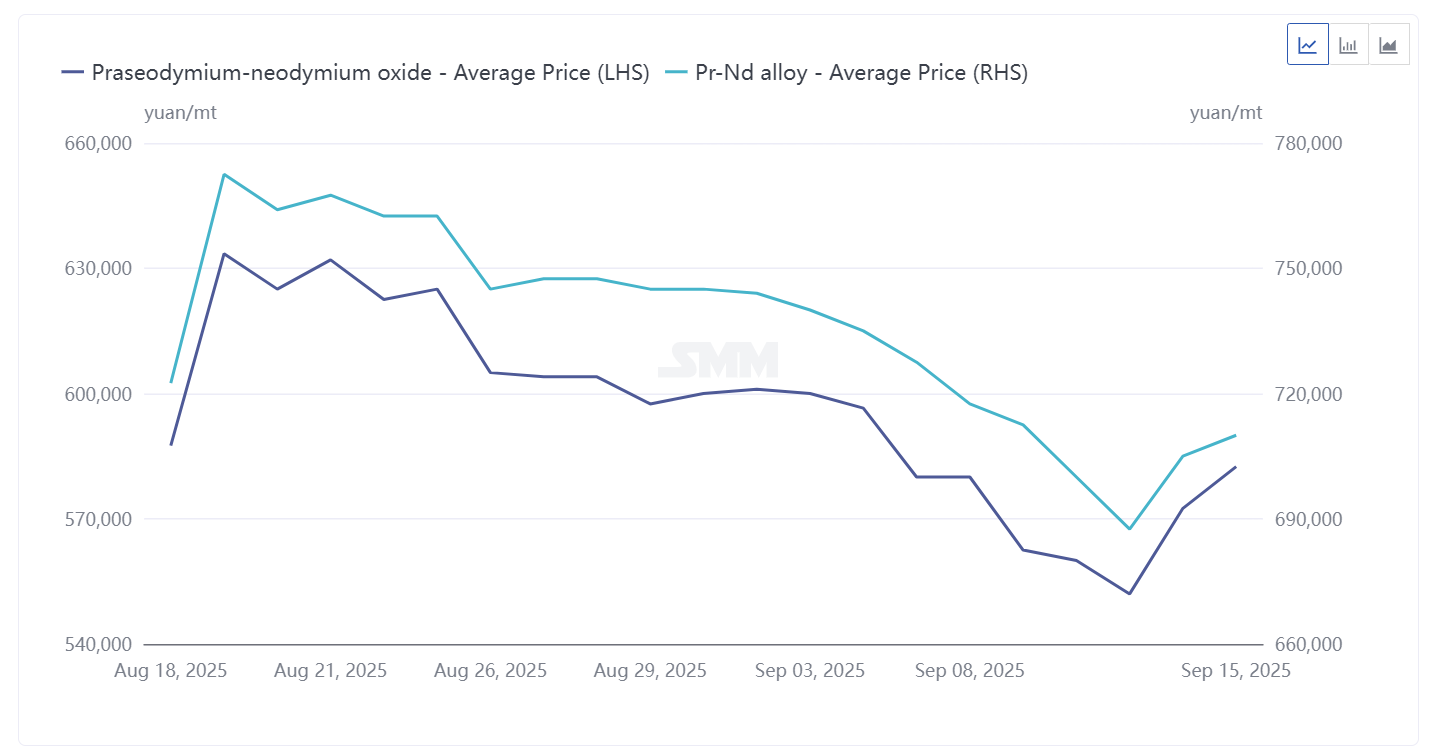
Last week, Pr-Nd oxide prices fell to 550,000 yuan/mt and then rebounded rapidly, rising to 580,000 yuan/mt as of today. A deep analysis of the reasons behind this bottoming out of Pr-Nd oxide prices reveals that the shift in market supply and demand sentiment was undoubtedly the most critical driving factor.

Last week, Pr-Nd oxide prices fell to 550,000 yuan/mt and then rebounded rapidly, rising to 580,000 yuan/mt as of today. A deep analysis of the reasons behind this bottoming out of Pr-Nd oxide prices reveals that the shift in market supply and demand sentiment was undoubtedly the most critical driving factor. When Pr-Nd prices pulled back to relatively low levels, the procurement mindset of enterprises across the industry chain, both upstream and downstream, changed significantly. For alloy plants and magnetic material enterprises, lower Pr-Nd prices meant lower procurement costs, thereby boosting their purchase willingness. Particularly in the latter half of last week, large magnetic material enterprises collectively conducted tender activities. This move not only directly drove a short-term sharp rise in demand for Pr-Nd alloy but also sent a positive demand signal to the market, further stimulating the procurement enthusiasm of other enterprises.

At the same time, traders were optimistic about prices being at the bottom range and actively restocked to go long. On the other hand, suppliers were unwilling to continue driving down prices to sell at current levels, leading to a tightening of spot cargo circulating in the market. Under the dual effects of rising demand and reduced supply, Pr-Nd oxide prices naturally rose in response, successfully bottoming out.

However, looking ahead, the momentum for Pr-Nd prices to continue rising significantly may not be strong. Demand side, the traditionally expected peak season of September-October, which the market had been anticipating, saw some demand actually front-loaded. Downstream enterprises had already conducted a certain degree of procurement and stockpiling earlier, resulting in no significant surge in actual new orders at present. In particular, magnetic material enterprises mostly procured based on rigid demand, with no large-scale sustained restocking. If end-user demand in sectors such as new energy vehicles and home appliances falls short of expectations, showing weak growth or even a decline, then Pr-Nd prices would undoubtedly face significant difficulties in breaking through the current price range in the short term. Overall, in the absence of sustained strong demand support, Pr-Nd prices are likely to show a volatile and consolidating trend.

Data Source Statement: Except for publicly available information, all other data are processed by SMM based on publicly available information, market communication, and relying on SMM‘s internal database model. They are for reference only and do not constitute decision-making recommendations.

For any inquiries or to learn more information, please contact: lemonzhao@smm.cn
For more information on how to access our research reports, please contact:service.en@smm.cn
Related News
Chile Unveils National Critical Minerals Strategy Amid Global Demand Surge
20 hours ago
Chile Unveils National Critical Minerals Strategy Amid Global Demand Surge
Read More
Chile Unveils National Critical Minerals Strategy Amid Global Demand Surge
Chile has released its National Critical Minerals Strategy, clearly positioning itself as a stable supplier of minerals. Currently, driven by artificial intelligence, the development of new technologies, and the energy transition, global demand for these critical minerals continues to grow. The announcement of this strategy holds particular significance in the weeks before President Boric leaves office, highlighting Chile’s intention to transition from over-reliance on the copper industry toward adapting to a decarbonized economy and achieving resource diversification. Chile has identified 14 critical minerals, specifically covering copper, lithium, molybdenum, rhenium, cobalt, rare earths, antimony, selenium, tellurium, gold, silver, iron ore, boron, and iodine. Based on Chile’s current position in the global market, these 14 minerals are categorized into three groups: The first category includes copper, lithium, molybdenum, and rhenium. Their respective shares in global supply are 23%, 20.4%, 14.6%, and 46.8%, and other major economies have also designated these minerals as critical. The second category consists of minerals that are currently not produced or only produced in small quantities, including cobalt, rare earths, antimony, selenium, and tellurium. The third category comprises minerals already produced domestically in Chile with the potential to expand their role in the global value chain, such as gold, silver, iron ore, boron, and iodine.
20 hours ago
Overseas Pr-Nd offers surged rapidly, countries accelerated rare earth mine development [SMM Rare Earth Overseas Weekly Review]
22 hours ago
Overseas Pr-Nd offers surged rapidly, countries accelerated rare earth mine development [SMM Rare Earth Overseas Weekly Review]
Read More
Overseas Pr-Nd offers surged rapidly, countries accelerated rare earth mine development [SMM Rare Earth Overseas Weekly Review]
This week, overseas prices continued to rise due to multiple factors, and shipments tightened further. Key developments emerged in raw ore mining across the US, Asia, and Latin America. The US government strengthened domestic rare earth capacity through large-scale funding, a Malaysia-France cooperation project achieved substantial progress, Brazil formulated a national rare earth strategy to unlock resource potential, and India considered adjustments to mining policies to enhance extraction efficiency. These measures collectively reflect countries' heightened focus on rare earth supply chain security, though technological, cost, and capacity bottlenecks remain widespread challenges.
22 hours ago
India Mulls Tightening Mineral Rights Auction Policy to Boost Mining Output
Jan 30, 2026 10:15
India Mulls Tightening Mineral Rights Auction Policy to Boost Mining Output
Read More
India Mulls Tightening Mineral Rights Auction Policy to Boost Mining Output
Two informed sources revealed that to accelerate mining production, India is considering tightening its mineral rights auction policy to exclude mining enterprises that fail to apply for mining permits long after winning the auction. Official data show that since 2015, the Indian government has auctioned 594 mineral blocks, of which only 82 are in production, accounting for less than 14%. Sources said an internal government audit found that over the past five years, about 50 enterprises had not commenced mining after acquiring blocks, with some even failing to apply for mining permits. The two informed sources declined to be named as they were not authorized to speak. The Indian Ministry of Mines also did not respond to an email request for comment.
Jan 30, 2026 10:15