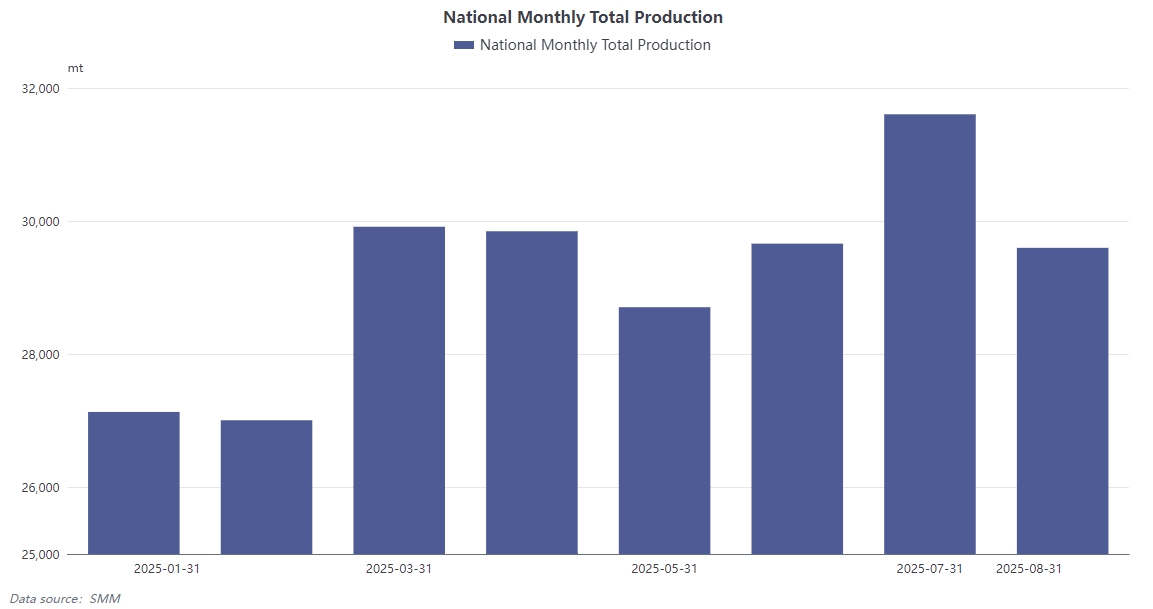
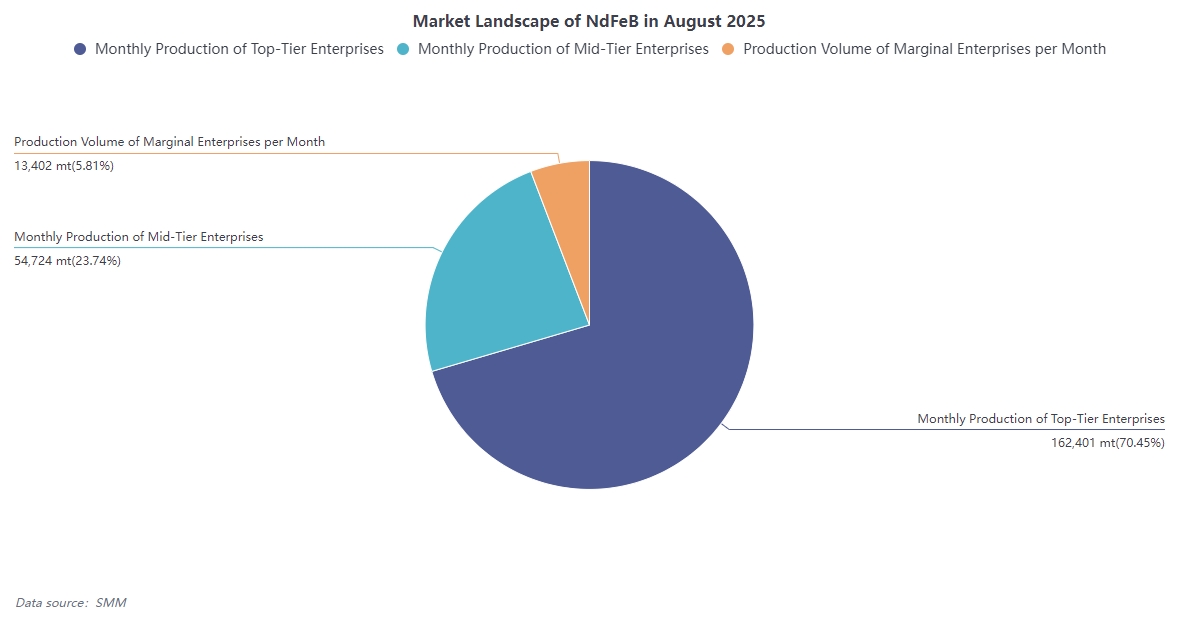
Pada Agustus 2025, industri bahan magnet sintered NdFeB Tiongkok menunjukkan penurunan produksi secara bulanan (MoM) namun mengalami konsolidasi keunggulan di antara perusahaan-perusahaan tingkat atas. Menurut data survei lapangan SMM, total produksi nasional sintered NdFeB mencapai 29.599 ton bulan itu, turun sekitar 6,3% MoM. Dalam hal struktur produksi, perusahaan tingkat atas memproduksi 20.904 ton, menyumbang 70,45% dari total; perusahaan menengah memproduksi 6.997 ton, menyumbang 23,74%; sementara perusahaan kecil hanya menyumbang 5,81%. Industri ini menunjukkan tingkat konsentrasi yang tinggi, dengan perusahaan-perusahaan tingkat atas mendominasi pangsa pasar. Perusahaan tingkat atas terus memegang posisi signifikan baik dalam volume produksi maupun teknologi, dan muncul tren pesanan yang semakin beralih ke perusahaan-perusahaan ini, semakin memperkuat pola industri di mana yang kuat semakin kuat.
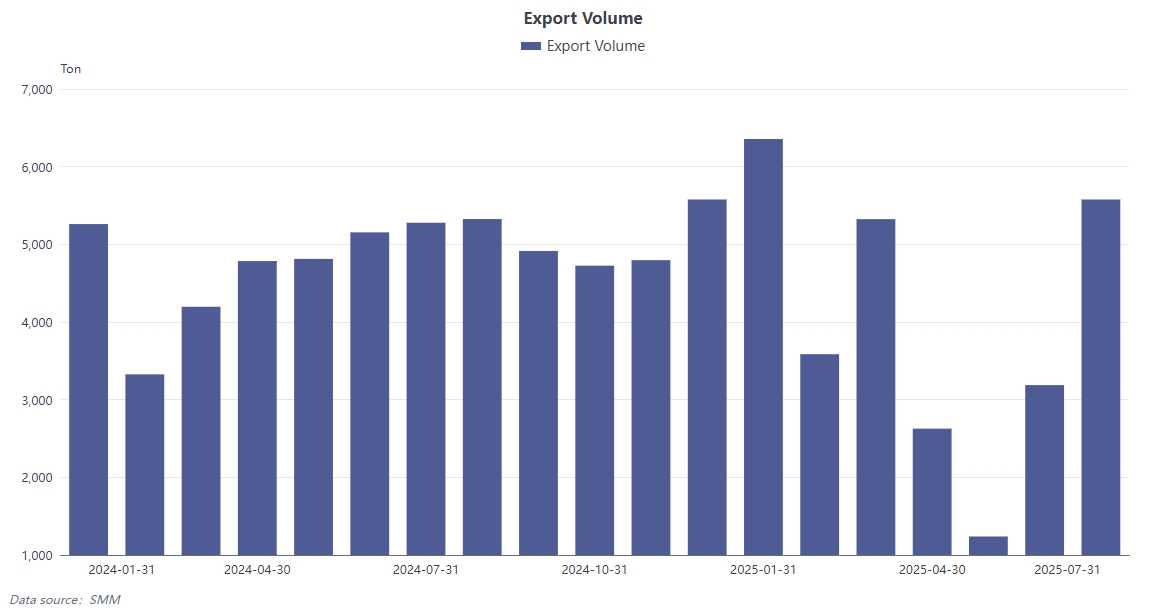
Dalam hal tingkat operasi, rata-rata nasional tingkat operasi pabrik sintered NdFeB pada Agustus 2025 adalah 69,24%, turun 4,69% MoM. Berdasarkan ukuran perusahaan, tingkat operasi untuk perusahaan tingkat atas adalah 67,34%, perusahaan menengah 66,97%, dan perusahaan ujung bawah 62,13%, dengan tingkat operasi keseluruhan cenderung menurun, mencerminkan tekanan produksi jangka pendek yang meluas di industri. Di pasar ekspor, menurut Administrasi Umum Bea Cukai, Tiongkok mengekspor 5.791,8 ton pada Agustus. Meskipun data ekspor bahan magnet belum dirilis secara resmi, berdasarkan pengalaman sebelumnya, ekspor bahan magnet pada Agustus 2025 diperkirakan setidaknya 5.200 ton, datar MoM. Dari Januari hingga Juli 2025, total ekspor bahan magnet adalah 27.890,6 ton, turun 14% dari 32.813,07 ton pada periode yang sama tahun 2024. Penurunan ini terutama disebabkan oleh meningkatnya ketegangan Tiongkok-AS setelah Trump menjabat pada tahun 2025, dengan AS memberlakukan tarif besar dan Tiongkok menerapkan kontrol ekspor, yang menekan permintaan ekspor sepanjang semester pertama.
Alasan utama penurunan produksi bahan magnet pada Agustus dapat diatribusikan kepada dampak gabungan dari berbagai faktor: tekanan signifikan pada sisi biaya, dengan harga bahan baku NdFeB seperti oksida Pr-Nd dan paduan Pr-Nd tetap tinggi sepanjang Juli dan Agustus. Mengambil contoh paduan Pr-Nd, harga rata-rata bulanannya tetap berada di 638.636 yuan, dengan kenaikan tajam berturut-turut di antaranya. Biaya tinggi ini menyebabkan sentimen tunggu dan lihat yang nyata di antara pengguna akhir, dengan beberapa pesanan tidak mendesak ditunda sementara, dan perusahaan beralih ke konsumsi inventaris sebagai prioritas. Permintaan penggunaan akhir memasuki musim sepi tradisional, dengan produksi dan penjualan kendaraan energi baru domestik terus menurun pada Agustus. Sektor peralatan rumah tangga, yang diwakili oleh AC, secara bertahap mengurangi produksi seiring berakhirnya periode musim panas. Sektor elektronik 3C, tanpa stimulasi dari model baru, mengalami produksi jenuh dan kenaikan yang relatif kecil. Sementara itu, sektor industri seperti tenaga angin dan robot industri terkena dampak cuaca musim panas yang panas, yang mengurangi tingkat operasi pabrik dan melemahkan dukungan untuk pesanan magnet permanen NdFeB. Hambatan kebijakan di pasar ekspor memperparah perpecahan internal. Meskipun ada permintaan pesanan dari wilayah seperti Eropa dan AS, dan ekspor diperkirakan tetap pada tingkat yang relatif tinggi, kebijakan saat ini yang mengharuskan deklarasi untuk bahan magnet NdFeB mengakibatkan lisensi ekspor terkonsentrasi di tangan perusahaan besar terkemuka. Usaha kecil dan menengah kesulitan mendapatkan lisensi, membuat mereka tidak kompetitif dalam ekspor dan akhirnya menyebabkan tingkat operasi tidak mencukupi, memperburuk penurunan produksi secara keseluruhan.
Biaya bahan baku tinggi merupakan faktor utama yang menekan produksi. Sebagai bahan baku kunci untuk bahan magnet NdFeB, fluktuasi harga paduan Pr-Nd langsung memengaruhi biaya produksi dan margin keuntungan perusahaan bahan magnet. Harga tinggi rata-rata 638.636 yuan/ton sepanjang Juli-Agustus jauh melebihi tingkat historis untuk periode yang sama, dan ditambah dengan kenaikan harga berturut-turut selama waktu ini, memberikan tekanan biaya signifikan pada perusahaan bahan magnet hilir. Menghadapi harga bahan baku setinggi ini, perusahaan aplikasi penggunaan akhir menunjukkan keinginan pembelian yang berkurang signifikan. Selain pesanan esensial, banyak pelanggan memilih menunda rencana pengadaan, memprioritaskan pencernaan inventaris sendiri, dan menunggu penyesuaian harga. Sentimen tunggu dan lihat ini merambat ke hulu sepanjang rantai industri, langsung mengurangi pesanan perusahaan bahan magnet, sehingga memaksa mereka menyesuaikan rencana produksi dan menurunkan tingkat operasi.
Kelemahan permintaan musiman digabung dengan kinerja lesu di berbagai sektor aplikasi secara kolektif menyebabkan penarikan keseluruhan permintaan domestik pada Agustus. Sebagai penggerak utama pertumbuhan material magnet NdFeB berkinerja tinggi, sektor kendaraan listrik baru (NEV) mengalami penurunan berkelanjutan dalam produksi dan penjualan, mengurangi konsumsi langsung material magnet. Di sektor peralatan rumah tangga, khususnya manufaktur AC, jadwal produksi secara bertahap disesuaikan ke bawah seiring berakhirnya musim konsumsi puncak musim panas, menurunkan permintaan untuk komponen magnet terkait. Pasar elektronik 3C, tanpa stimulasi dari model baru yang revolusioner, mencapai kejenuhan dalam produksi keseluruhan, menyulitkan penyediaan permintaan tambahan yang signifikan. Meskipun permintaan jangka panjang tetap positif di sektor industri seperti tenaga angin dan robot industri, Agustus juga dibatasi oleh suhu musim panas yang tinggi. Pabrik di banyak wilayah menyesuaikan jam operasi atau mengurangi beban produksi untuk mengatasi panas ekstrem dan periode puncak listrik, secara tidak langsung mengurangi permintaan pesanan jangka pendek untuk magnet permanen NdFeB.
Intensifikasi hambatan kebijakan ekspor telah memperburuk diferensiasi struktural dalam industri, menjadi faktor kelembagaan kunci yang mempengaruhi produksi keseluruhan. Meskipun terdapat permintaan di pasar Eropa dan AS, serta ekspor diperkirakan tetap pada tingkat yang relatif tinggi, sistem deklarasi dan perizinan ekspor saat ini untuk material magnet NdFeB, dalam praktiknya, mengarahkan sumber daya lisensi ekspor lebih kepada perusahaan tingkat atas yang berskala besar dan memenuhi kepatuhan. Perusahaan menengah dan ujung bawah kesulitan mendapatkan lisensi ekspor dengan lancar dalam kondisi kebijakan tersebut, mengakibatkan kehilangan daya saing di pasar internasional dan ketidakmampuan mengamankan pesanan luar negeri secara efektif. Akibatnya, tingkat operasi mereka semakin menurun, memberikan dampak negatif yang nyata pada total produksi material magnet nasional pada Agustus. Tren pesanan ekspor yang terkonsentrasi di perusahaan tingkat atas, sambil mengonsolidasi posisi dominan mereka, secara objektif membatasi utilisasi kapasitas keseluruhan, karena langkah ekspansi kapasitas di antara perusahaan tingkat atas tidak mampu sepenuhnya mengkompensasi kekosongan pasar yang ditinggalkan oleh keluarnya perusahaan kecil dan menengah dalam jangka pendek.
Ke depan, industri magnet permanen tanah jarang sedang mengalami periode penyesuaian yang dipicu oleh kontradiksi struktural "kelebihan di segmen rendah dan kekurangan di segmen tinggi". "Involution ini diperkirakan akan mereda secara bertahap antara tahun 2026 dan 2028, didorong oleh penutupan kapasitas yang dipicu kebijakan, munculnya permintaan baru, dan terobosan teknologi. Dalam jangka pendek, meskipun harga bahan baku tanah jarang telah turun sedikit dari level tertingginya, pasokan tetap ketat karena kendala seperti kuota penambangan, impor bijih yang berkurang, dan kebijakan perlindungan lingkungan. Permintaan hilir diperkirakan akan menguat secara bulanan seiring memasuki musim konsumsi puncak tradisional, yang akan mendukung harga bahan magnet. Dalam jangka panjang, perkembangan pesat industri seperti kendaraan listrik, tenaga angin, dan robotika akan terus mendorong pertumbuhan permintaan tanah jarang. Kesenjangan pasokan-permintaan NdFeB global mungkin bertahan dan melebar seiring waktu, memberikan keunggulan kompetitif bagi perusahaan-perusahaan terkemuka yang memiliki sumber daya, keahlian teknologi, dan hambatan pelanggan.
![Harga logam tanah jarang menunjukkan kinerja beragam; sentimen wait-and-see di hilir masih kuat [Tinjauan Harian Logam Tanah Jarang SMM]](https://imgqn.smm.cn/usercenter/rqOXm20251217171744.jpeg)