1. Company Profile and Industry Position
- Rio Tinto
Company Profile
Founded in Spain in 1873, Rio Tinto Group is headquartered in the UK, with its Australian headquarters in Melbourne. Initially established as a copper ore producer during Spain's early mining industry, Rio Tinto embarked on an overseas diversification strategy, executing a series of influential acquisitions and mergers of mining companies beyond Spain. This transformed it into a multinational corporation specializing in the exploration, mining, and processing of mineral resources.
Within Rio Tinto's operations, its global organizational structure comprises four major product groups: Iron Ore, Aluminum, Copper & Diamonds, and Energy & Industrial Minerals.
Focusing on Rio Tinto's iron ore business, the company is a world-leading iron ore producer and exporter. Leveraging its world-class assets in Western Australia's Pilbara region and Canada, it has long provided high-grade, stable resource supplies to the global steel industry. Currently, Rio Tinto Group ranks as the largest iron ore producer in Australia and globally, and also holding the top market share for iron ore products in China.
Business in China
Rio Tinto Group's primary engagement with China revolves around two-way trade. In the 1970s, Rio Tinto became the first company to ship iron ore from Australia to China. Over the past few decades, it has supplied over 3.5 billion mt of iron ore and other metal minerals to the Chinese market, solely through its own operations. Currently, more than 50% of Rio Tinto's revenue is derived from its business in China.
Presently, Rio Tinto primarily exports iron ore, copper, alumina, nickel, gold, borates, and titanium oxide raw materials to China. As the world's second-largest iron ore producer, the company holds the leading market share in China. It maintains representative offices in Beijing, Shanghai, Guangzhou, and Hong Kong, while conducting exploration projects in Xinjiang, Gansu, and Yunnan, primarily focused on copper and nickel. Market demand is expected to remain robust for an extended period. Rio Tinto remains steadfast in its commitment to meeting China's economic development needs for raw materials. In recent years, the group has delivered outstanding operational performance, largely attributable to the strong growth of China's economy.
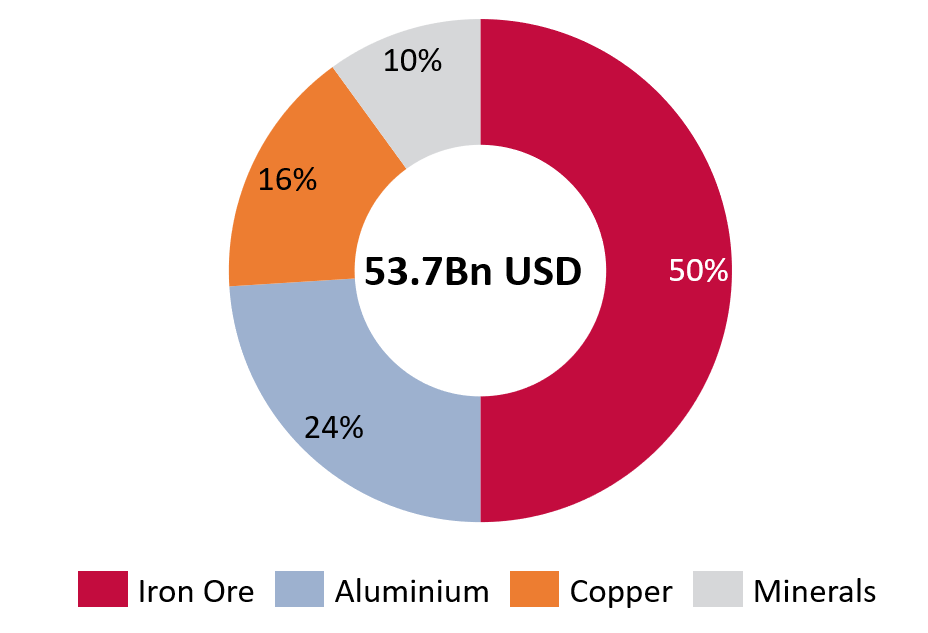
Rio Tinto Group's 2024 Major Revenue Composition
2. Iron Ore Production, Shipments and Main Products
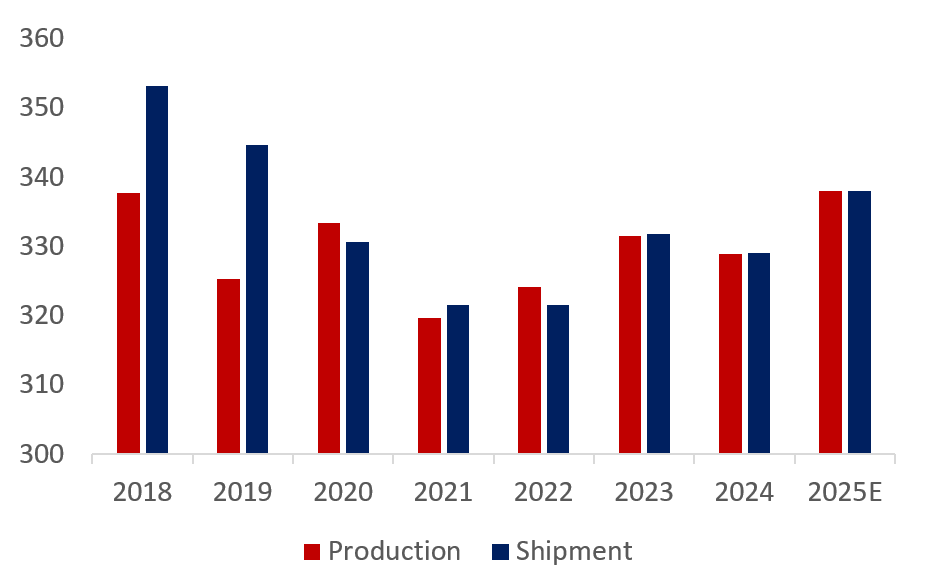
In 1960, the Australian federal government relaxed restrictions on iron ore exports, stimulating the development of exploration activities. In 1962, geologists from CRA discovered the Mount Tom Price iron ore deposit in the Pilbara region, after which Rio Tinto began constructing the Dampier port and the Mount Tom Price mine. In 1966, with the first shipment of iron ore transported from Mount Tom Price to Dampier port and exported to Japan, Rio Tinto's iron ore business embarked on a remarkable journey. Over the subsequent five decades, Rio Tinto's iron ore production in the Pilbara region grew from 1.4 million mt in 1966 to 329 million mt in 2024, with the 2025 production guidance ranging between 323 million and 338 million mt.
Historical Iron Ore Production and Shipments
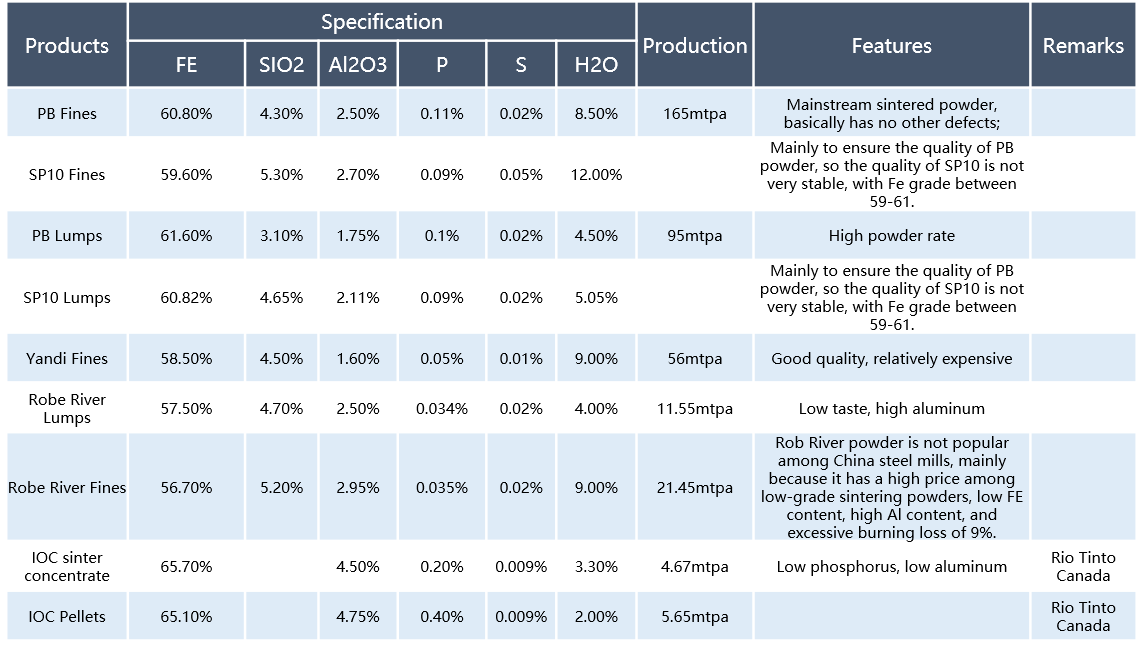
Main Products
3. Status of Mines Under the Group
Introduction to Subsidiary Mines
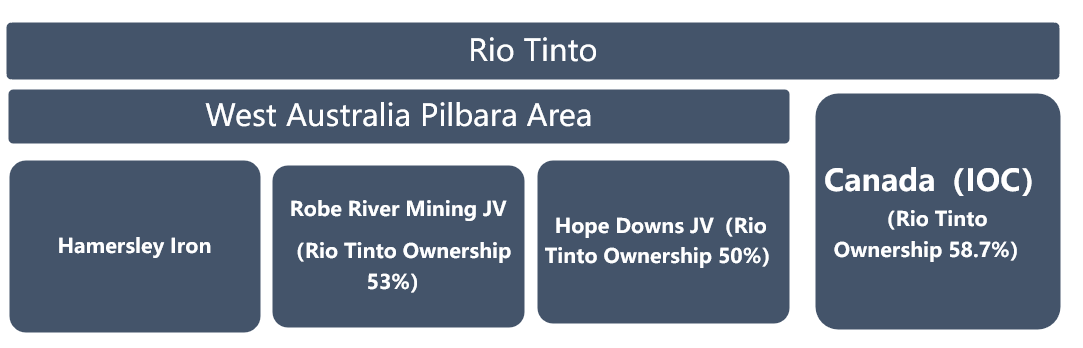
Pilbara Iron Ore Mines: 16 in Total
The Pilbara region in Western Australia comprises 16 mines with an annual capacity of 360 million mt. Rio Tinto operates a world-class integrated iron ore production network, along with four dedicated shipping terminals, a nearly 2,000-kilometer railway network, and supporting infrastructure. Currently, the railway system's transport capacity and port loading capacity have reached 360 million mt per year. Production operations are centrally managed from the Perth Operations Centre, located 1,500 kilometers away from Pilbara, enabling remote control of mines, railway systems, and ports, including unmanned trucks, automated drills, and autonomous trains.
Based on ownership structure, Rio Tinto's Pilbara iron ore assets are divided into four parts:
- Hamersley Iron (100% owned by Rio Tinto),
- Robe River Mining JV (53% owned by Rio Tinto),
- Hope Downs JV (50% owned by Rio Tinto),
- BAO-HI Ranges JV (54% owned by Rio Tinto, 46% by Baosteel).
Canada's IOC Mining Company Carol Lake Mine:
The Iron Ore Company of Canada (IOC), a joint venture mine owned by Rio Tinto, is a partnership between Rio Tinto (58.7%), Mitsubishi (26.2%), and Labrador Iron Ore Royalty Income Corporation (15.1%). Managed and operated by Rio Tinto, it is a leading North American producer and exporter of pellets and concentrates. IOC's mining area is the Carol Lake Mine, an open-pit mine located in Labrador City. The site also includes a processing plant, a port and stockyard in Sept-Iles Port, Quebec, and a 418-kilometer railway connecting the mine to the port. In 2024, the mine's iron ore production reached 16.08 million mt, with operational lifespan extending to 2081.
4. Future Expansion Projects
New project is to enhance the production capacity
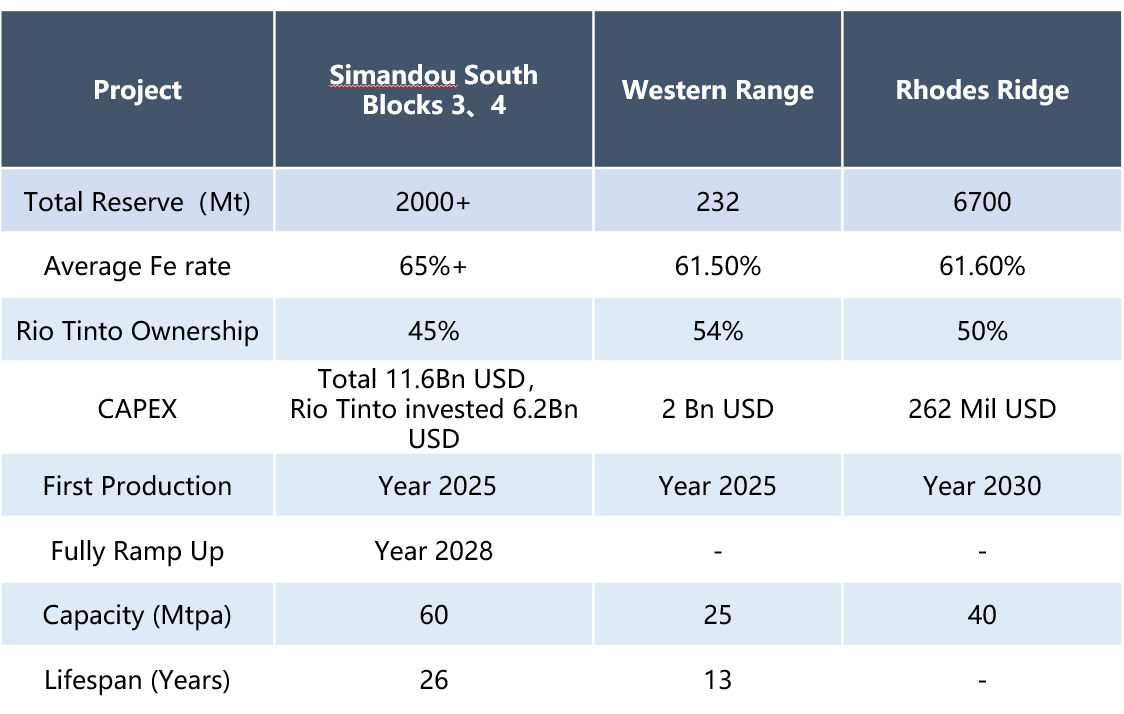
The Simandou project, located in Guinea, was announced in 2023. It is developed by Simfer (Rio Tinto holds a 45% stake), a joint venture between the company, Baowu Group, and the Guinean government, to exploit Blocks 3 and 4 in the southern section of the Simandou iron ore deposit. The first shipment is expected in November 2025, with full production targeted around 2028 and an annual capacity of 60 million mt.
The Western Range project, located in Western Australia, is a collaboration with China Baowu Group (Rio Tinto holds a 54% stake). It includes a crusher and an 18-kilometer conveyor connecting to the processing plant. Construction began in 2023, and successful commissioning was achieved in June 2025. Production will continue to ramp up throughout 2025 until reaching full capacity of 2,500 mt.
The Rhodes Ridge project, situated in the eastern Pilbara, is 50% owned by Rio Tinto. It involves modernizing operations in the Rhodes Ridge area, including infrastructure expansion and resource drilling programs. The project also considers constructing a new plant with an annual capacity of 40 million mt, with first ore production anticipated before 2030.
![Before the holiday, the black chain is unlikely to see a trend-driven market [SMM Steel Industry Chain Weekly Report].](https://imgqn.smm.cn/usercenter/zUFfM20251217171748.jpg)
![[SMM Chromium Daily Review] Inquiries and Transactions Weakened, Chromium Market Showed Mediocre Performance Before the Holiday](https://imgqn.smm.cn/usercenter/ENDOs20251217171718.jpg)