In July 2025, the sodium-ion battery (sodium-ion battery) industry chain exhibited a unique development trend under the dual influence of total expansion and structural adjustment. The proportion of polyanion-type NFPP in cathode materials continued to rise to 69%, while the accelerated release of hard carbon anode capacity drove production to surge more than two-fold YoY. The battery cell segment maintained double-digit MoM growth, collectively building upward momentum for the industry chain. Meanwhile, structural issues such as order fluctuations in electrolytes and limited penetration in energy storage terminals remained unresolved. The industry is transitioning from competition over technical routes to the stage of large-scale application.
Cathode Materials: Continuous Increase in NFPP Proportion, Accelerated Production Ramp-up in H2
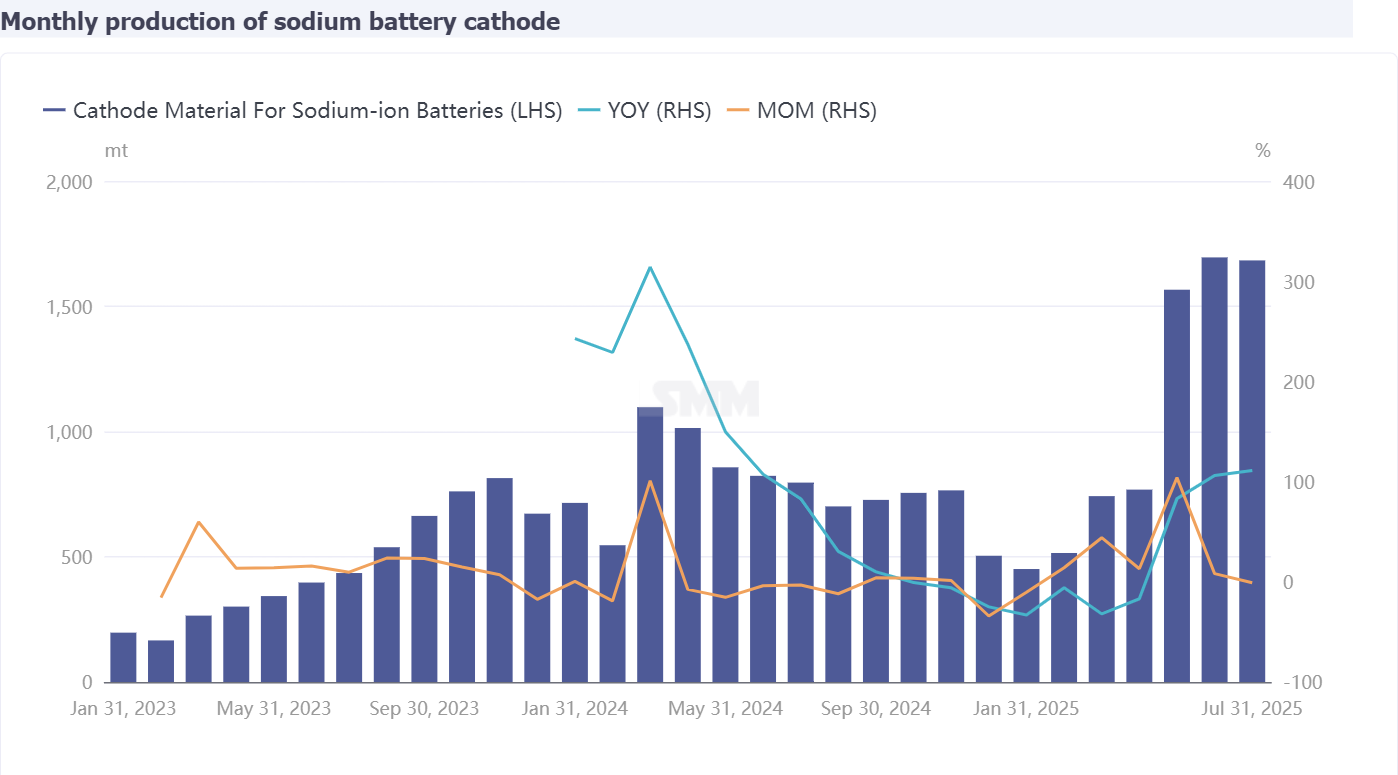
In July, sodium-ion battery cathode material production decreased slightly by 1% MoM but remained high with a 111% YoY increase. Among them, the proportion of polyanion-type NFPP in total production rose to 69%, an increase of 2 percentage points MoM. The slight decline in monthly production was mainly due to the continued contraction in the production of layered oxide (O3-type) materials, which further concentrated the proportion of NFPP. Despite the rapid expansion of NFPP in the sodium-ion battery field, O3-type materials still occupy an irreplaceable position in specific scenarios such as power-type and C-rate-type applications due to their performance advantages. Currently, downstream demand for NFPP is growing significantly. With the gradual implementation of sodium-ion battery energy storage projects in H2, related production capacity will enter an accelerated ramp-up phase. It is expected that sodium-ion battery cathode material production will increase by 7% MoM in August, with the YoY growth rate expanding to 157%.
Hard Carbon Anode Materials: Continuous Production Ramp-up, Few Large-scale Enterprises
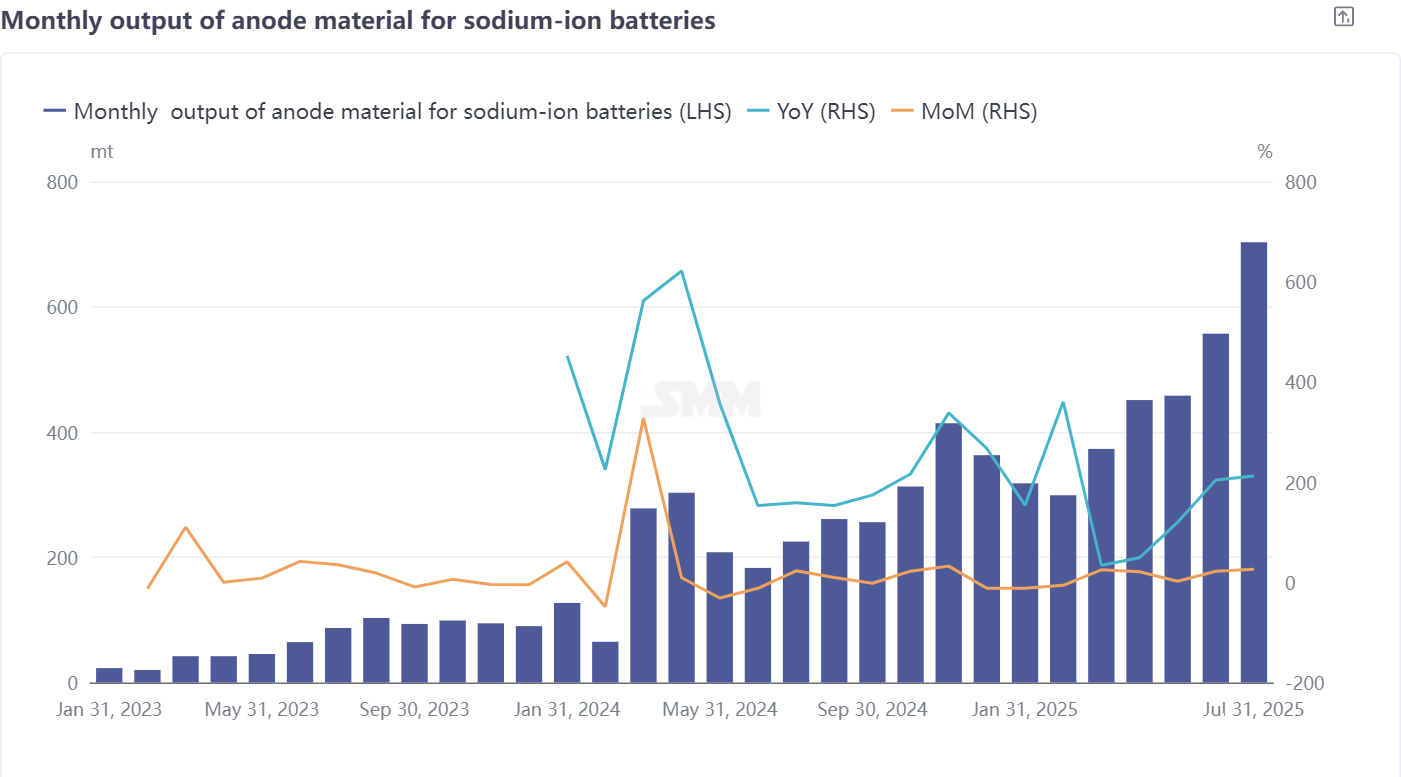
In July, sodium-ion battery anode material production increased significantly by 26% MoM and surged by 212% YoY. Top-tier enterprises still maintain a significant lead in hard carbon anode capacity. In terms of technical routes, biomass-based hard carbon remains the mainstream in the current industry. However, in recent months, the import price of coconut shell charcoal has risen sharply, prompting domestic enterprises to start shifting to alternative biomass resources and continuously advancing R&D on low-cost processes. It is expected that production will increase by 5% MoM in August, with a YoY growth rate of 182%.
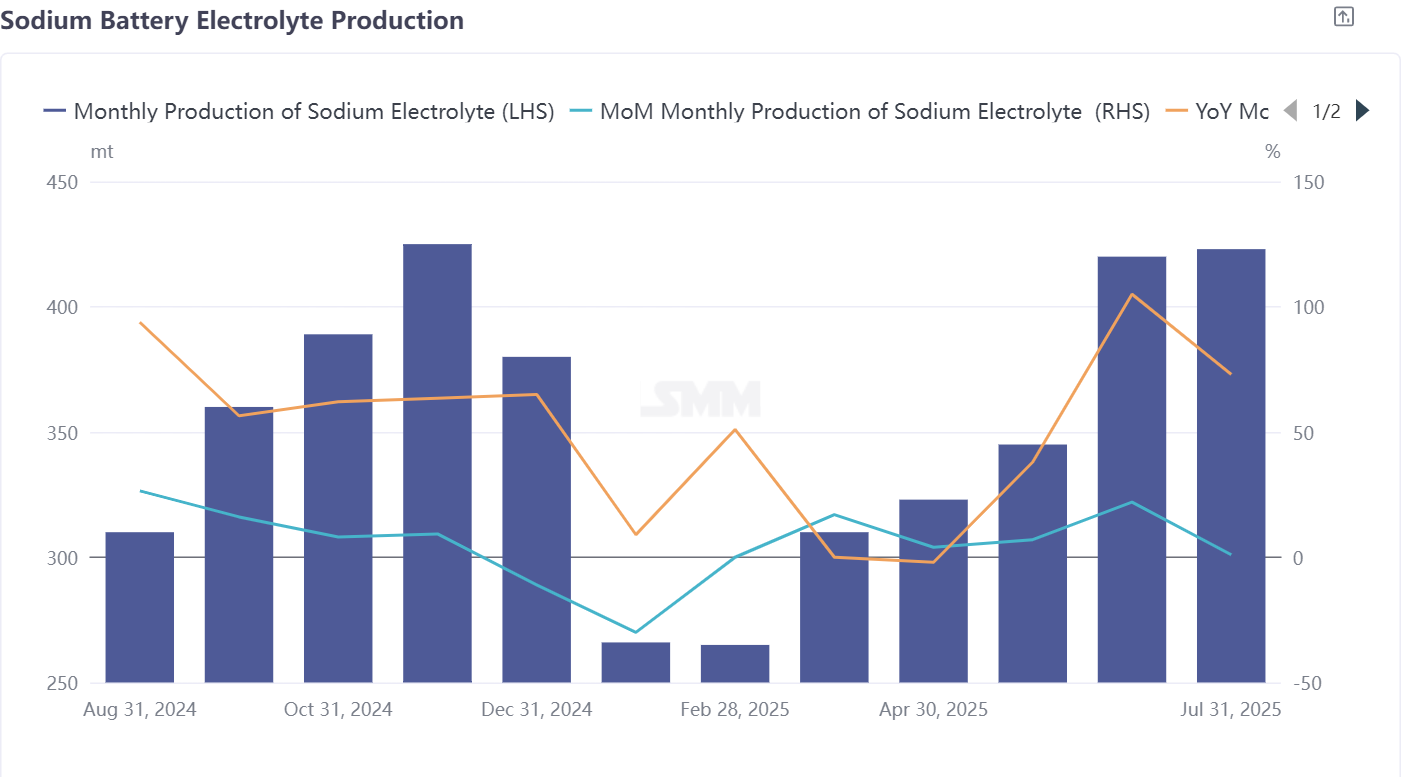
Electrolytes: Insufficient Order Stability, Supply System to be ImprovedIn July, the production of sodium-ion battery electrolyte increased by 1% MoM and 73% YoY. This segment exhibits significant customization characteristics, with enterprises generally adopting a produce-based-on-sales model. Due to differences in formulations, the cost of electrolytes varies significantly—electrolytes suitable for NFPP have lower requirements for raw materials and additives, offering prominent cost advantages and facilitating the scaled-down cost application of sodium-ion batteries. It is expected that in August, the production of electrolytes will increase by 4% MoM and 41% YoY.
Battery Cells and End-Use Applications: Steady Growth in Battery Cell Production and Differentiated Advancement in End-Use Applications
In July, the production of sodium-ion battery cells increased by 22% MoM and 109% YoY. In terms of end-use applications, the market launch of sodium-ion battery-powered electric two-wheelers in 2025 has reached a scale of tens of thousands of units. Sodium-ion battery start-stop systems are gradually being promoted due to their higher cost tolerance. In the ESS sector, LFP remains the mainstream choice, but sodium-ion batteries still possess differentiated competitiveness in low-temperature scenarios. Despite the reduction in policy-driven ESS projects in H1, there are still opportunities for market growth in H2.
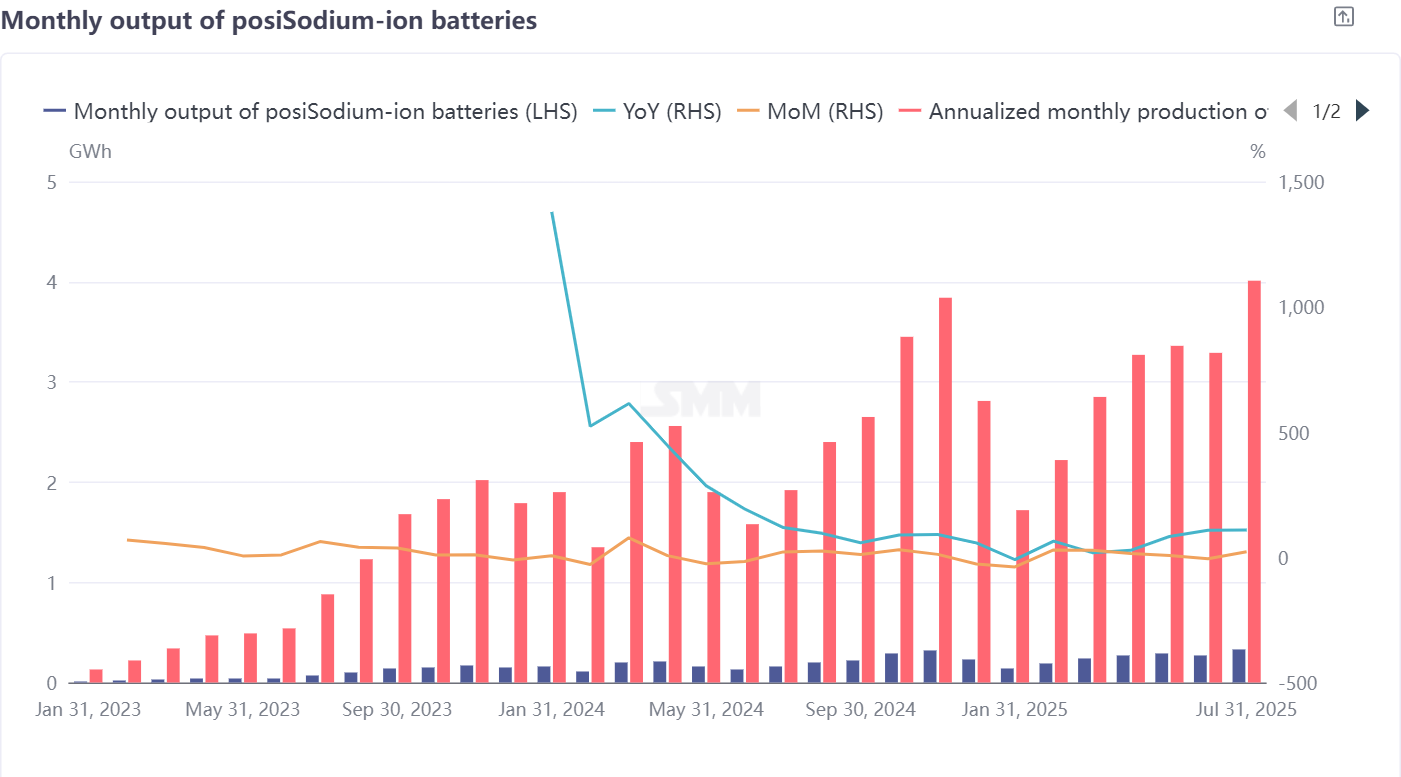
In July, each segment of the sodium-ion battery industry chain exhibited characteristics of "overall growth with structural differentiation." Within the cathode materials, the dominance of NFPP has strengthened, with accelerated capacity release for hard carbon anodes. The battery cell segment maintained a high growth momentum, jointly driving upward momentum in the industry chain. However, issues such as fluctuating orders for electrolytes and limited penetration in ESS terminals still need to be addressed. With the implementation of ESS projects in H2 and the maturation of low-cost technology routes, the sodium-ion battery industry chain is expected to enter an accelerated phase of simultaneous growth in volume and price. The scaled-up application of the NFPP system and technological complementarity in differentiated scenarios will become the core development logic.