With raw material supply constraints no longer present, prices fluctuate around costs under a supply surplus pattern

Published: Jul 29, 2025 18:00

SMM July 29 News:

Reviewing H1 2025, China's alumina existing capacity and operating capacity both hit record highs. The country's alumina existing capacity increased by 7.3 million mt/year to 110.32 million mt/year, while the monthly average operating capacity reached 88.24 million mt/year, up 7.42 million mt/year (9.2%) YoY and 1.85 million mt/year (2.1%) compared with H2 2024. From January to June 2025, China's cumulative metallurgical-grade alumina production totaled 43.68 million mt, with net alumina exports reaching 1.075 million mt. Domestic aluminum production demand amounted to 41.78 million mt, resulting in an overall alumina surplus and a downward price trend.
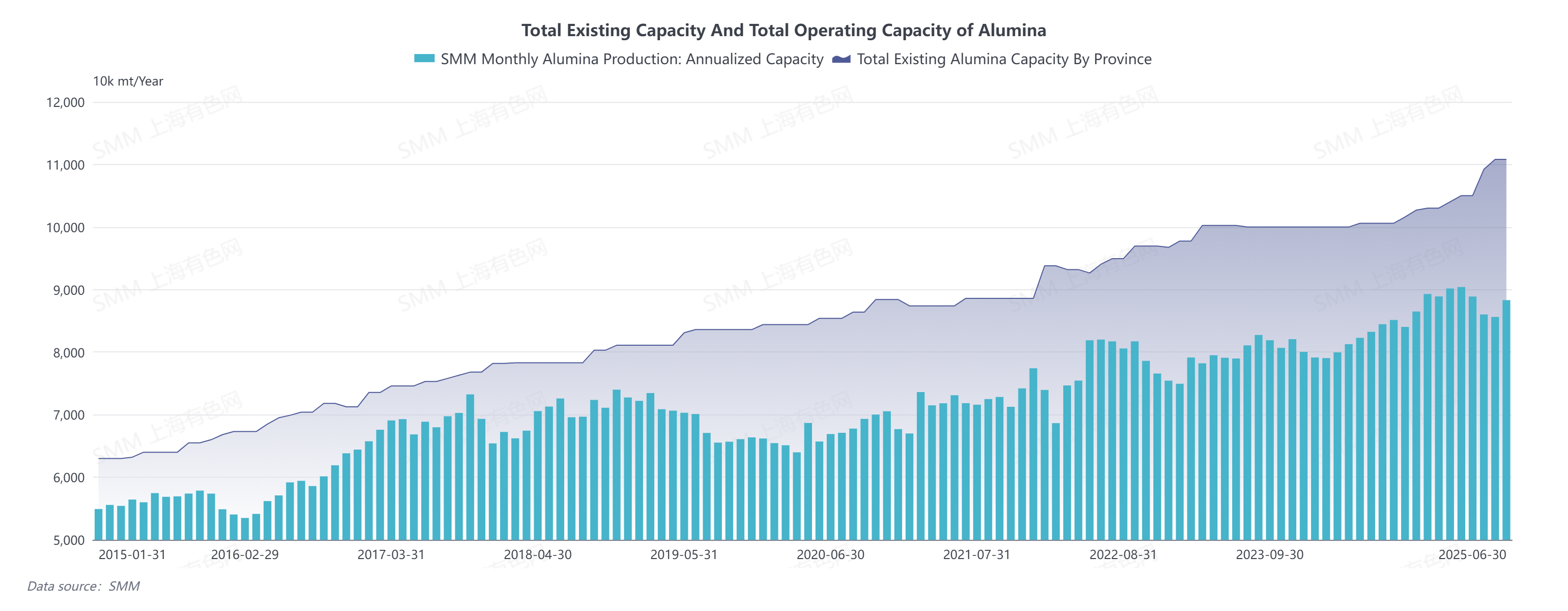
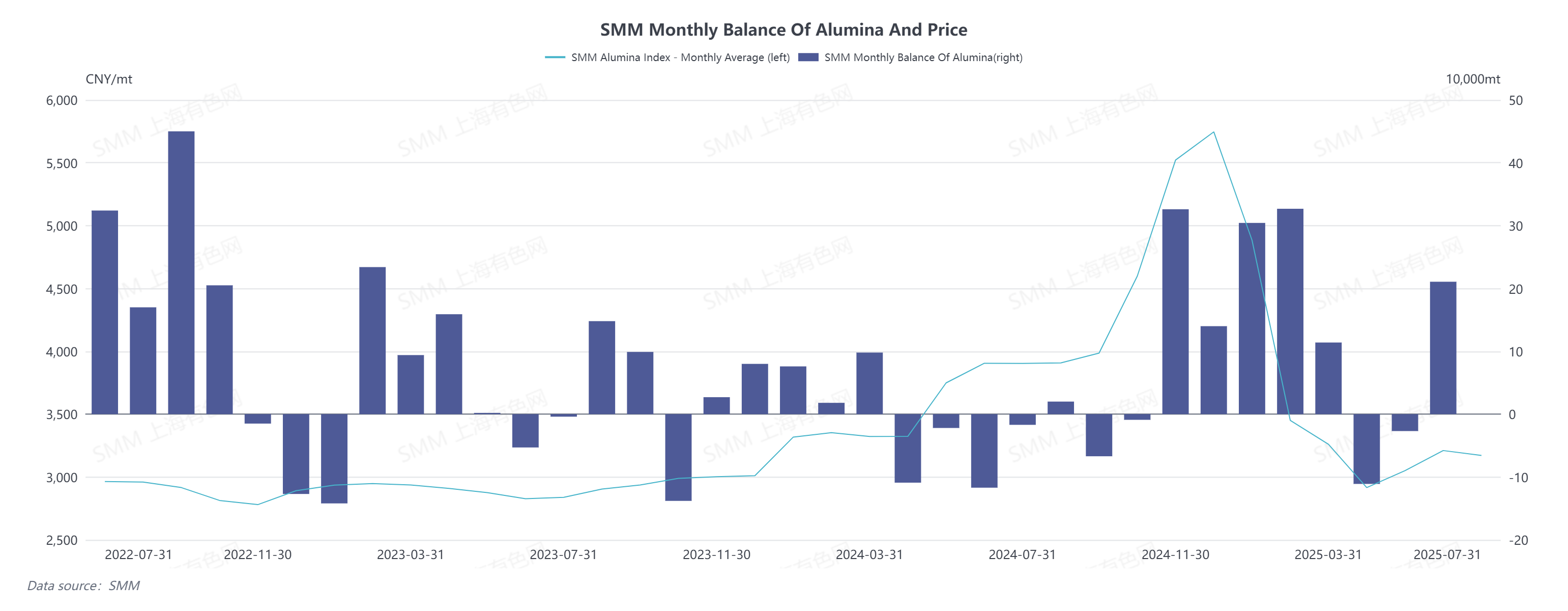
In 2024, raw material constraints limited alumina production growth, pushing alumina prices to a decade-high. Entering 2025, the lingering effects of high prices kept alumina profitability strong. According to SMM's daily cost-profit model, the theoretical profit for the alumina industry reached 2,279 yuan/mt on January 2, turning negative only by mid-March. Stimulated by high ore prices, bauxite supply increased, lifting raw material constraints. Boosted by profitability, alumina operating capacity rose, shifting the market into sustained surplus and triggering a rapid price pullback, followed by fluctuations around cost levels.
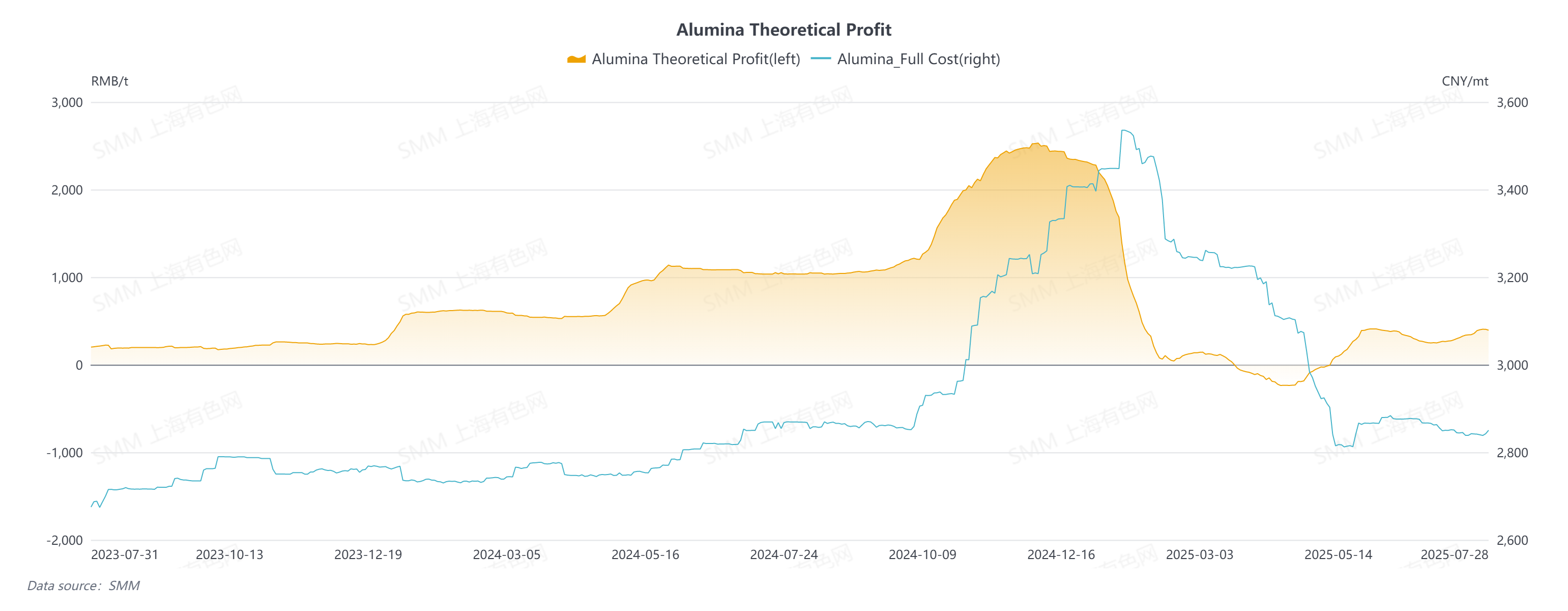
Monthly supply-demand and price trends:

In January-February, spot alumina prices fell sharply, but producers remained profitable, maintaining moderate production enthusiasm. Operating capacity continued to rise, reaching 90.17 million mt/year and 90.41 million mt/year, respectively.

In March, alumina prices continued declining, but ore price drops lagged. Spot prices gradually approached production cost lines, reducing overproduction. Some producers cut output due to ore supply or cost issues, lowering operating capacity. However, sustained prior profitability strengthened loss tolerance, with most producers avoiding maintenance, keeping capacity high.

In April-May, monthly average spot alumina prices hit H1 lows, causing severe losses. Producers selectively cut output, reducing supply and shifting the market into deficit. From May, spot prices rebounded from lows, peaking between late May and early June.

In June, alumina prices maintained a downtrend, but the monthly average rose MoM, improving profitability. Some idled capacity resumed, coupled with new capacity ramping up, lifting annualized operating capacity back above 88 million mt/year.
H2 outlook: Raw material supply is unlikely to constrain alumina operating capacity, with the market expected to remain in surplus. Spot prices may fluctuate around cost levels.

Cost side, bauxite prices trended downward in H1, while caustic soda prices also fell significantly from year-start, reducing alumina costs.

In Q1, SMM's imported bauxite CIF index averaged $101.42/mt, with alumina average costs at 3,337 yuan/mt. In Q2, ore prices dropped sharply, with the CIF index falling 22.5% to $78.57/mt, pulling average costs down to 2,942 yuan/mt. Assuming H2 imported ore averages $75/mt and domestic ore prices stabilize, alumina average costs may range between 2,800-2,900 yuan/mt. With lower cost lines, alumina prices are likely to remain in the doldrums, fluctuating around costs.

Data Source Statement: Except for publicly available information, all other data are processed by SMM based on publicly available information, market communication, and relying on SMM‘s internal database model. They are for reference only and do not constitute decision-making recommendations.

For any inquiries or to learn more information, please contact: lemonzhao@smm.cn
For more information on how to access our research reports, please contact:service.en@smm.cn
Related News
Fed Governor Milan Pushes for Over 100 Basis Points Cut, Contradicts Barkin on Caution
15 hours ago
Fed Governor Milan Pushes for Over 100 Basis Points Cut, Contradicts Barkin on Caution
Read More
Fed Governor Milan Pushes for Over 100 Basis Points Cut, Contradicts Barkin on Caution
Federal Reserve Governor Milan pointed out that it is necessary for the US Fed to cut interest rates by more than 100 basis points this year. At the same time, he is very much looking forward to the performance of Kevin Warsh as Fed Chairman. However, Richmond Fed President Barkin emphasized that monetary policy must remain cautious until inflation fully pulls back to the target level, thereby ensuring the stability of the labour market.
15 hours ago
Democratic Senators Demand Delay in Fed Nomination Amid Criminal Investigation
15 hours ago
Democratic Senators Demand Delay in Fed Nomination Amid Criminal Investigation
Read More
Democratic Senators Demand Delay in Fed Nomination Amid Criminal Investigation
All 11 Democratic members of the US Senate Banking Committee jointly sent a letter to the committee's chairman, Tim Scott, requesting that all nomination processes for the prospective Fed Chairman, Kevin Warsh, be postponed until the criminal investigation into current Fed Chairman Powell and other board members is concluded. However, Scott stated that Warsh's confirmation was a done deal.
15 hours ago
Fed to Keep Large Banks' Capital Levels Unchanged, Postpones Stress Test Reforms Until 2027
15 hours ago
Fed to Keep Large Banks' Capital Levels Unchanged, Postpones Stress Test Reforms Until 2027
Read More
Fed to Keep Large Banks' Capital Levels Unchanged, Postpones Stress Test Reforms Until 2027
The US Fed has announced that it will maintain the capital levels of large banks unchanged during the upcoming stress test cycle (corresponding to the 2026 cycle). At the same time, the US Fed is planning multidimensional reforms to this annual test, aiming to enhance its transparency. The US Fed's Vice Chair for Supervision, Bowman, revealed that adjustments to the stress capital buffer requirements for large banks will be postponed until 2027. This move is intended to provide the US Fed with sufficient time to evaluate potential flaws that may be exposed in its testing models when assessing banks' financial conditions under simulated economic downturn scenarios.
15 hours ago