Updated Jul 16, 2025
By Ella Nilsen
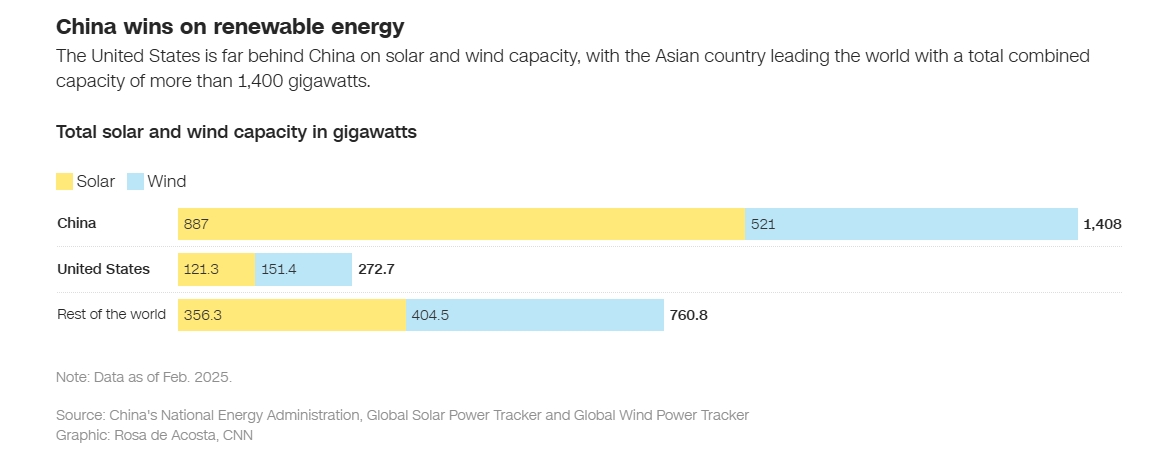
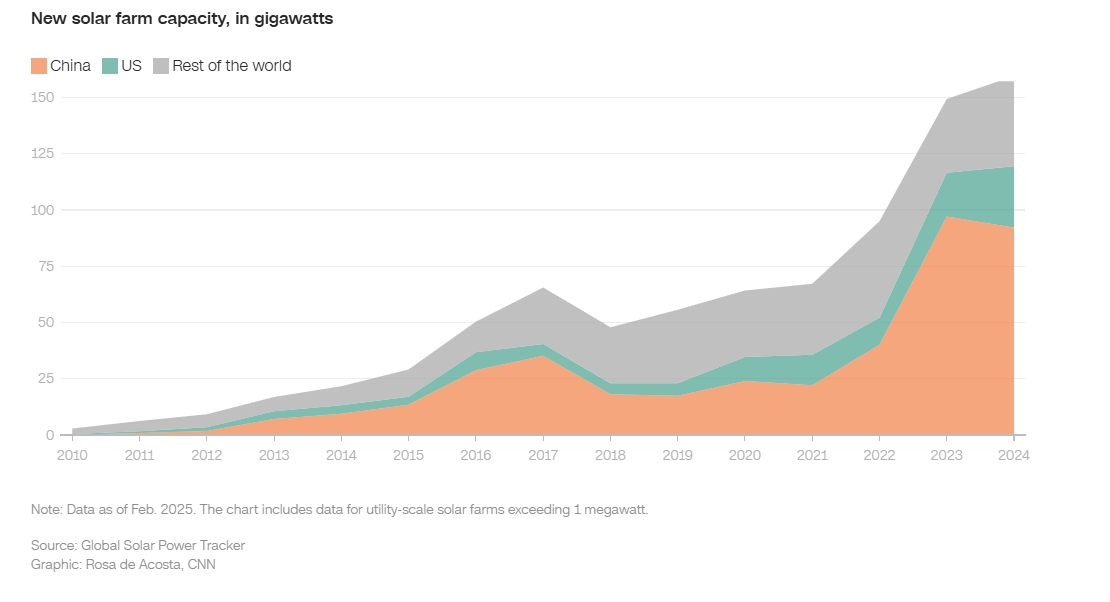
The new clean energy regime can be summarized in one incredible statistic: China installed more wind and solar power in a single year than the total amount of renewable energy currently operating in the United States.
America was already laps behind China in the race to dominate the industry, new data from Global Energy Monitor shows. President Donald Trump’s “big, beautiful,” spending bill will secure its position as a clean-energy loser, experts told CNN.
The spending law Trump signed earlier this month knee-caps clean energy tax credits for wind and solar. Business leaders say it will raise electricity prices for businesses and consumers alike here, as the cheapest electrons on the grid (generated by wind and solar) become more costly to build and are replaced with more expensive gas.
At the same time, pulling funds from the clean energy industry puts it on its heels just as it was looking to make gains toward more efficient technologies and better battery storage.
Meanwhile, China is currently building 510 gigawatts of utility-scale solar and wind capacity, according to Global Energy Monitor. It will be added to the eye-popping 1,400 gigawatts already online — five times what is operating in the US.
In short, “the game has already been called,” said Li Shuo, director of the China climate hub at the Asia Society Policy Institute.
Wind and solar, bolstered by giant batteries that can store their energy, are also becoming an increasingly dominant force in the US, but on a much smaller scale. Renewables generate the vast majority of new electricity that’s come online in the past few years in the US and make up about 85% of what is currently waiting to be approved in the nation’s permitting queue.
The US had roughly 275 gigawatts of wind and solar operating at the end of last year. There are another 150 gigawatts of wind and solar planned for construction through 2031, according to the US Energy Information Administration — projects at risk with Trump and Republicans’ bill that quickly phases out subsidies for renewables.
In the US, wind and solar developers are running into the buzzsaw that is President Donald Trump. Trump pushed forcefully to kill tax credits for wind and solar development in his signature law, succeeding in curtailing the credits and vowing to hinder the industry in other ways.
The law effectively cuts planned renewables additions to the grid in half over the next decade compared to projections without it, according to modeling done by the non-partisan think tank Rhodium Group. That will mean rising electricity prices in every continental US state, due to the price of renewables increasing and more expensive gas filling the gap, as CNN has reported.
Even with China’s blistering pace of installations so far, 510 gigawatts of wind and solar currently being built is astonishing. Shuo said the number seemed a little higher than what Chinese analysts have projected.
Mengqi Zhang and Yujia Han, the two Global Energy Monitor analysts who authored the report, told CNN that part of the reason the number is so high is that Chinese renewables developers were racing to build out quickly in order to claim government subsidies that expired in June.
“This is why the surge is coming before May,” Han said.
Most of China’s wind and solar farms are far away from its largest cities. But in China’s capital of Beijing, the country’s energy transition is apparent in another way – it is difficult to find a gas-powered car driving on the roads, Shuo said. Shuo recently visited Beijing and said nearly all Uber drivers there are driving EVs.
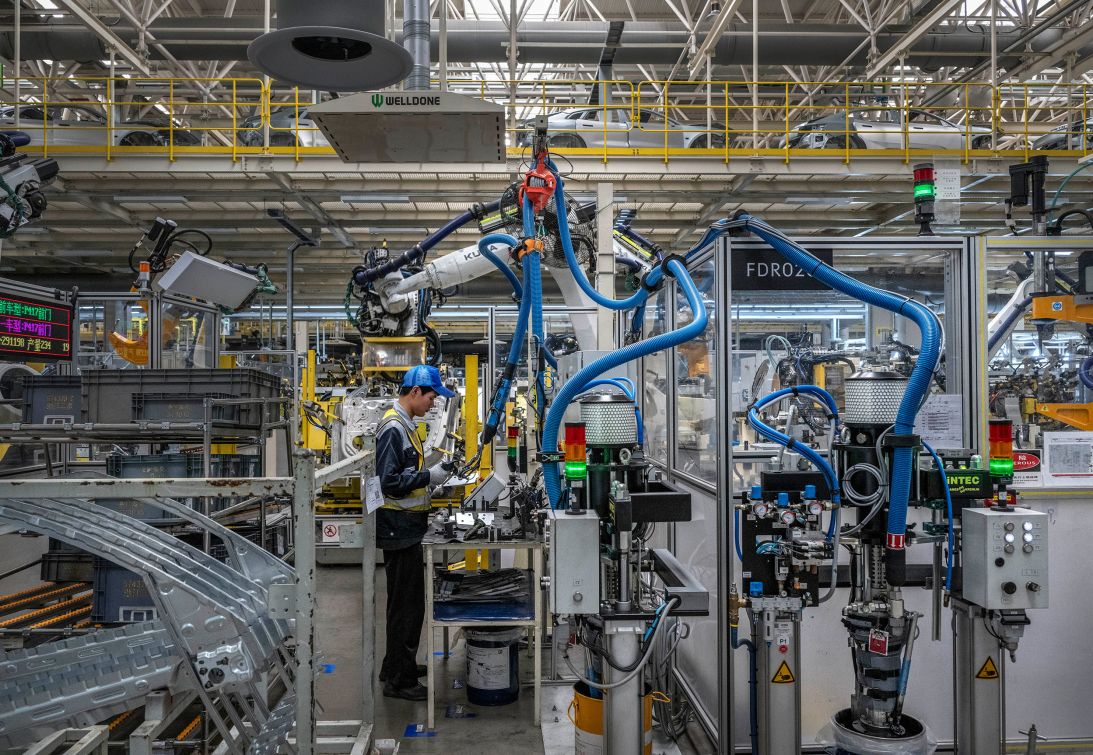
A worker controls a robotic arm on the production line at an electric vehicle factory in Ningbo, China, on May 29.
Kevin Frayer/Getty Images“All the drivers will tell you it just doesn’t make any economic sense for them to purchase another (gas) vehicle,” Shuo said. “Some of them told me that the fuel cost of driving an EV is about one sixth of an (gas)-powered vehicle.”
Climate analysts in China feel confident the nation has reached its peak oil use, given the dramatic uptick in EV use, Shuo said. But the outstanding question is China’s power sector, and whether all the wind and solar the country has installed over the last several years can displace coal-fired power. Over the few months, China’s increased demand for power has been met entirely by renewables, meaning the country hasn’t increased its planet-warming pollution even as it’s using more power.
“There’s still a lot of entrenched interest to support coal, but overall what we’re looking at is renewable energy eating into the share of fossil fuel power generation,” Shuo said.
Meanwhile, in the US, more expensive electricity could significantly hamper economic development and discourage companies from building here, undermining one of Trump’s own priorities. With less wind and solar coming online due to the GOP law, plus long wait times to get new natural gas plants up and running, Rhodium analyst Ben King said some data centers and large manufacturing facilities may struggle to get enough power.
“Data centers, semiconductor manufacturing and other sources of new industrial load, that just might not be able to come online, because we may not have the generators to meet that demand,” King said.
![[SMM PV News] Waaree Energies Approves INR 39B for Solar Glass Plant and Ups Stake in Subsidiary](https://imgqn.smm.cn/usercenter/fYlYx20251217171740.jpg)
![[SMM PV News] South Korea Targets 2,500 'Sunlight Income Villages' by 2030](https://imgqn.smm.cn/usercenter/NWqnx20251217171739.jpg)
![[SMM PV News] Saudi Arabia Adds 7.8 GW of Solar in 2025](https://imgqn.smm.cn/usercenter/LlMgj20251217171739.jpg)