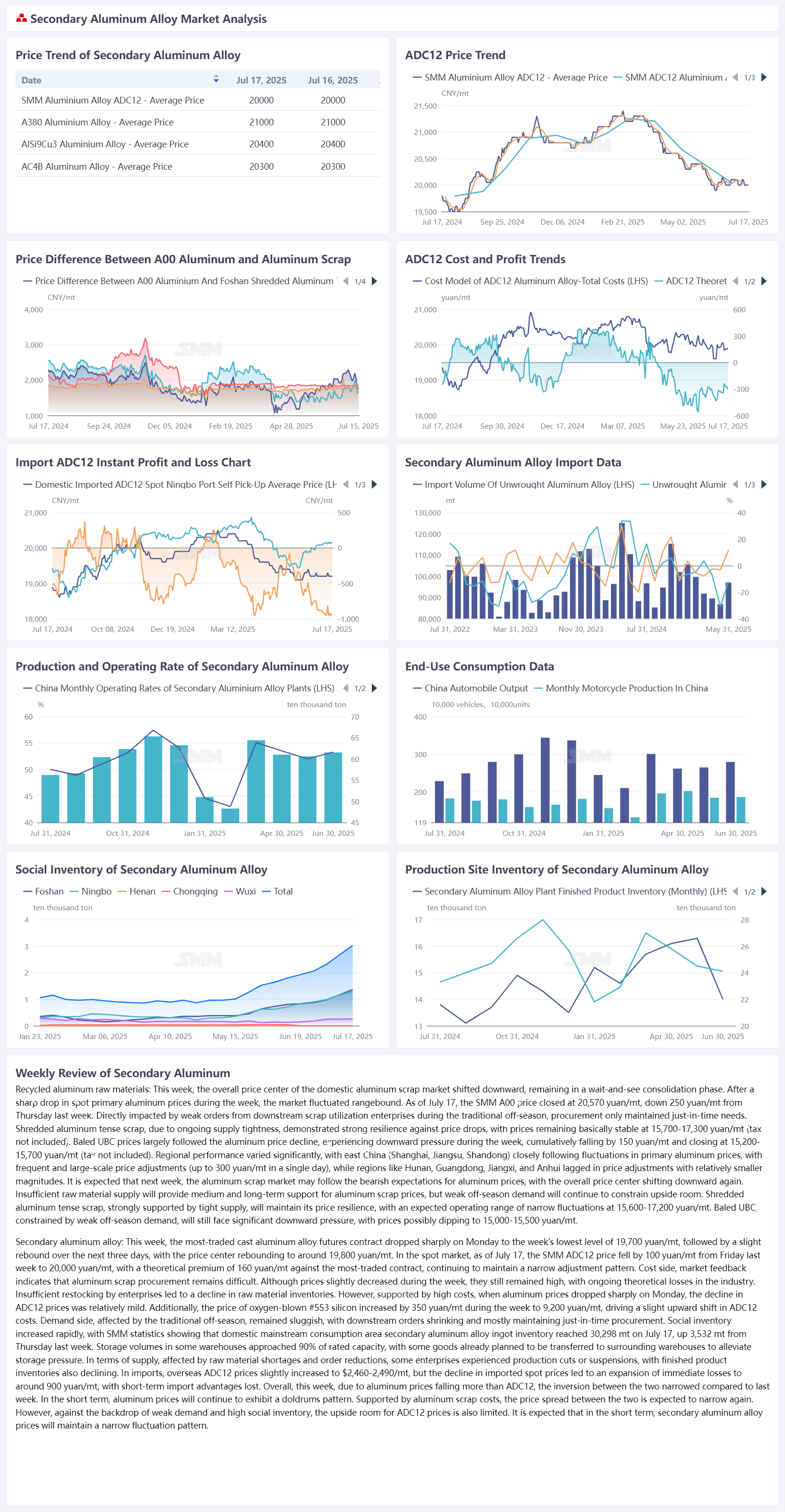
Aluminum scrap:This week, the overall price center of the domestic aluminum scrap market shifted downward, with the market in a wait-and-see consolidation phase. Spot primary aluminum prices plummeted sharply and then fluctuated rangebound during the week. As of July 17, the SMM A00 aluminum price closed at 20,570 yuan/mt, down 250 yuan/mt from Thursday last week. Directly impacted by the weak orders from downstream scrap utilization enterprises during the traditional off-season, purchases only maintained just-in-time demand. Shredded aluminum tense scrap demonstrated strong resilience against price drops due to persistent supply tightness, with outstanding price resilience. Prices remained basically stable within the range of 15,700-17,300 yuan/mt (tax not included) during the week. Baled UBC prices largely followed the aluminum price decline, with prices under pressure and declining cumulatively by 150 yuan/mt during the week, closing at 15,200-15,700 yuan/mt (tax not included). Regional performance varied significantly. East China (Shanghai, Jiangsu, Shandong) closely followed the fluctuations in primary aluminum prices, with frequent and relatively large price adjustments (up to 300 yuan/mt in a single day). In contrast, Hunan, Guangdong, Jiangxi, Anhui, and other regions experienced delayed price adjustments with relatively smaller magnitudes. It is expected that next week, the aluminum scrap market may follow the bearish expectations for aluminum prices, with the overall price center shifting downward again. Insufficient raw material supply will provide medium and long-term support for aluminum scrap prices, but weak off-season demand will continue to constrain upside room. Shredded aluminum tense scrap will remain resilient in price due to strong support from tight supply, with prices expected to fluctuate rangebound within the 15,600-17,200 yuan/mt range. Baled UBC will face significant downward pressure due to weak off-season demand, with prices possibly dropping to 15,000-15,500 yuan/mt.
Secondary aluminum alloy:This week, the most-traded contract for cast aluminum alloy futures opened sharply lower on Monday, reaching the week's low of 19,700 yuan/mt, before rebounding slightly over the next three days, with the price center rebounding to around 19,800 yuan/mt. In the spot market, as of July 17, the SMM ADC12 price fell by 100 yuan/mt from last Friday to 20,000 yuan/mt, with a theoretical premium of 160 yuan/mt against the most-traded contract, continuing to maintain a narrow adjustment pattern. Cost side, market feedback indicates that the difficulty in purchasing aluminum scrap remains high. Although prices have slightly decreased during the week, they still remain at elevated levels, with sustained theoretical losses in the industry. Insufficient restocking by enterprises has led to a decline in raw material inventories. However, supported by high costs, when aluminum prices fell sharply on Monday, the decline in ADC12 prices was relatively mild. Additionally, the price of oxygen-blown #553 silicon rose by 350 yuan/mt during the week to 9,200 yuan/mt, driving a slight increase in ADC12 costs. On the demand side, influenced by the traditional off-season, demand remains sluggish, with downstream orders shrinking and most purchases being made on a just-in-time basis. Social inventories have increased rapidly, with SMM statistics showing that the inventory of secondary aluminum alloy ingots in domestic mainstream consumption areas reached 30,298 mt on July 17, an increase of 3,532 mt from last Thursday. Storage volumes in some warehouses have approached 90% of their rated capacity, and currently, some goods are planned to be transferred to surrounding warehouses to alleviate storage pressure. In terms of supply, affected by raw material shortages and order reductions, some enterprises have experienced production cuts or suspensions, leading to a decline in finished product inventories. On the import front, overseas ADC12 prices have slightly risen to $2,460-$2,490/mt, but the decline in imported spot prices has widened immediate losses to around 900 yuan/mt, resulting in a short-term loss of import advantages. Overall, this week, due to the larger decline in aluminum prices compared to ADC12, the inversion between the two narrowed compared to last week. In the short term, aluminum prices will continue to exhibit a pattern of being in the doldrums. Supported by aluminum scrap costs, the price spread between the two is expected to narrow again. However, against the backdrop of weak demand and high social inventories, the upside room for ADC12 prices is also limited. It is expected that in the short term, secondary aluminum alloy prices will maintain a pattern of fluctuating rangebound.

![Geopolitical Disruptions and a Stronger Dollar Combined to Keep Aluminum Prices Volatile Under Pressure [SMM Aluminum Morning Meeting Summary]](https://imgqn.smm.cn/usercenter/TFHUe20251217171651.jpg)
![Futures Rebound Drove Quote Increases, While Weak Transactions Capped Gains [SMM Cast Aluminum Alloy Morning Comment]](https://imgqn.smm.cn/usercenter/fFkYh20251217171651.jpg)