
》Check SMM metal quotes, data, and market analysis
》Subscribe to view historical price trends of SMM metal spot cargoes
In the first half of 2025 (H1), copper prices in the three major markets (LME, COMEX, and SHFE) exhibited a wavy upward trend. After a sharp drop in early April, strong buying interest continued to drive copper prices higher in a wavy pattern. In H1, influenced by both macroeconomic factors and fundamental conditions, copper prices in the three markets moved in the same direction but with fluctuating price spreads among them.
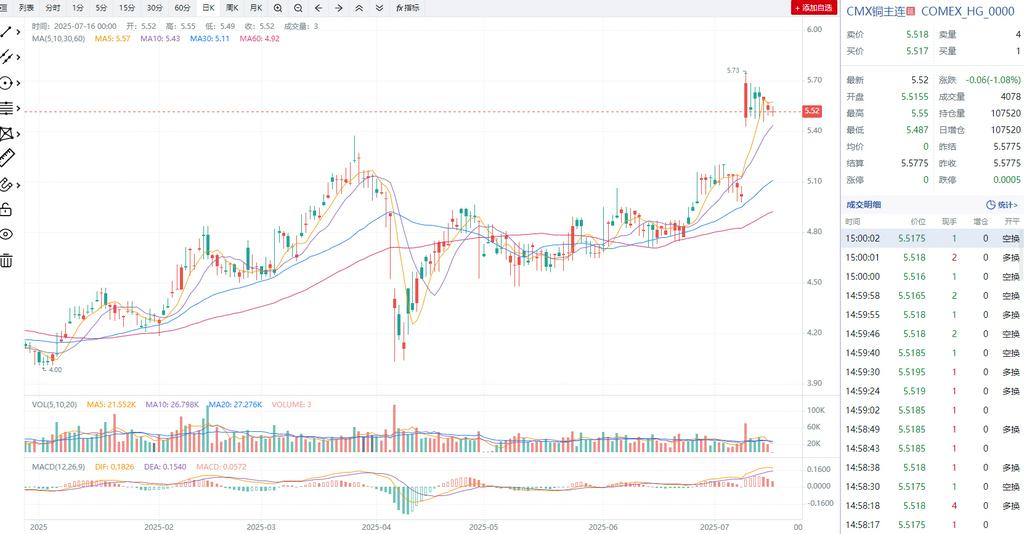
In the first half of 2025, COMEX copper prices performed exceptionally strongly, leading the global copper price rally. As tariff expectations gradually heated up, starting from late February, prices embarked on a sharp upward trend. On March 26, during the trading session, COMEX copper futures prices briefly hit a new annual high of $5.37 per pound, with a cumulative increase of up to 20%. Throughout H1, COMEX copper prices broke through key resistance levels multiple times, continuously challenging historical highs. By the end of June, COMEX copper prices were just a step away from the historical high of $5.37 per pound set in March.
On February 25, Trump initiated a copper import investigation under Section 232 of the Trade Expansion Act of 1962, covering all categories including raw copper, copper cathode, and copper alloys. Although the US had not yet officially imposed tariffs on copper, the market widely expected that copper tariffs could reach 25% in 2025. This expectation triggered severe disruptions in the global copper supply chain. Traders, anticipating that the US would impose tariffs on copper and aiming to profit from the rise in US copper prices, transferred a large amount of copper inventory from markets like LME to the US. This led to a surge in COMEX market inventory while also exacerbating concerns about copper supply deficits in the US. The combined effect of this expectation and the actual changes in inventory structure sparked strong bullish sentiment among investors, driving prices to continue climbing. Additionally, demand growth driven by the US domestic economic recovery and capital inflows due to a weaker US dollar further strengthened the upward trend of COMEX copper prices.
According to SMM data, the US imported a cumulative 680,000 mt of copper cathode from January to May 2025, and COMEX copper inventory reached 191,600 mt as of June 30; both were historical highs.
In the LME market, copper prices also exhibited an upward trend in the first half of the year, but with a slightly different rhythm compared to the COMEX market. From the beginning of the year to early March, LME copper prices climbed steadily, breaking through the $10,000 per mt mark on March 20 and reaching a high of $10,046.5 per mt. On March 26, they peaked at $10,164.5 per mt, setting a new high since early October 2024, with a cumulative increase of 13%. In early April, due to market discussions triggered by Trump's imposition of tariffs on foreign countries, risk assets came under pressure, and LME copper prices plummeted below $9,000 per mt, briefly hitting a bottom of $8,105 per mt. Subsequently, as buyers re-entered the market, copper prices resumed their upward trend.
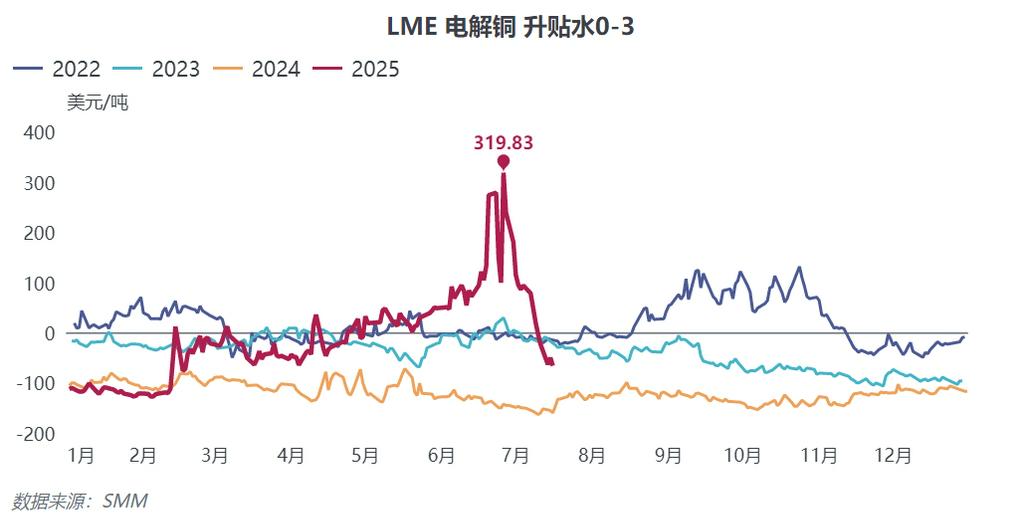
The initial rise in LME copper prices in the first half of the year was mainly driven by the structural adjustment of global copper inventories, with a significant amount of inventory flowing from the LME to the COMEX market, leading to a substantial decrease in LME inventories. LME copper inventories fell from 271,400 mt at the beginning of the year to 90,600 mt by June 30, a decline exceeding 60%. The rapid destocking exacerbated market concerns about spot supply, driving prices higher. However, after entering Q2, as the market digested tariff expectations and demand in other regions remained relatively weak, the upward momentum of LME copper prices gradually weakened. Nevertheless, global traders closely monitored structural changes in the LME amid declining LME inventories, leading to the emergence of a strong backwardation structure in the LME.
In the SHFE market, copper prices generally followed the upward trend of COMEX and LME markets in the first half of the year, but with a relatively stable fluctuation range. After the Chinese New Year, copper prices climbed from around 75,000 yuan/mt before the holiday to around 77,000 yuan/mt. Driven by favourable macro factors and expectations of a contraction in copper cathode supply in early March, prices rose further. By the close on March 20, the most-traded SHFE copper futures contract was reported at 81,670 yuan/mt, reaching a peak of 83,320 yuan/mt on March 26, a new high since early June 2024, with a cumulative increase exceeding 10%. After Q2, influenced by the seasonal weakening of domestic demand and global copper price fluctuations, SHFE copper prices entered a rangebound fluctuation zone, oscillating between 78,000 and 81,000 yuan/mt.
From the perspective of domestic supply and demand, the tight supply situation of domestic copper ore persisted in the first half of the year, with copper concentrate TCs continuously declining. By the end of June, China's spot copper concentrate TCs fell to a record low of negative $45 per mt. However, due to the continuous expansion of domestic smelting capacity and the considerable revenue from by-products such as blister copper and copper anode and sulphuric acid at some smelters, domestic copper cathode production defied market consensus and increased instead of decreasing in the first half of the year, with monthly production reaching new historical highs. On the demand side, domestic demand for copper was strongly supported by policies in the home appliance, automotive, and power sectors in Q1. After entering Q2, a rush to export in April led to a significant destocking of domestic inventories. However, with the arrival of the traditional off-season in late May and the partial exhaustion of earlier demand, domestic copper demand gradually weakened.
In April, due to robust demand and relatively tight supply, significant destocking in the social inventory led to a widening of the backwardation structure in the near-month contracts of SHFE copper futures. However, after the delivery of the SHFE copper 2505 contract ended, market participants were not optimistic about future consumption and the continued increase in supply, leading to a lack of confidence in the backwardation structure of near-month contracts, and borrow players exited the market.
Summary:
Uncertainties in trade policies at the macro level, particularly tariff expectations in the US, have emerged as a key force disrupting the market. Meanwhile, the divergence of the global economy and the trend of the US dollar have also provided support for copper prices. On the fundamental side, global copper ore supply is tight, and processing fees are declining. Domestic demand was strong initially but weakened later, while overseas demand showed a divergent trend. Looking ahead to H2, the global copper market still faces numerous uncertainties. The final implementation of the US tariff policy, changes in copper ore supply, the extent of domestic demand recovery, and the performance of overseas economies will all have a significant impact on the trend of copper prices.
》Check the SMM Metal Industry Chain Database