On July 4, 2025 (U.S. Eastern Time), the One Big Beautiful Bill Act (OBBBA) was officially signed into law by President Trump. The OBBBA significantly tightens the PV subsidy provisions established under the 2022 Inflation Reduction Act (IRA). This article analyzes the updated PV-related provisions introduced by the OBBBA and explores their potential impact on the U.S. PV market.
PV subsidy phase-out date brought forward
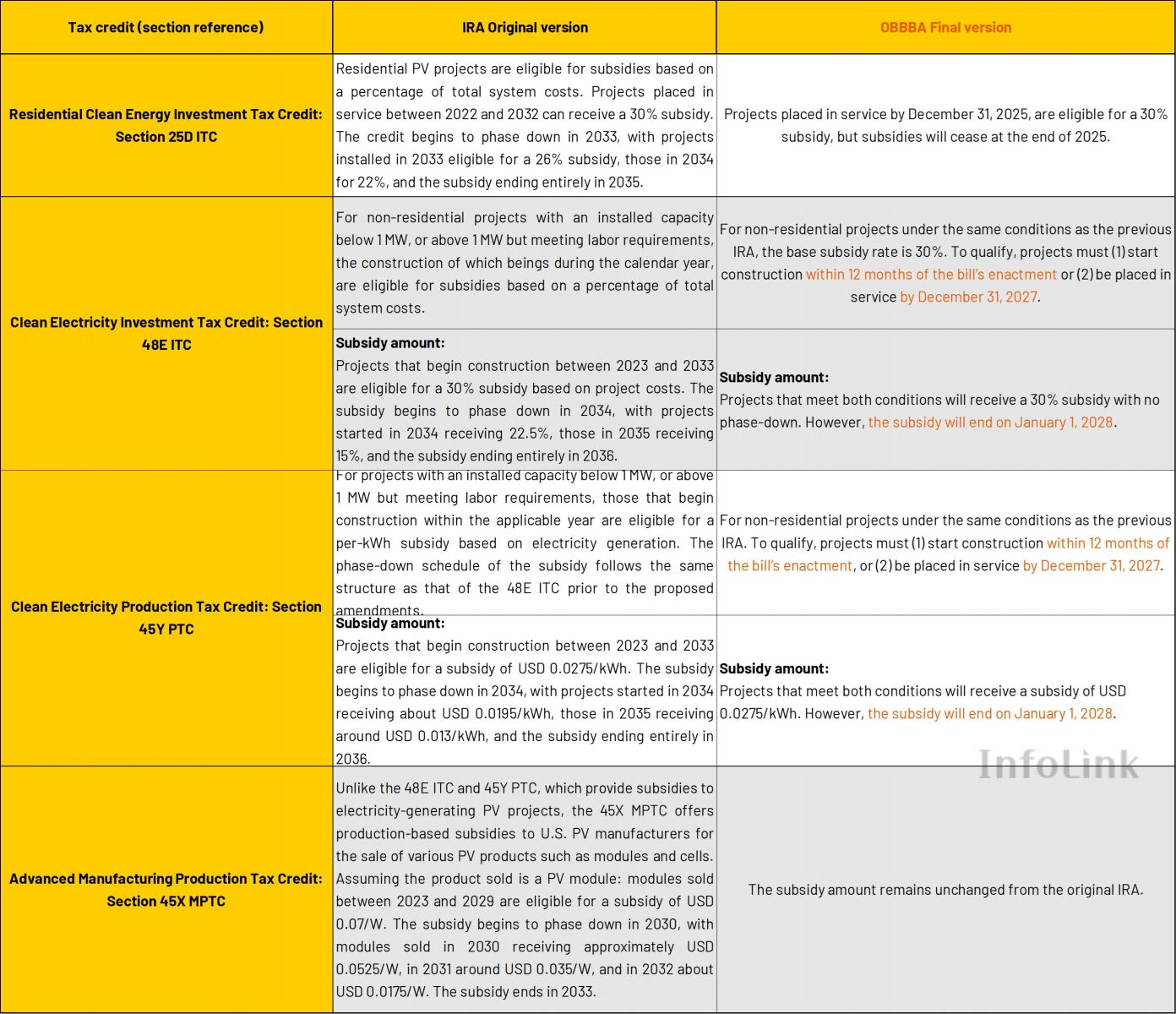
Compared to the IRA, the OBBBA introduces substantial revisions to the eligibility criteria for PV tax credits by shifting the key qualification date from "beginning of construction" (BOC) to "placed in service" (PIS). Furthermore, tax credits for Section 25D applicable to residential PV installations will expire at the end of 2025, while the termination of subsidies under Sections 48E and 45Y has been brought forward to the end of 2027.
Foreign Entity regulations officially announced
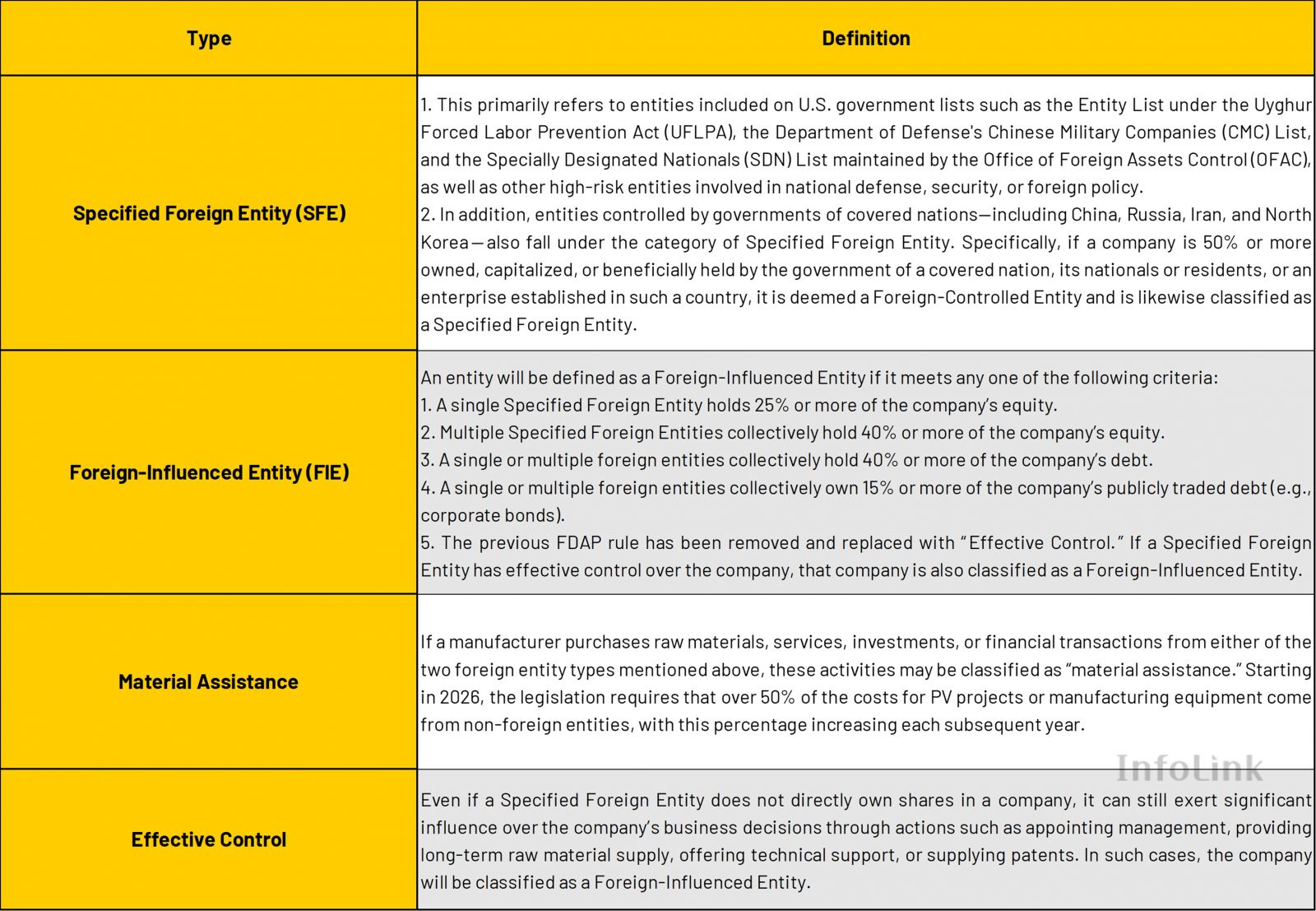
The OBBBA explicitly defines “Prohibited Foreign Entity,” which includes “Specified Foreign Entity” and “Foreign-Influenced Entity.” Once a non-U.S. manufacturer is classified under either category, it becomes ineligible for key subsidies, such as the credits under Sections 48E, 45Y, and 45X. This has significant implications for manufacturers’ market strategies and investment planning in the U.S.
InfoLink analysis
1. Significant policy shift signals a restructuring phases for solar energy in the U.S.
The passage of OBBBA marks a fundamental pivot toward “America First” in the U.S. solar industry. Residential PV systems will lose the Section 25D credit starting January 1, 2026, while subsidies for utility-scale plants and C&I projects will continue through the end of 2027. This differentiated policy approach is set to reshape the U.S. PV market landscape. A surge in residential installations is expected in late 2025, followed by a sustained downturn after 2026.
2. Pairing energy storage becomes a key factor for project economic viability
Amid the accelerated phase-out of PV subsidies, incentives for standalone energy storage projects remain intact. The energy storage of solar-plus-storage projects will remain eligible for the 30% ITC, offering a policy advantage over standalone PV projects.
High electricity prices allow C&I rooftop projects to remain economically viable despite the subsidy phase-out. Pairing with energy storage system (ESS) can improve financial returns, with solar-plus-storage solutions already a rising trend in Europe and the U.S. While ESS adoption is expected to increase, it must comply with foreign entity restrictions and other regulatory requirements.
3. Mid- to long-term competitiveness will hinge on compliance capabilities
U.S. federal policies are shifting the PV market’s competitive focus from scale and cost to the compliance capabilities of the supply chain. The Act establishes a stringent supplier certification system, with non-compliance subject to significant fines. This will compel project developers and equipment suppliers to allocate additional resources to compliance management systems.
For PV manufacturers in the U.S., third-country investment strategies will face tighter scrutiny. The third country relying on Chinese supply chains will remain exposed to compliance risks. As a result, in recent years, despite higher module prices and comparatively less advanced technology, many U.S. utility-scale project developers have opted to rely on domestic suppliers to mitigate potential policy risks and compliance uncertainties.
Overall, PV manufacturers that can thoroughly understand U.S. policies, adjust capacity deployment, strengthen local partnerships, and build a reliable supply chain will gain a clear competitive edge and be well-positioned for sustainable growth in the U.S. market.
![[SMM PV News] Armenia Hits 1.1 GW Solar Capacity,](https://imgqn.smm.cn/usercenter/qQwIB20251217171741.jpg)
![Spot Market and Domestic Inventory Brief Review (February 5, 2026) [SMM Silver Market Weekly Review]](https://imgqn.smm.cn/usercenter/tSwaX20251217171735.jpg)