Outlook on China's Sponge Titanium Market: Export Growth & Competitive Landscape[SMM Analysis]

Published: Jul 04, 2025 09:39 (GMT+8)
Source: SMM
[SMM Analysis: Outlook on China's Sponge Titanium Market: Export Growth & Competitive Landscape] The sponge titanium market will undergo a significant transformation in 2025. China dominates the supply side with 68% of global production capacity, and exports in the first half of the year increased by 78% year-on-year. The current market shows a clear differentiation, with Japanese companies continuing to monopolise the high-end market, while Chinese companies occupy the mid-to-low-end market with their price competitiveness. The European market has strict product quality requirements but scattered orders, the US market is restricted by tariff policies, and the Southeast Asian market faces intense price competition. The industry is facing multiple challenges, including Japan's technological leadership, the upcoming implementation of carbon tariffs in Europe, and the continued expansion of domestic production capacity.

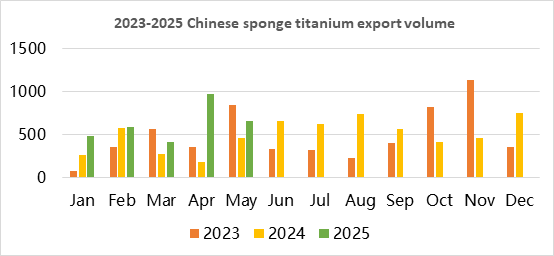
Since 2025, the price of sponge titanium has shown a significant upward trend, primarily due to the successful implementation of previous production cuts and inventory clearance measures. This trend has been further supported by domestic demand and chemical industry orders, as well as growth in overseas orders. Customs data indicates that China's sponge titanium exports reached 3,140 tonnes in the first half of 2025, representing a substantial year-on-year increase of 78%, reflecting the rapid expansion of overseas market demand.

Under the impetus of national supply-side reforms and environmental protection policies, semi-process production methods and outdated production capacity are gradually exiting the market, while leading companies are accelerating their transition to full-process production, resulting in a continuous increase in the concentration of China's sponge titanium industry. It is worth noting that there are significant price differences among enterprises for sponge titanium of different grades. This primarily stems from the differentiation in downstream titanium material orders—enterprises with higher prices primarily target the high-end sponge titanium market, while those with lower prices focus on supplying the mid-to-low-end market. This differentiated pricing strategy also constitutes a competitive advantage for China's sponge titanium in the international market.
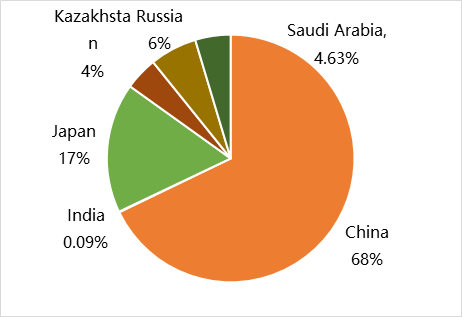
In terms of global production share, China accounts for 68% of the world's total sponge titanium production, firmly maintaining its position as the global leader. However, feedback from export markets indicates that Japan remains a significant competitor in the Asian market, with its sponge titanium industry dominated by Dongbang Titanium Industry and Osaka Titanium Industry Technology, which focus on the high-end order market. It is reported that Dongbang Titanium Industry has recently continued to expand its production capacity, further solidifying Japan's global leadership in the high-end sponge titanium sector. In contrast, China still lags behind in terms of advanced sponge titanium production technology. The Russian sponge titanium market is experiencing a significant decline. Due to the Russia-Ukraine conflict, the country has lost a large number of international orders, leading to severe oversupply of sponge titanium and titanium ingot products. Currently, these accumulated inventories are primarily entering the Chinese market through trade channels, but the absorption process is progressing slowly.

According to domestic manufacturers, European customers generally prefer Grade 0 sponge titanium, but each order has different product requirements, making it difficult to establish a unified standard. Additionally, there are significant differences in price, payment terms, and delivery schedules, though overall quality requirements are stringent. The European supply chain is highly fragmented, with limited domestic smelting capacity and significant differences in demand among manufacturers. In contrast, the American supply chain is more complete, but export difficulties are significant due to tariff barriers. Southeast Asian customers primarily purchase lower-grade sponge titanium such as Grade 2, but they exert significant pressure to lower prices, resulting in relatively limited export profit margins.

Looking ahead to the prospects for Chinese sponge titanium exports, the civilian chemical sector is expected to become an important growth area. Against the backdrop of continuously increasing domestic production capacity, expanding overseas markets will become an important channel for absorbing excess capacity. In the future, it will be necessary to establish a more comprehensive export mechanism to promote healthy market development. SMM will continue to monitor and promptly update price dynamics in overseas sponge titanium markets.

Data Source Statement: Except for publicly available information, all other data are processed by SMM based on publicly available information, market communication, and relying on SMM's internal database model. They are for reference only and do not constitute decision-making recommendations.

For any inquiries or for more information, please contact: lemonzhao@smm.cn
For more information on how to access our research reports, please contact:service.en@smm.cn
Related News
Titanium Market Weekly in the Doldrums, Industry Chain Divergence Continues [SMM Titanium Weekly Review]
13 hours ago
Titanium Market Weekly in the Doldrums, Industry Chain Divergence Continues [SMM Titanium Weekly Review]
Read More
Titanium Market Weekly in the Doldrums, Industry Chain Divergence Continues [SMM Titanium Weekly Review]
[SMM Titanium Weekly Review: Titanium Market Consolidates on a Weak Note This Week, Industry Chain Divergence Persists] The titanium market overall consolidated on a weak note this week. Titanium concentrates were in ample supply, with domestic growth combined with high imported inventory, low-priced cargoes weighing on the market, and downstream buyers pushing for lower prices, leaving ore prices under pressure. Titanium dioxide held steady, with improved orders in September driving production resumptions, but the "October peak season" failed to materialize, as new orders were few and transactions weak, with limited support from raw materials. Titanium slag consolidated on a weak note, with losses persisting, operating rates at low levels, downstream just-in-time procurement, and supply contraction finding a floor but unable to rise. Titanium sponge remained in the doldrums, with new capacity releases combined with production resumptions after maintenance creating significant supply pressure, while downstream buyers pushed for lower prices and transactions were thin. Titanium products showed a cold-hot divergence, with the civilian segment sluggish amid fierce price competition, while aerospace and military orders were full but provided limited boost. Overall, end-use demand has not fully recovered, with short-term divergence and a weak consolidation expected, and attention on post-holiday restocking and low-end capacity rationalization.
13 hours ago
Nigeria's Ondo State Inks $362M Deal for West Africa's First Integrated Titanium Plant
15 hours ago
Nigeria's Ondo State Inks $362M Deal for West Africa's First Integrated Titanium Plant
Read More
Nigeria's Ondo State Inks $362M Deal for West Africa's First Integrated Titanium Plant
【SMM Titanium Flash】On October 12th, the government of Ondo State, Nigeria, signed an agreement worth $362 million with PyVee Limited to build a titanium processing plant in the Ilaje Local Government Area, implemented through a public-private partnership model. Positioned as the first fully integrated titanium value chain processing plant in West Africa, the project will be advanced in two phases: the first phase involves an investment of approximately $12 million to build a commercial pilot plant, which is expected to be operational about 21 months after signing; the second phase involves the construction of a full-scale titanium processing complex. The state government participates by exchanging land for equity, and the project is expected to generate an annual economic value of over 300 billion naira for Ondo State. With the implementation of the project, Nigeria's participation in the global titanium processing industry is expected to increase.
15 hours ago
EU Grants Strategic Status to Verde Magnesium Project, Aiming for 90,000 Tons Annual Production by 2036
15 hours ago
EU Grants Strategic Status to Verde Magnesium Project, Aiming for 90,000 Tons Annual Production by 2036
Read More
EU Grants Strategic Status to Verde Magnesium Project, Aiming for 90,000 Tons Annual Production by 2036
【SMM Titanium Flash】On October 13th, the European Commission granted the strategic project status of the key raw material bill for the processing link of the Verde Magnesium Industries project in Romania. Together with the previously approved mining link, this project has become the only one in Europe to obtain CRMA strategic status across the entire value chain of primary magnesium. Its phased production roadmap shows that the annual production target is set at 360 tons in 2028, increasing to 30,000 tons in 2031, and further expanding to 90,000 tons in 2036. With the establishment of strategic status across the entire chain, the construction of local primary magnesium supply capacity in Europe is expected to accelerate.
15 hours ago