Amidst the surging tide of global energy transformation, sodium-ion batteries (sodium-ion batteries), with their unique advantages such as abundant resource reserves, low cost, and excellent low-temperature performance, are gradually emerging as a shining new star in the new energy sector. In June 2025, the sodium-ion battery industry has been buzzing with good news, with enterprises going into production, product launches, technological breakthroughs, and market expansions all contributing to a vibrant new industry landscape.
Major Projects Land, Advancing the Scaling Process
On June 12th, Paragonage's first flexible mass production line for sodium-ion batteries in China was officially launched in the Xishan Economic and Technological Development Zone, Wuxi City. This landmark event has pressed the accelerator for the large-scale production of the sodium-ion battery industry. The production line focuses on the development and application of sodium-ion cylindrical battery cells (32140) and pouch battery cells, employing advanced flexible manufacturing technology and a high-speed production line. The use of flexible manufacturing technology enables the production line to quickly respond to changes in market demand, achieving flexible production of battery cells of different specifications and types, greatly enhancing production efficiency and product adaptability.
On the same day, the 2024 First China Sodium-ion Battery Light Power and Electricity Energy Storage Conference - Baoying "Green Waters and Mountains, Sodium-ion Batteries Empowering Dual Carbon Goals" New Energy Industry City Promotion Conference and the Opening Ceremony of China Sodium Energy were successfully held in Baoying County, Yangzhou City, Jiangsu Province. At the event, China Sodium Energy (Yangzhou) Co., Ltd. officially launched the Phase II 4GWh sodium-ion battery project, which will mainly produce 32140 full-tab large cylindrical sodium-ion battery products. The full-tab design effectively reduces the internal resistance of the battery, enhancing charging and discharging performance, and holds broad application prospects in both energy storage and power sectors.
On June 17th, the construction of the high C-rate polyanion sodium-ion energy storage battery cathode and anode material industrialisation project of Weinan Bona New Energy Technology Co., Ltd. commenced. The project, with a planned total investment of 1.1 billion yuan, will be constructed in two phases, further improving the upstream layout of the sodium-ion battery industry chain.
Cathode Material Shows Robust Growth, NFPP Stands Out
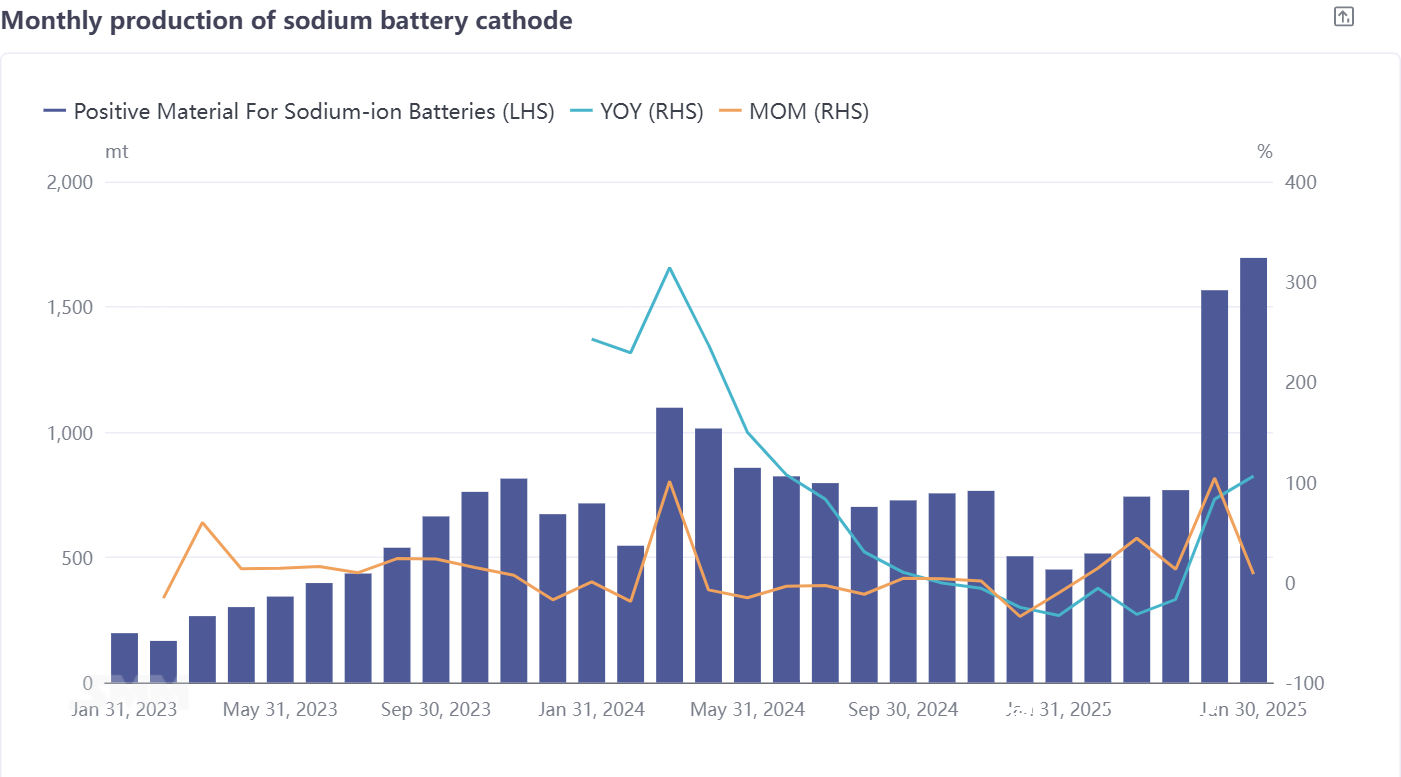
Material side, sodium-ion battery cathode production in June demonstrated strong growth momentum, up 8% MoM and 106% YoY. Among them, the polyanion NFPP material performed particularly well, accounting for 67% of total output, far exceeding layered oxide O3, P2, and Prussian blue systems. NFPP material, with its excellent cycle stability and high power performance, has been widely adopted in start-stop and two-wheeler applications. However, its mass production capacity is currently concentrated in a few enterprises. With sustained market demand growth in H2, undersupply may emerge. Notably, NFPP is at a critical stage of cost reduction through mass production. As technology matures and scale production advances, there remains significant room for price declines. SMM expects sodium-ion battery cathode output to grow 13% MoM and 140% YoY in July.
Anode Material Capacity Expands Amid Cost Challenges
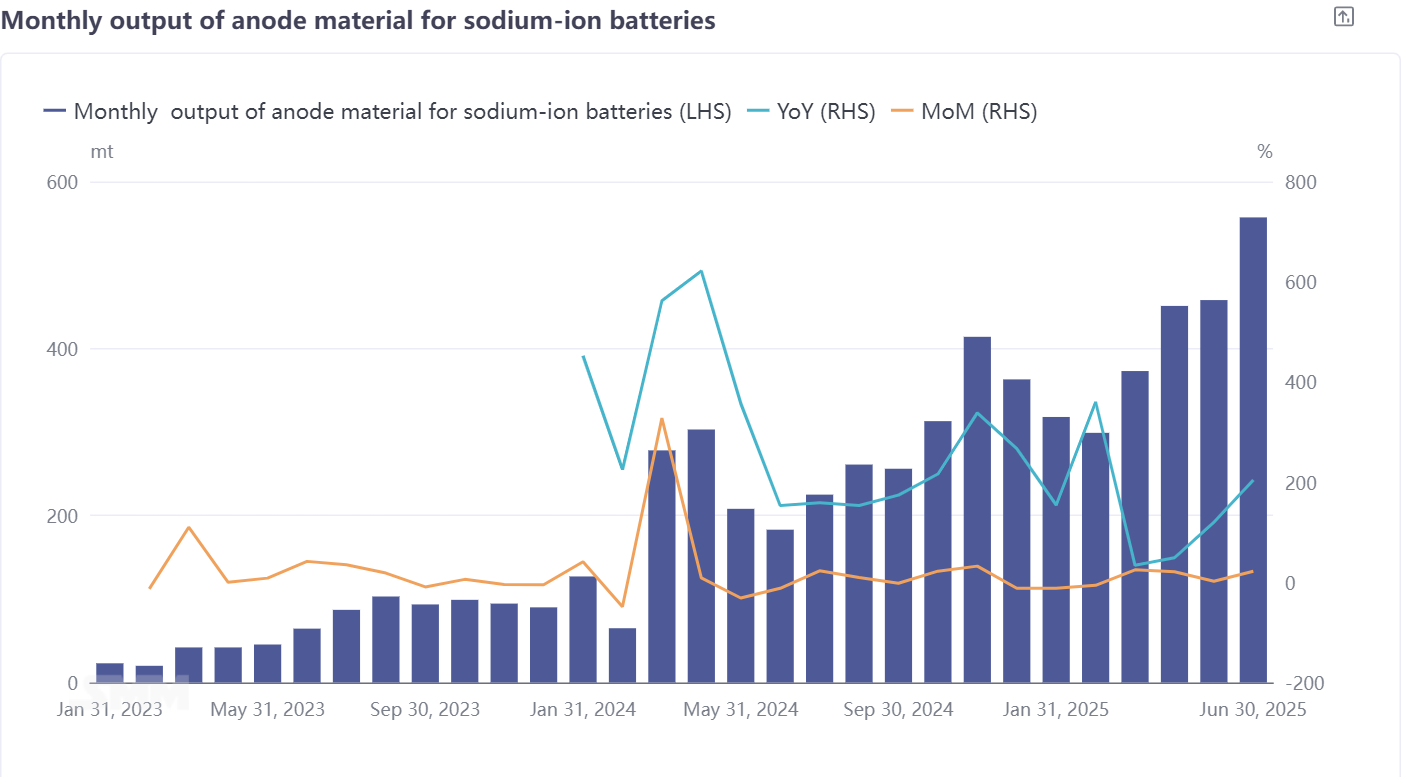
For sodium-ion battery anode materials, despite capacity expansion, multiple challenges persist. June saw anode output rise 22% MoM and 204% YoY, though major hard carbon anode orders are mostly non-binding agreements for the next five years. Constrained by existing capacity and high procurement costs of biomass coconut shell carbon, significant output breakthroughs are unlikely in the short term. July output is projected to increase only 5% MoM and 160% YoY.
Electrolyte Output Rises as Cost Reduction Accelerates
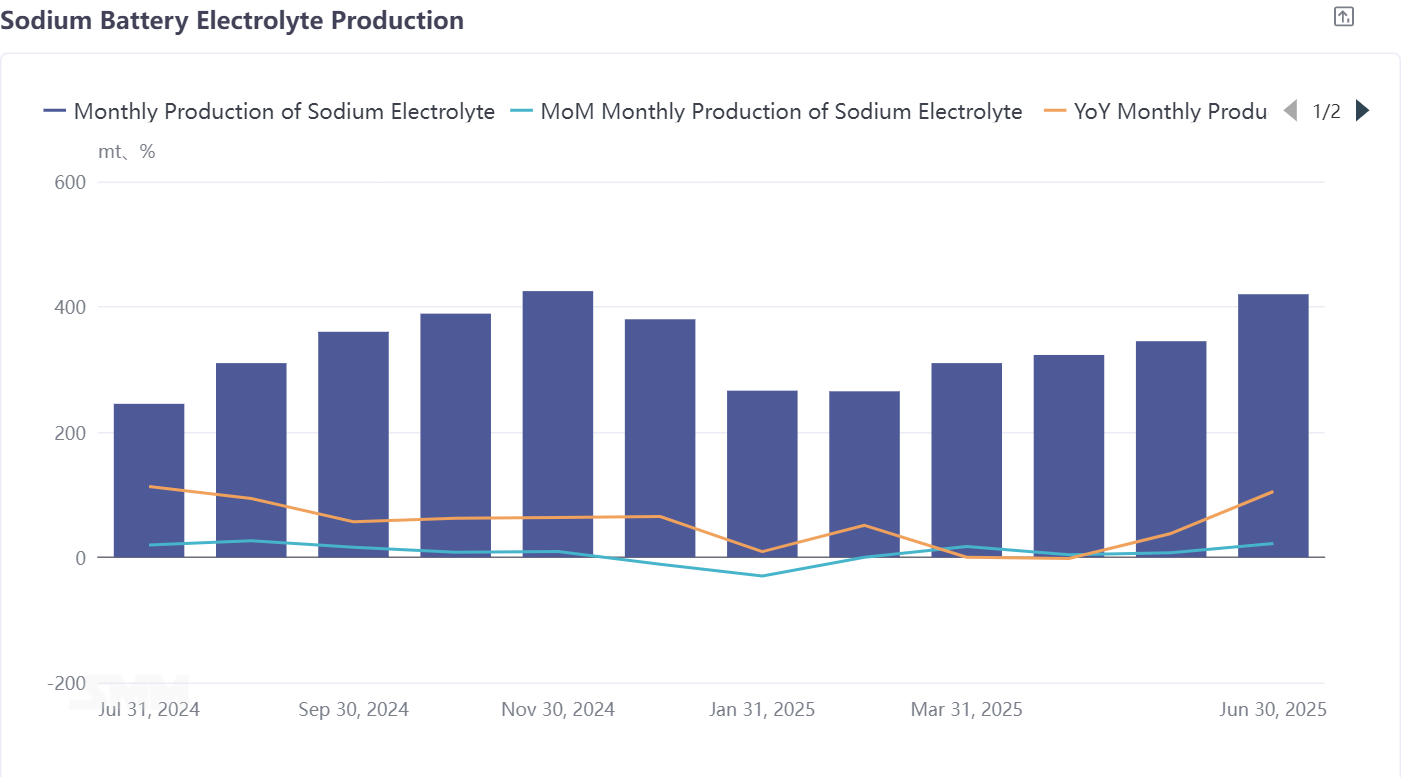
In the electrolyte sector, sodium-ion battery electrolyte production grew 22% MoM and 105% YoY in June. Its production model remains primarily produce-based-on-sales with high customization. As NFPP material demand climbs, electrolyte demand follows, driving mass production of electrolytes, salts, and additives. This accelerates cost reduction and enhances market competitiveness.
Battery Cell Segment Sees Robust Demand and Expansion
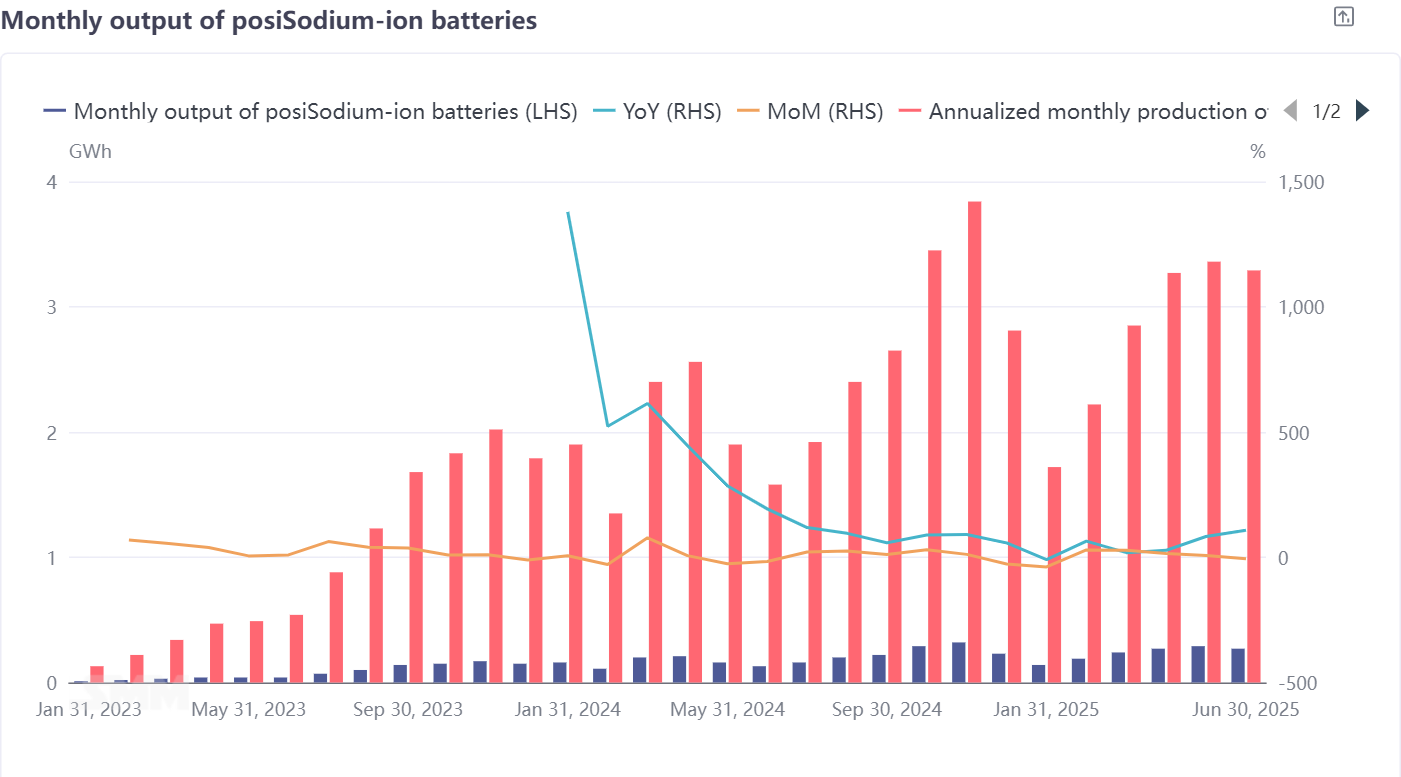
For battery cells, despite a 6% MoM decline in June, output still rose 108% YoY. Some enterprises have signed ESS cooperation agreements for H2, while backup power applications also show robust demand. In 2025, multiple sodium-ion battery cell enterprises are actively transitioning from layered oxide to polyanion systems. Both traditional lithium battery players and sodium-ion startups are accelerating capacity expansion and stockpiling. Cell output is expected to continue rising in coming months, speeding up commercialization of sodium-ion batteries in ESS, start-stop, and two- and three-wheeler applications. In June 2025, the sodium-ion battery industry made significant progress in production layout, technological R&D, and market expansion. From the material side to the battery cell side, the collaborative development of each link laid a solid foundation for the growth of the sodium-ion battery industry. Despite challenges remaining in areas such as cost control of anode materials, with continuous technological breakthroughs and the continuous expansion of industrial scale, sodium-ion batteries are expected to occupy a more important position in the new energy field, contributing powerful strength to the realization of global energy transformation and the "dual carbon" goals.
![[SMM Cobalt-Lithium Morning Meeting Summary] Raw Material Divergence Intensifies; Peak Season Demand Uneven, Prices Consolidate](https://imgqn.smm.cn/usercenter/GVVKq20251217171728.jpg)
![[SMM Cobalt Morning Meeting Summary] Weak Demand Combined with Lower Costs, Industry Chain Price Center Continues to Decline](https://imgqn.smm.cn/usercenter/tfLay20251217171725.jpg)