In Q1 2025, as a transitional year for the implementation of the "reverse invoicing" policy, many enterprises indicated that the policy was still unclear and chose to suspend production, observing how enterprises in other provinces implemented and enforced the policy. As local government departments across the country implemented the specific workflow for "reverse invoicing," enterprises gradually resumed production. However, secondary copper rod enterprises stated that most secondary copper raw material yards or suppliers were not yet familiar with the new "reverse invoicing" policy and would not fully cooperate with secondary copper rod enterprises in carrying out "reverse invoicing" work. Consequently, many enterprises could only pay relevant taxes according to the "presumptive taxation" method.
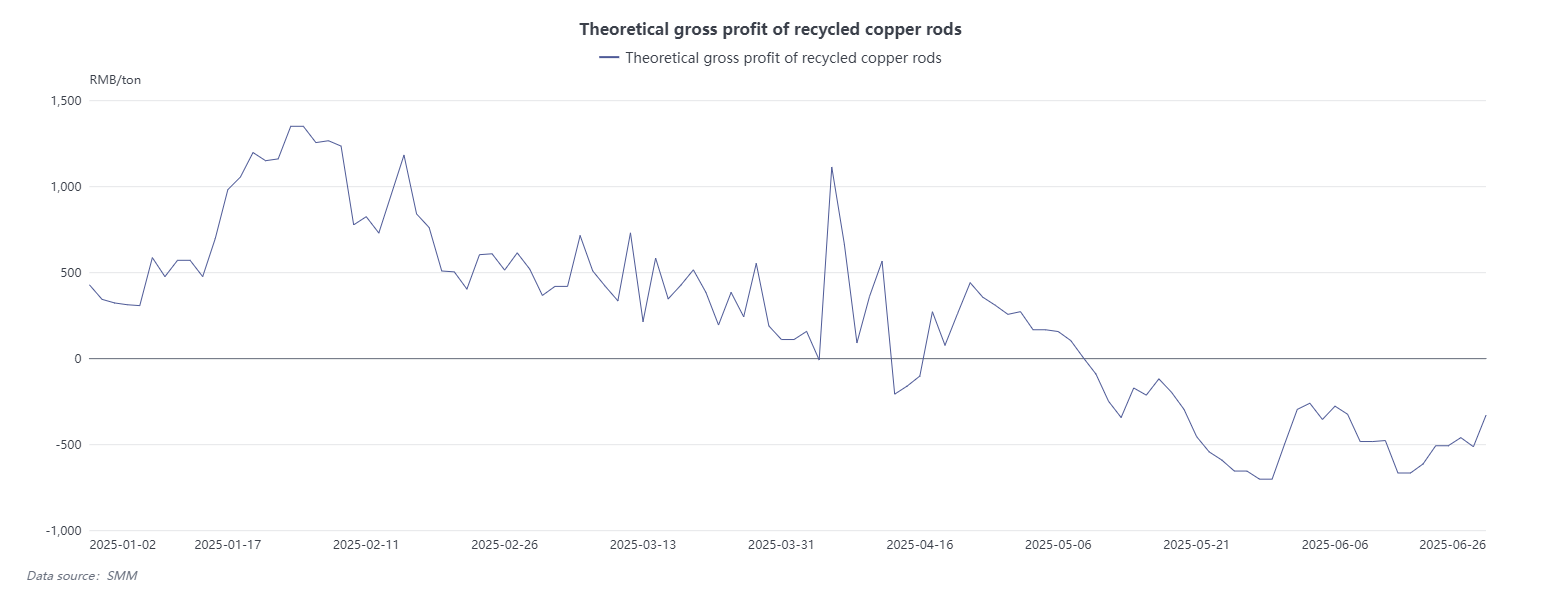
In Q2 2025, the issue of the US-China trade war affected commodity prices. After a significant retreat, copper prices rebounded only slightly. China's tariff retaliation against US goods prevented US secondary copper raw materials from entering China. Domestic supply of secondary copper raw materials was already inadequate, and now, with the loss of the US as a major overseas supplier of secondary copper raw materials, domestic secondary copper raw material prices remained artificially high for a time. Due to the expected decline in domestic and overseas imported secondary copper raw material supplies, many secondary copper raw material suppliers and traders were unwilling to sell their inventories at low prices. There was even a situation where secondary copper raw material prices "rose with copper prices but did not fall with them." Secondary copper rod enterprises stated that entering the off-season for consumption in May and June, orders were already insufficient. The artificially high prices of secondary copper raw materials were now putting significant pressure on enterprise production. According to the SMM gross profit model for secondary copper rod sales, it can be seen that the sales profits of secondary copper rod enterprises have been below the zero line since May and have shown a trend of continuous expansion. Enterprises stated that for every metric ton (mt) of secondary copper rod produced and sold, the factory incurs a loss of at least 200 yuan or even more. If production is not resumed, expenses such as worker wages and fixed costs would also exceed the losses caused by producing copper rods. Enterprises could only be forced to resume production. However, with the continuous high prices of secondary copper raw materials and difficulties in procurement most of the time, enterprise production was intermittent. Additionally, during the transitional period of policy implementation, the implementation and enforcement of the policy varied across the country. Enterprises in Xiaogan, Hubei Province, stated that the local government currently leads other provinces in terms of enforcement. Changes in procurement costs have also caused enterprises to lose certain price advantages. Enterprises hope for clarity in policy implementation as soon as possible and for consistent policy enforcement and intensity nationwide to avoid an unequal market competition environment caused by inconsistent policy implementation across regions.
 In summary, 2025 serves as a transitional year for the "reverse invoicing" policy. The rapid response of enterprises in Hubei province has enabled them to seize the opportunity to become familiar with the policy and operate smoothly during its full implementation in 2026. However, the instability in the supply and pricing of secondary copper raw materials has made the policy implementation less than smooth. Enterprises are actively seeking the best ways to implement the new policy. According to the SMM survey, pilot enterprises in various provinces across the country have begun to fully implement "reverse invoicing," and the scope of the pilot program will be expanded in the future. The implementation of "reverse invoicing" allows secondary copper rod enterprises to improve their input invoice sources and solve a major problem in the recycling and circulation of renewable resources. The deductibility of input and output invoices also helps enterprises reduce certain tax costs. The implementation of "reverse invoicing" by enterprises can be said to bring only benefits and no harm.