Rare earth permanent magnets' exports in May 2025 hit a new historical low in nearly five years. How will the subsequent exports change? [SMM Analysis]

Published: Jun 20, 2025 16:21
[SMM Analysis: Exports of rare earth permanent magnets hit a new five-year low in May 2025. How will exports change in the future?] Although the regulated items are medium-heavy rare earths containing dysprosium and terbium, for permanent magnet products that do not contain medium-heavy rare earths such as dysprosium and terbium, customs authorities need to conduct identification. In cases where the license issued by the national export control management authority has not been presented to customs, customs authorities may question whether the items fall within the scope of export control. During the questioning period, export enterprises are required to provide corresponding materials to customs for verification. During the identification or questioning period, customs authorities will not release the relevant exported goods. Additionally, there were four days in April when exports were not subject to restrictions, which also contributed to the decline in exports in May compared to April.

SMM News on June 20: In May 2025, the exports of rare earth permanent magnets reached 1,238.47 mt, down 52.85% MoM and 74.26% YoY, hitting a new historical low in nearly five years after the record low in April. The export data in April hit a historical low due to the impact of macro policies. Then why did the exports in May still drop by more than half compared to April?
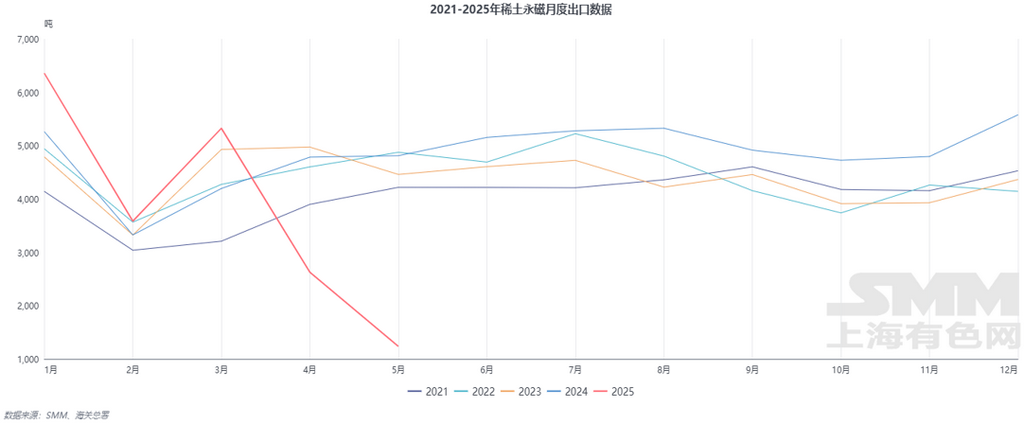
This is mainly because rare earth permanent magnet products share the same customs code: 85051110. Although the controlled items are medium-heavy rare earths containing dysprosium and terbium, for permanent magnet products that do not contain dysprosium and terbium, customs needs to conduct identification. Additionally, for cases where the license issued by the national export control management authority has not been submitted to customs, customs may question whether the products fall within the scope of export control. During the identification or questioning period, customs will not release the relevant export goods. Moreover, there were still four days in April when exports were not subject to control, which also contributed to the decline in exports in May compared to April.
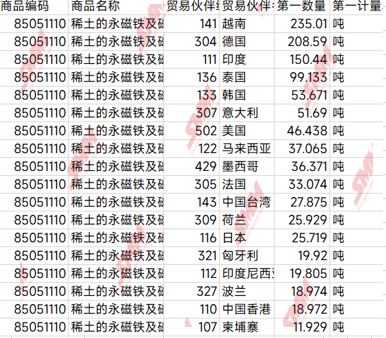
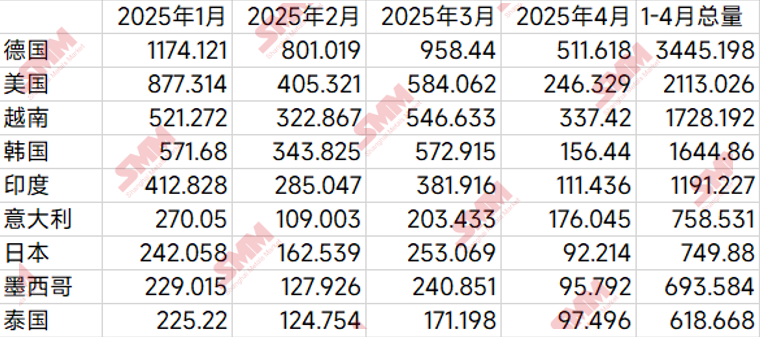
The chart above shows the exports of rare earth permanent magnet products by destination in May. It can be seen that due to export controls, the overall exports are not significant. Vietnam and Germany, ranking at the top, have obtained some export licenses, resulting in a significant increase in exports compared to other countries. Notably, the export data for the US shows that from January to April, the total exports to the US were 2,113.026 mt, making it the second-largest exporter after Germany. However, in May, the export data was only 46.438 mt, even though there were 246.329 mt in April under export controls, down 81.15% MoM. Affected by this, Ford Motor has shut down operations at some of its US factories due to a shortage of rare earth magnets. Rare earth magnets have always been a central issue in Sino-US trade negotiations. With talks held in London in June, China and the US have reached a consensus in principle on economic and trade consultations. Regarding rare earth issues, China fully considers the reasonable needs and concerns of various countries in the civilian sector, reviews export license applications for rare earth-related items in accordance with laws and regulations, has approved a certain number of compliant applications in accordance with the law, and will continue to strengthen the review of compliant applications. It is expected that in the long term, with continuous exchanges in Sino-US economic and trade consultations and accelerated approval of export licenses, the exports of rare earth permanent magnets are expected to increase.
》Apply for a Free Trial of SMM Metal Industry Chain Database
Data Source Statement: Except for publicly available information, all other data are processed by SMM based on publicly available information, market communication, and relying on SMM‘s internal database model. They are for reference only and do not constitute decision-making recommendations.

For any inquiries or to learn more information, please contact: lemonzhao@smm.cn
For more information on how to access our research reports, please contact:service.en@smm.cn
Related News
Frontier Secures $20 Million and Signs Rare Earth Offtake Agreement
18 hours ago
Frontier Secures $20 Million and Signs Rare Earth Offtake Agreement
Read More
Frontier Secures $20 Million and Signs Rare Earth Offtake Agreement
Luxembourg-based Frontier Rare Earths today announced it successfully obtained a $20 million investment from South Africa's Industrial Development Corporation (IDS) and signed an offtake agreement with France's Carester. The company has now initiated the final feasibility study for its South African magnet-use rare earth and battery-grade manganese project. Frontier Rare Earths is currently advancing the development of the Zandkopsdrift project in South Africa. The project is expected to achieve an annual capacity of approximately 3,038 mt of Pr-Nd oxide, 114 mt of dysprosium oxide, and 25 mt of terbium oxide over the first 25 years.
18 hours ago
US Provides $565 Million in Financing for Brazilian Rare Earth Project
18 hours ago
US Provides $565 Million in Financing for Brazilian Rare Earth Project
Read More
US Provides $565 Million in Financing for Brazilian Rare Earth Project
Serra Verde, a Brazilian rare earth element producer, announced today that the US International Development Finance Corporation (DFC) offered it a financing package worth $565 million, which also includes an option for the US government to acquire a minority stake in the company. Serra Verde’s Pela Ema ionic clay deposit in Brazil is scheduled to begin commercial production in 2024, with an expected annual output of 5,000 mt of total rare earth oxides, including dysprosium, erbium, neodymium, and praseodymium. Serra Verde plans to use the funds to refinance existing loan facilities and expand production capacity. The project aims to increase total rare earth oxide production to 6,500 mt per year by 2027.
18 hours ago
US DFC Offers $565M Financing to Brazilian Rare Earth Project
18 hours ago
US DFC Offers $565M Financing to Brazilian Rare Earth Project
Read More
US DFC Offers $565M Financing to Brazilian Rare Earth Project
[SMM Flash: US Provides $565 Million in Financing for Brazilian Rare Earth Project] Serra Verde (a Brazilian rare earth element producer) announced today that the US International Development Finance Corporation (DFC) has provided it with a financing package worth $565 million, which also includes an option for the US government to acquire a minority stake in the company. Serra Verde's Pela Ema ionic clay deposit in Brazil is scheduled to commence commercial production in 2024, with an expected annual output of 5,000 mt of total rare earth oxides, including elements such as dysprosium, erbium, neodymium, and praseodymium. Serra Verde plans to use the funds to refinance existing loan facilities and expand production capacity. The project aims to increase the annual production of total rare earth oxides to 6,500 mt by 2027.
18 hours ago
Rare earth permanent magnets' exports in May 2025 hit a new historical low in nearly five years. How will the subsequent exports change? [SMM Analysis] - Shanghai Metals Market (SMM)