[SMM Analysis]The Impact of U.S. Tariffs on Chinese Energy Storage Cells: An Exploration of Export Methods and Price Changes—Part III: Direct Export from China, Transshipment via Malaysia, and Local Production in the U.S.

Published: May 31, 2025 12:46
Source: SMM
[SMM Analysis]Summarizing the three articles in this series, the author believes that around 70% of U.S. tariffs on China may be a theoretical equilibrium level. If the tariffs are below around 70%, China's LFP energy storage cells still have a price advantage over those produced by the U.S. on its own production lines. If the tariffs are above around 70%, it would be more advantageous for the U.S. to produce LFP energy storage cells locally. However, assuming that the transshipment trade channel is not completely blocked, transshipment trade remains the most economical way of trade.

This article is the third in a series on the export methods and price impacts of China's energy storage cells to the United States under the backdrop of U.S. tariffs on China. The previous articles have mentioned that, despite the current uncertainties of U.S. tariffs on China, the existing energy storage tariff measures are divided into three time nodes: May 14, 2025, August 13, 2025, and January 1, 2026, with tariffs set at 40.9%, 64.9%, and 82.4%, respectively.

This third article aims to analyze the price impacts on energy storage cells produced in China and exported directly, re-exported via Malaysia, and those potentially manufactured in the U.S. using lithium iron phosphate (LFP) technology after January 1, 2026. Some of the data used are theoretical, which may result in seemingly high outcomes. The author will provide detailed explanations for the data values to enable readers to replace relevant data and obtain more targeted conclusions.

Taking the domestically produced 280Ah lithium iron phosphate (LFP) energy storage cell as an example:

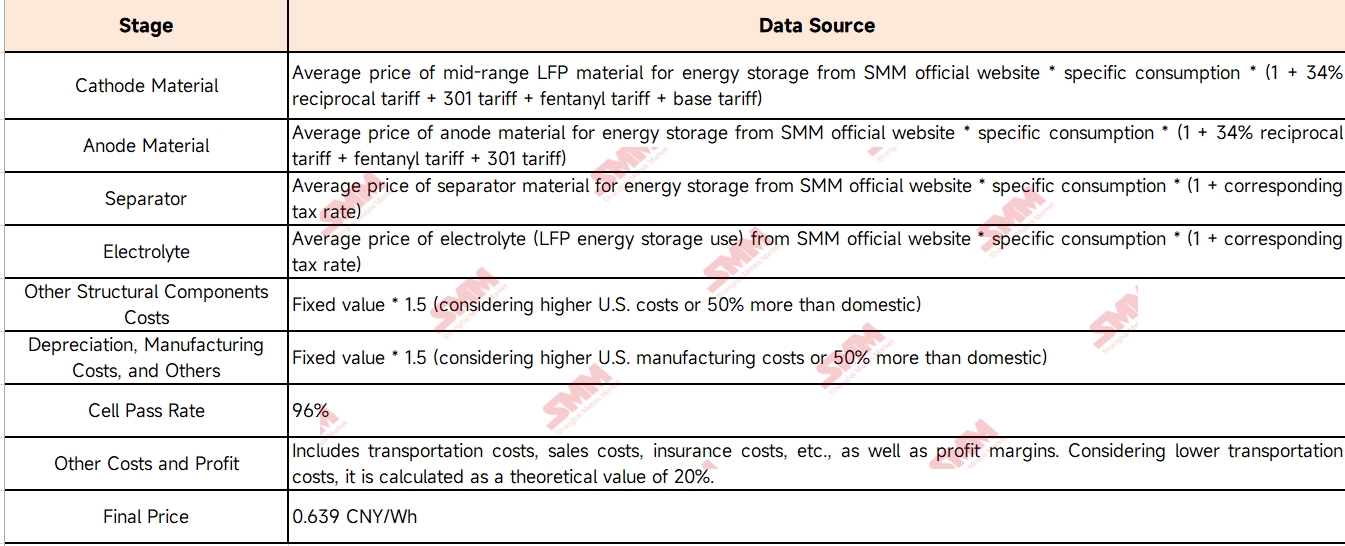
(1)The data sources and changes for each link are shown in the table below: Direct export from China to the U.S.

(2)The data sources and changes for each link are shown in the table below: Transshipment from China to the U.S. via Malaysia:
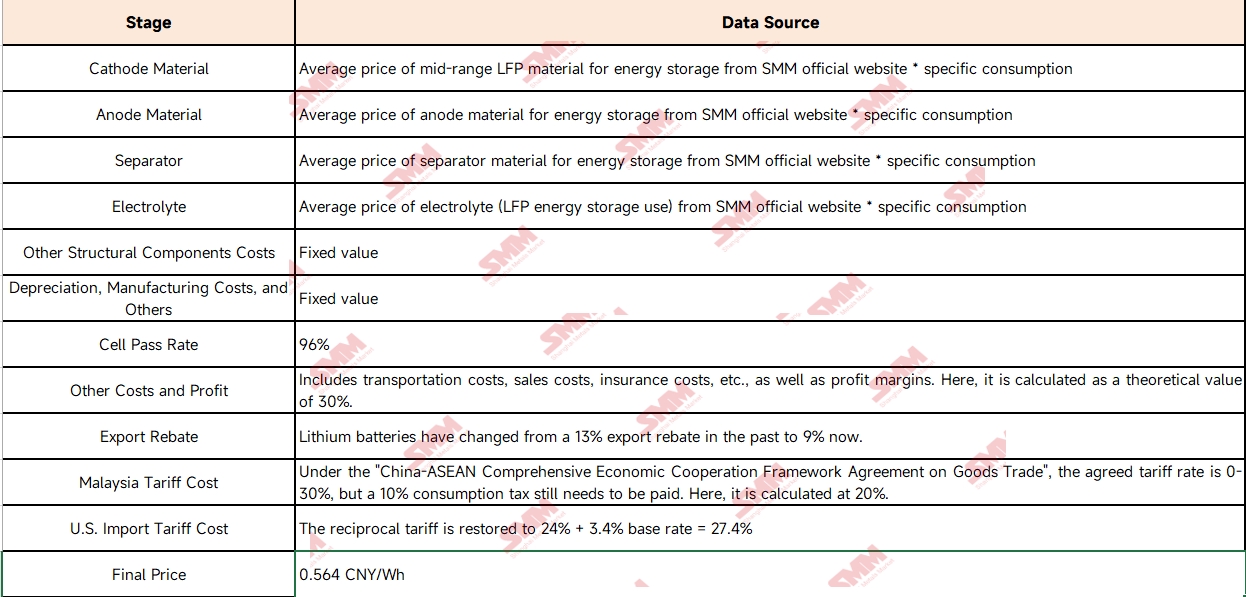
(3)The data sources and changes for each link are shown in the table below: Locally produced LFP cells in the United States:
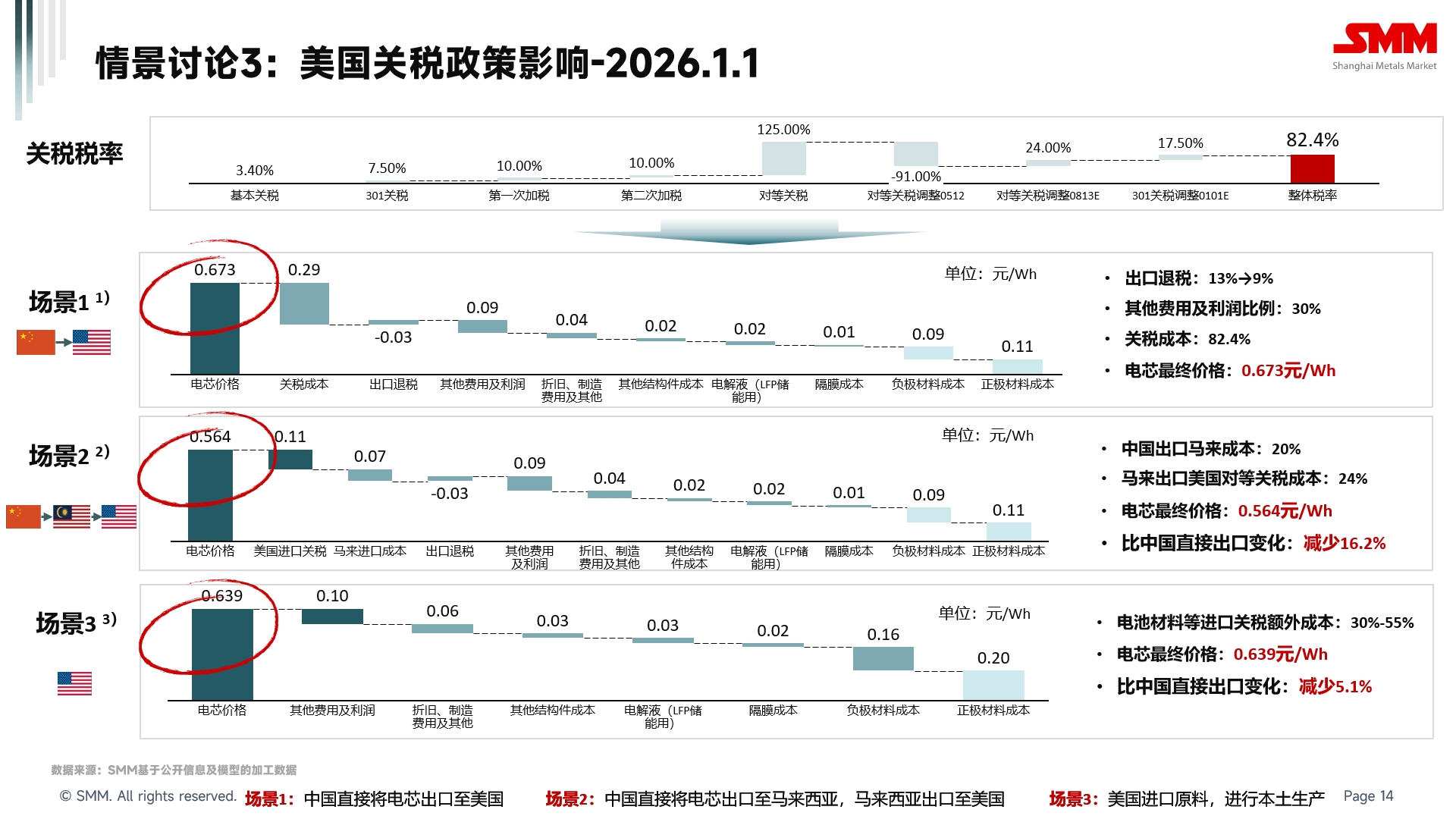
To sum up the above calculations, after January 1, 2026, taking the direct export price of cells from China at 0.673 CNY/Wh, the transshipment via Malaysia has a price advantage of 16.2%. The cost of directly producing energy storage cells in the U.S. may also have a relatively competitive edge under the high tariffs, reducing the price by 5.1% compared to directly purchasing cells from China.

Summarizing the three articles in this series, the author believes that around 70% of U.S. tariffs on China may be a theoretical equilibrium level. If the tariffs are below around 70%, China's LFP energy storage cells still have a price advantage over those produced by the U.S. on its own production lines. If the tariffs are above around 70%, it would be more advantageous for the U.S. to produce LFP energy storage cells locally. However, assuming that the transshipment trade channel is not completely blocked, transshipment trade remains the most economical way of trade.

The above summary is organized as follows:
Note: Some of the calculated data were obtained by the author through communication and processing in the market, while more data originated from the average prices of various stages on the SMM official website. In addition, in the current actual operations, the increased costs resulting from the U.S. tariffs on China are mainly borne by overseas clients. Therefore, the results calculated in this article may be higher than the actual transaction prices. Any improper aspects are welcome to be criticized and corrected by everyone.


SMM New Energy Industry Research Department


Cong Wang 021-51666838

Xiaodan Yu 021-20707870

Rui Ma 021-51595780

Disheng Feng 021-51666714

Yujun Liu 021-20707895

Yanlin Lü 021-20707875

Zhicheng Zhou 021-51666711

Haohan Zhang 021-51666752

Zihan Wang 021-51666914

Xiaoxuan Ren 021-20707866

Jie Wang 021-51595902

Yang Xu 021-51666760

Boling Chen 021-51666836
Data Source Statement: Except for publicly available information, all other data are processed by SMM based on publicly available information, market communication, and relying on SMM‘s internal database model. They are for reference only and do not constitute decision-making recommendations.

For any inquiries or to learn more information, please contact: lemonzhao@smm.cn
For more information on how to access our research reports, please contact:service.en@smm.cn
Related News
In January, national passenger car producers' new energy wholesale estimates reached 900,000 units, up 1% YoY.
18 hours ago
In January, national passenger car producers' new energy wholesale estimates reached 900,000 units, up 1% YoY.
Read More
In January, national passenger car producers' new energy wholesale estimates reached 900,000 units, up 1% YoY.
According to the latest data from the Passenger Car Association, in December 2025, producers with new energy wholesale sales exceeding 10,000 units accounted for 93% of the total wholesale sales of passenger NEVs that month. Based on preliminary January data, these producers achieved sales of 830,000 units in January. As most producers have already locked in their major sales figures, by applying the structural proportion from the previous month to the current month's data, the estimated wholesale sales of passenger NEVs nationwide in January were 900,000 units. According to comprehensive preliminary monthly association data: the estimated wholesale sales of NEVs by national passenger car producers in January 2026 were 900,000 units, up 1% YoY.
18 hours ago
CAAM: In 2025, 476,000 complete vehicles were imported, down 32.4% YoY.
18 hours ago
CAAM: In 2025, 476,000 complete vehicles were imported, down 32.4% YoY.
Read More
CAAM: In 2025, 476,000 complete vehicles were imported, down 32.4% YoY.
据中国汽车工业协会整理的海关总署数据显示,2025年12月,汽车整车进口3.0万辆,环比下降30.4%,同比下降56.1%;进口金额14.7亿美元,环比下降23.6%,同比下降52.5%。2025年,汽车整车进口47.6万辆,同比下降32.4%;进口金额236.4亿美元,同比下降39.7%。
18 hours ago
Canada Announces New EV Strategy, to Collaborate with China
18 hours ago
Canada Announces New EV Strategy, to Collaborate with China
Read More
Canada Announces New EV Strategy, to Collaborate with China
According to CCTV News, on February 5, Canadian Prime Minister Mark Carney announced a new electric vehicle strategy, including the reinstatement of car purchase subsidies, and stated that Canada will cooperate with China to promote the local production and export of EVs in Canada. According to a statement released by the Prime Minister's Office of Canada, the country will make full use of existing and newly established trade agreements, including a recently reached EV cooperation agreement with China, to facilitate large-scale investment in this sector, diversify Canada’s automotive export markets, and position Canada as one of the global leaders in the electric vehicle industry.
18 hours ago
[SMM Analysis]The Impact of U.S. Tariffs on Chinese Energy Storage Cells: An Exploration of Export Methods and Price Changes—Part III: Direct Export from China, Transshipment via Malaysia, and Local Production in the U.S. - Shanghai Metals Market (SMM)