Behind the Decline in China's Secondary Lead Operating Rate: The Dual Challenges of High Costs and Market Stagnation【SMM Analysis】

Published: May 16, 2025 20:08
Source: SMM
Since April, the operating rate has declined by about 30 percentage points due to tight raw material supply, high costs, weak end-use consumption, and poor lead ingot sales. The low scrap volume of waste lead-acid batteries has led to scarce market supply and significant pressure on recyclers. Secondary lead smelters face tight scrap battery arrivals, low raw material inventories, and high purchase offers. Intense competition for raw materials and customer-specific price increases have further complicated the situation. Lead prices remained sideways during the week, with downstream battery producers showing a strong wait-and-see sentiment. Secondary lead smelters had low willingness to sell due to cost pressure, and the spot market for secondary refined lead was sluggish. As of May 16, the theoretical profit and loss value for large-scale secondary lead enterprises was -592 yuan/mt, and -820 yuan/mt for small- and medium-sized enterprises.

From May 10 to May 16, 2025, the weekly operating rate of SMM secondary lead in four provinces was 37.22%, down by 0.43 percentage points from the previous week.
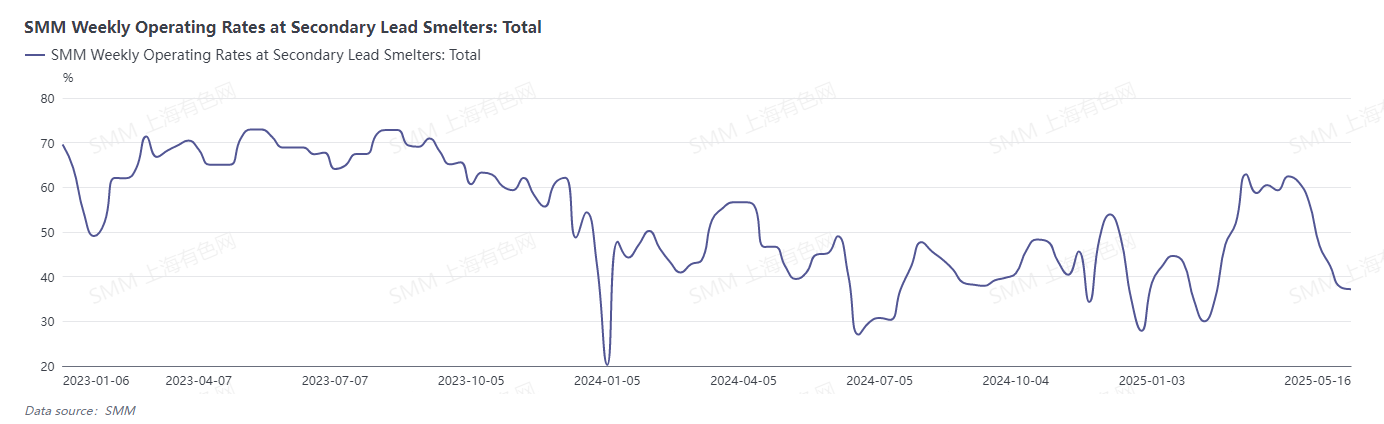
As shown in the chart above, the weekly operating rate of secondary lead has been on a declining trend since April, with a drop of approximately 30 percentage points. According to SMM, the key factors suppressing enterprises’ production enthusiasm are the tight supply of secondary lead raw materials, which has led to high costs, weak terminal consumption, and poor sales of lead ingots, as well as the losses resulting from the combination of these two factors. The low scrapping volume of spent lead-acid batteries has led to a scarcity of market supplies, putting great pressure on recyclers to collect goods and making them reluctant to deliver.

As a result, secondary lead smelters are facing a tight supply of waste batteries arriving at their plants and low raw material inventory levels, which makes it difficult to lower their purchase quotations. Moreover, the intense competition among secondary lead smelters for raw material purchases has led to a strong wait-and-see attitude among recyclers due to the practice of offering individual price increases to customers. For example, the current mainstream market price for scrap electric batteries, excluding tax, is between 10,050 and 10,100 yuan per ton. A smelter in the East China region said that after quoting a price of 10,050 yuan per ton, it was like “a stone sinking into the sea,” with no response from any recycler. No recycler is willing to offer goods at this price, while some individual recyclers have contacted the smelter to request a price increase of at least 10 yuan per ton. In summary, the tight supply of raw materials is not expected to ease in the short term, and the artificial control of supplies has further exacerbated the situation.

During the week, lead prices remained in a range-bound fluctuation. Downstream battery manufacturers are heavily observing and waiting, primarily relying on long-term orders to meet their production needs, with a low willingness to purchase spot orders of lead ingots. Meanwhile, secondary lead smelting enterprises, facing cost pressures, are reluctant to sell and find it difficult to accept transactions at a significant discount. Amidst the sentiment of "upstream producers not selling and downstream consumers not buying," the trading activity in the spot market for refined secondary lead remains sluggish. Additionally, the poor enthusiasm of downstream customers for purchasing lead has made it difficult for electrolytic lead holders to sell their goods, with some brands of lead even offering small discounts relative to the SMM 1# lead (Primary)average price. Under such market conditions, secondary lead enterprises are forced to offer larger discounts to sell their products, with no profit to speak of. As of May 16, 2025, the theoretical profit and loss value for large-scale secondary lead enterprises was -592 yuan per ton, while for medium and small-scale secondary lead enterprises, it was -820 yuan per ton.
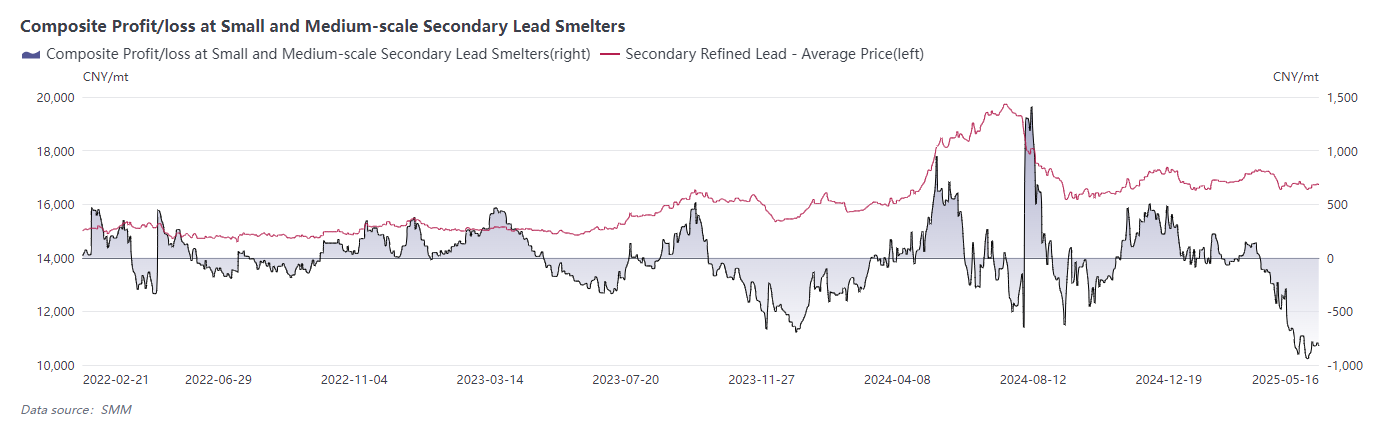
This week, the operating rate of secondary lead continued to decline, while the finished product inventory maintained an upward trend. Since the current sales price of secondary lead is below the cost, once sold, the loss is inevitable. Most enterprises would rather accumulate inventory than sell. Given that the current operating rate of secondary lead is already below 40%, SMM estimates that the finished lead inventory may not continue to increase next week. In addition, the limited supply of waste batteries arriving at the plants makes it difficult to accumulate raw material inventory, compounded by the weak demand for lead ingots from downstream battery manufacturers. The sluggish market has dampened the production enthusiasm of secondary lead smelting enterprises. However, as there are already many enterprises that have reduced or suspended production, the decline in the operating rate in the future may slow down.

Data Source Statement: Except for publicly available information, all other data are processed by SMM based on publicly available information, market communication, and relying on SMM‘s internal database model. They are for reference only and do not constitute decision-making recommendations.

For any inquiries or to learn more information, please contact: lemonzhao@smm.cn
For more information on how to access our research reports, please contact:service.en@smm.cn
Related News
Lead Prices Stagnant, Smelters Maintain Firm Offers Amid Losses
17 hours ago
Lead Prices Stagnant, Smelters Maintain Firm Offers Amid Losses
Read More
Lead Prices Stagnant, Smelters Maintain Firm Offers Amid Losses
Lead prices were in the doldrums, while secondary lead smelters maintained firm offers due to losses. The mainstream spot order ex-factory prices including tax narrowed the discount to the SMM #1 lead average price by 100 yuan/mt, shifting to a premium of 0–25 yuan/mt, with some smelters halting offers and sales.
17 hours ago
"Domestic Secondary Crude Lead Market Slows as Holidays Approach, Smelters Halt Production"
17 hours ago
"Domestic Secondary Crude Lead Market Slows as Holidays Approach, Smelters Halt Production"
Read More
"Domestic Secondary Crude Lead Market Slows as Holidays Approach, Smelters Halt Production"
Pre-holiday stockpiling by downstream enterprises had largely concluded, and a few had already entered the holiday period, completely suspending procurement. Next week, secondary lead smelters will enter a concentrated wave of production halts and holidays, resulting in sluggish trading activity in the spot market. Offers for spot refined lead orders were sparse, with prices moving in line with the market.
17 hours ago
Sluggish Transactions in Domestic Secondary Crude Lead Market, Prices at 15,250-15,400 Yuan/mt
17 hours ago
Sluggish Transactions in Domestic Secondary Crude Lead Market, Prices at 15,250-15,400 Yuan/mt
Read More
Sluggish Transactions in Domestic Secondary Crude Lead Market, Prices at 15,250-15,400 Yuan/mt
The domestic secondary crude lead market experienced sluggish transactions. As of February 6, 2026, the ex-factory tax-exclusive offers for domestic secondary crude lead stood at 15,250-15,400 yuan/mt. Downstream refined lead and alloy smelters gradually entered the holiday period, showing weak stockpiling willingness. Overseas lead ingot suppliers basically halted transactions with China due to poor consumption in the Chinese market, with only some previously concluded shipments maintaining normal in-transit transportation. The trading atmosphere in the secondary crude lead market will continue to weaken next week.
17 hours ago
Behind the Decline in China's Secondary Lead Operating Rate: The Dual Challenges of High Costs and Market Stagnation【SMM Analysis】 - Shanghai Metals Market (SMM)