SMM May 10 News:
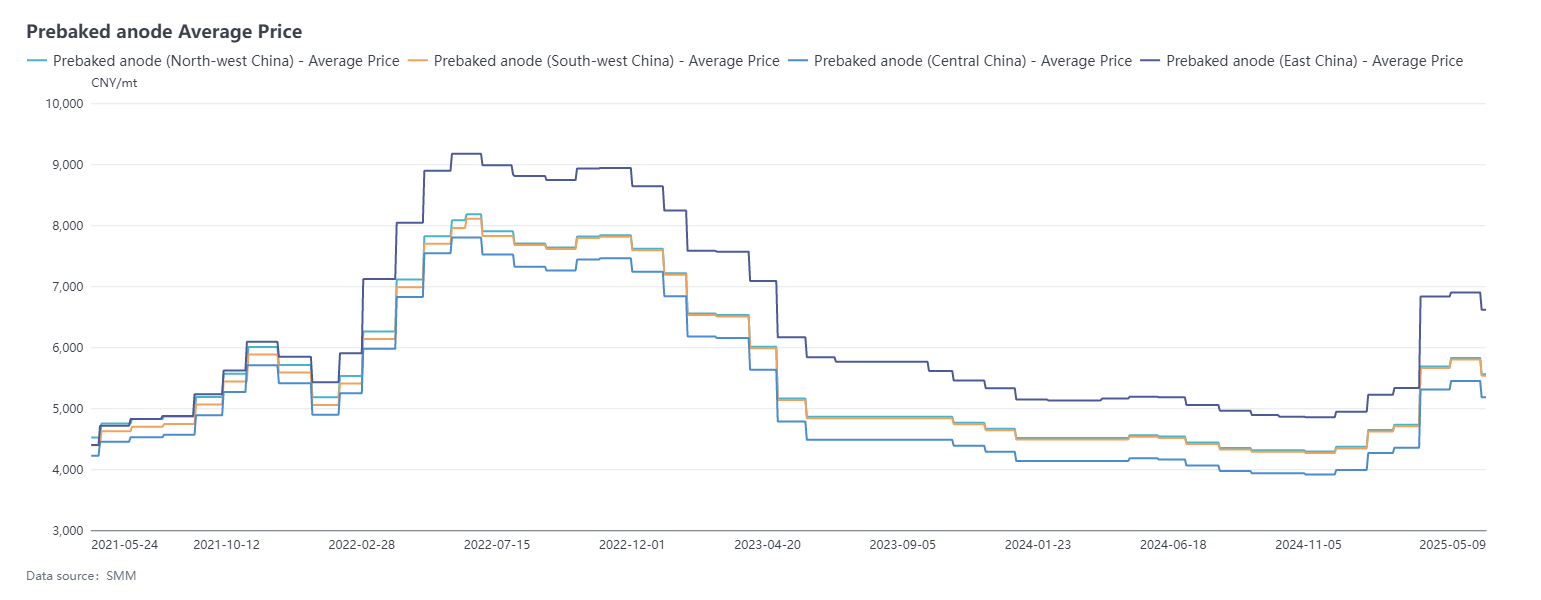
From April 7 to May 9, the SMM prebaked anode price shifted from rising to falling. The benchmark purchase price for an aluminum plant in Shandong in May 2025 was 4,939 yuan/mt, down 5.11% from the benchmark price of the previous month. According to SMM, the export order prices for prebaked anodes in May were mainly adjusted downward due to falling costs, with adjustments concentrated around 30-50 US dollars/mt. As of now, the anode prices in east China, as reported by SMM, closed at 4,939-8,294 yuan/mt.
Raw Material Side: During this period, the market prices of petroleum coke and coal tar pitch showed varying degrees of decline. For petroleum coke, the price of low-sulphur petroleum coke fell significantly from highs due to poor downstream purchasing activity and weak demand. According to SMM statistics, the price of low-sulphur petroleum coke in north-east China continued to decline during this period. As of now, its average price was approximately 3,958 yuan/mt, down 7.78% from April 7. The price of petroleum coke from local refineries also continued to fall due to poor downstream purchasing enthusiasm. By April 14, the average price of petroleum coke from local refineries, as reported by SMM, had dropped to 2,434 yuan/mt. Subsequently, due to some improvement in downstream purchasing activity, the price rebounded to around 2,646 yuan/mt, but then resumed its downward trend. As of May 9, the average price of petroleum coke from local refineries had fallen to 2,433 yuan/mt, down approximately 2.37% from April 7. In the coal tar pitch market, prices showed a fluctuating downward trend during this period. According to SMM data, as of May 9, the average price of coal tar pitch was 3,787 yuan/mt, down 17.14% from April 7. Overall, both petroleum coke and coal tar pitch prices experienced varying degrees of decline, resulting in a significant loosening of cost support for prebaked anode enterprises.
From the supply perspective, prebaked anode enterprises operate based on orders throughout the year. In April 2025, the overall operation of the domestic prebaked anode industry remained stable, with only a few enterprises experiencing capacity fluctuations due to spring maintenance. During the month, aluminum capacity in Shandong was transferred to south China, leading to a reduction in regional demand. As a result, some prebaked anode enterprises saw a decline in order volumes, which affected their operating rates. Additionally, April had one fewer production day compared to the previous month. Under the combined influence of these factors, SMM data showed that the industry's operating rate in April was 75.45%, down 1.28 percentage points MoM. Despite this slight drop, the industry's operating rate remained at a high level.From a demand perspective, China's domestic aluminum industry is expected to exhibit a parallel trend of capacity growth and structural adjustment in 2025. By the end of April, the country's operating aluminum capacity had climbed to 43.91 million mt, with the industry's operating rate increasing slightly by 0.3 percentage points MoM and rising by 1.8 percentage points YoY to reach 96.1%. The capacity growth was mainly driven by the full resumption of production at aluminum smelters in the Sichuan and Chongqing region, as well as the full-capacity operation of a replacement and upgrade project at an aluminum smelter in Qinghai. However, minor maintenance work at individual aluminum smelters in Shanxi and Chongqing led to a capacity reduction of approximately 20,000 mt/year. Meanwhile, SMM data showed that an aluminum smelter was advancing a 200,000 mt/year capacity relocation and replacement project from Shandong to Yunnan, with the first batch of capacity expected to be operational in May. Entering May, the operating aluminum capacity remained at a high level. Maintenance work at enterprises was mostly carried out in small batches on a rotational basis, having a limited impact on overall supply. The second batch of capacity replacement plans from Shandong to Yunnan is expected to commence in Q3. The overseas market also released positive signals, with prebaked anode demand rising significantly as new aluminum capacity came online globally and existing capacity recovered. Customs data showed that China's cumulative prebaked anode exports reached 582,600 mt in Q1 2025, surging by 21.29% YoY, indicating a comprehensive improvement in the export market. Overall, the prebaked anode market in 2025 is expected to demonstrate strong growth resilience, supported by dual demand from both domestic and overseas markets.
Brief Commentary: An aluminum enterprise in Shandong has adjusted the benchmark tender price for prebaked anodes in May 2025, with a decrease of 266 yuan/mt MoM. Meanwhile, a major domestic prebaked anode sales company has also lowered its sales prices, with a MoM decline of 466 yuan/mt. The performance of the raw material side has become a key factor in market fluctuations. Prices of petroleum coke and coal tar pitch have both declined. According to SMM data, as of May 9, the comprehensive cost of prebaked anodes in China had dropped to 4,985 yuan/mt, a significant decrease of 7.08% from April 7. The easing of cost-side pressure has supported the industry's profitability: Based on a one-month production cycle, despite prebaked anode enterprises still operating at a loss, the theoretical loss amount has narrowed by approximately 103 yuan/mt MoM, indicating clear signs of market recovery. Currently, the petroleum coke market is experiencing a tug-of-war between sellers and buyers. On the one hand, an increase in the number of refineries undergoing maintenance has provided bottom support for prices. On the other hand, the persistent sluggishness in downstream procurement enthusiasm and strong wait-and-see sentiment have led to significant downward pressure on petroleum coke prices. SMM expects petroleum coke prices to continue their downward trend in May, thereby exerting a sustained impact on the cost side of prebaked anodes. Considering the aforementioned factors, SMM expects prebaked anode prices to remain in the doldrums next month.
![[SMM Aluminum Flash News] GeT Alloys Replaces Heavy Fuel Oil with Tyre-Derived Fuel in Aluminium Recycling](https://imgqn.smm.cn/usercenter/tYQzs20251217171653.jpg)
![[SMM Aluminum Flash News] Woodside Signs Gas Supply Agreement with Alcoa to Support Alumina Production](https://imgqn.smm.cn/usercenter/EVjRH20251217171653.jpg)
![[SMM Aluminum Flash News] Fosbel Promotes Ceramic Welding Technology for Online Aluminium Furnace Repairs](https://imgqn.smm.cn/usercenter/VTjoW20251217171653.jpg)